Explore Australian PR visa options, eligibility requirements and application pathways for skilled professionals and families planning to move from the UK.
Eligible provisional visas may lead to permanent residenceRegional pathway
Age, occupation, skills, English, experience and visa-specific criteriaCommon eligibility factors
Eligible applicants may be able to apply from outside AustraliaApplication location
Made by the Australian Department of Home AffairsVisa decision
Eligibility and documents
Valid passport and identity documents
Qualification certificates and academic transcripts, where required
Employment references and relevant work experience evidence
Skills assessment, if required for the visa
Accepted English language test results, if required
Expression of Interest and invitation, where applicable
State or territory nomination, where applicable
Eligible employer nomination or sponsorship, where applicable
Relationship and family documents, where applicable
Police certificates and health examinations, when requested
Evidence supporting all claims made in the application
Application process
1
Review Your Profile
Assess your age, occupation, qualifications, experience, English ability and long-term migration goals.
2
Choose a Visa Pathway
Compare skilled independent, state-nominated, employer-sponsored, regional and eligible family pathways.
3
Check Eligibility
Review the official visa criteria, occupation requirements and nomination or sponsorship rules.
4
Prepare Evidence
Arrange the relevant skills assessment, English test and supporting documents.
5
Complete Required Preliminary Steps
Submit an Expression of Interest, seek nomination or arrange employer sponsorship if your pathway requires it.
6
Lodge the Application
Apply through the official process after meeting the relevant requirements and invitation rules.
7
Respond to Requests
Provide further information and complete required health or character checks.
8
Receive a Decision
The Australian Department of Home Affairs makes the final visa decision.
Costs and fees
Visa application charge
Varies by visa subclass and applicant circumstances
Skills assessment
Depends on the assessing authority and occupation
English test
Depends on the test provider and test type
Medical examinations
May apply
Police certificates
May apply depending on requirements
Document translation
May apply
Professional assistance
Depends on the services selected
Fees change. Check the official source before you pay.
Australia permanent residency is a long-term immigration goal for skilled professionals, families and British citizens who want to live and work in Australia. It can provide the opportunity to build a career, settle with eligible family members and enjoy many of the benefits of living in Australia.
However, getting Australian permanent residency is not automatic. Applicants must qualify under an available visa pathway and meet the relevant requirements. These may include age, occupation, qualifications, work experience, English language ability, skills assessment, points, state nomination or employer sponsorship.
If you are researching Australia PR from UK, it is important to understand which visa options are available, whether you can apply directly for permanent residence and what steps you may need to complete before submitting an application.
This guide explains the main Australia PR pathways, eligibility requirements, application process, possible costs, processing times and benefits. It also highlights important differences between direct permanent visas and provisional visas that may lead to permanent residence later.
What Is Australian Permanent Residency?
Australian permanent residency means holding an Australian permanent visa that generally allows you to live in Australia indefinitely, subject to the conditions attached to your visa.
Permanent residents can generally work and study in Australia, access Medicare if eligible and sponsor certain eligible relatives for permanent residence. They may also be able to apply for Australian citizenship later if they meet the separate legal and residence requirements.
However, Australian permanent residency is not the same as citizenship. Permanent residents do not automatically receive all the rights available to Australian citizens. For example, voting in federal elections is generally reserved for Australian citizens.
There is also an important difference between permanent residence and the right to return to Australia after travelling overseas. A permanent visa usually includes a travel facility for a limited period. If that facility expires while you are outside Australia, you may need a Resident Return visa or another appropriate visa to return as a permanent resident.
Australia does not generally issue a physical PR card in the same way some other countries issue residence cards. Your visa status is normally recorded electronically and can be checked through the relevant Australian Government systems.
Yes. People living in the United Kingdom can apply for Australian permanent residency if they meet the eligibility requirements of an available visa pathway. You do not necessarily need to move to Australia first to begin the process.
British citizenship or UK residence does not automatically qualify you for Australian permanent residency. You must still meet the requirements of the visa you intend to apply for.
Applicants based in the UK may explore skilled migration, state-nominated migration, employer-sponsored visas and eligible family pathways. The right option depends on your personal circumstances and the immigration rules in force when you apply.
For example, a skilled professional with an eligible occupation and a suitable skills assessment may investigate a points-tested visa. Someone who has secured an eligible position with an Australian employer may consider an employer-sponsored pathway. A person with an eligible partner or family relationship in Australia may need to explore the relevant family visa category.
When considering how to get PR in Australia from the UK, start by reviewing your occupation, age, qualifications, work history and English language ability. These factors can help identify which pathways are worth investigating.
It is also important to understand that similar applicants may have different outcomes. Two people with the same job title may not qualify under the same pathway if their qualifications, work duties, experience or other circumstances differ.
Main Australia Permanent Residency Visa Options
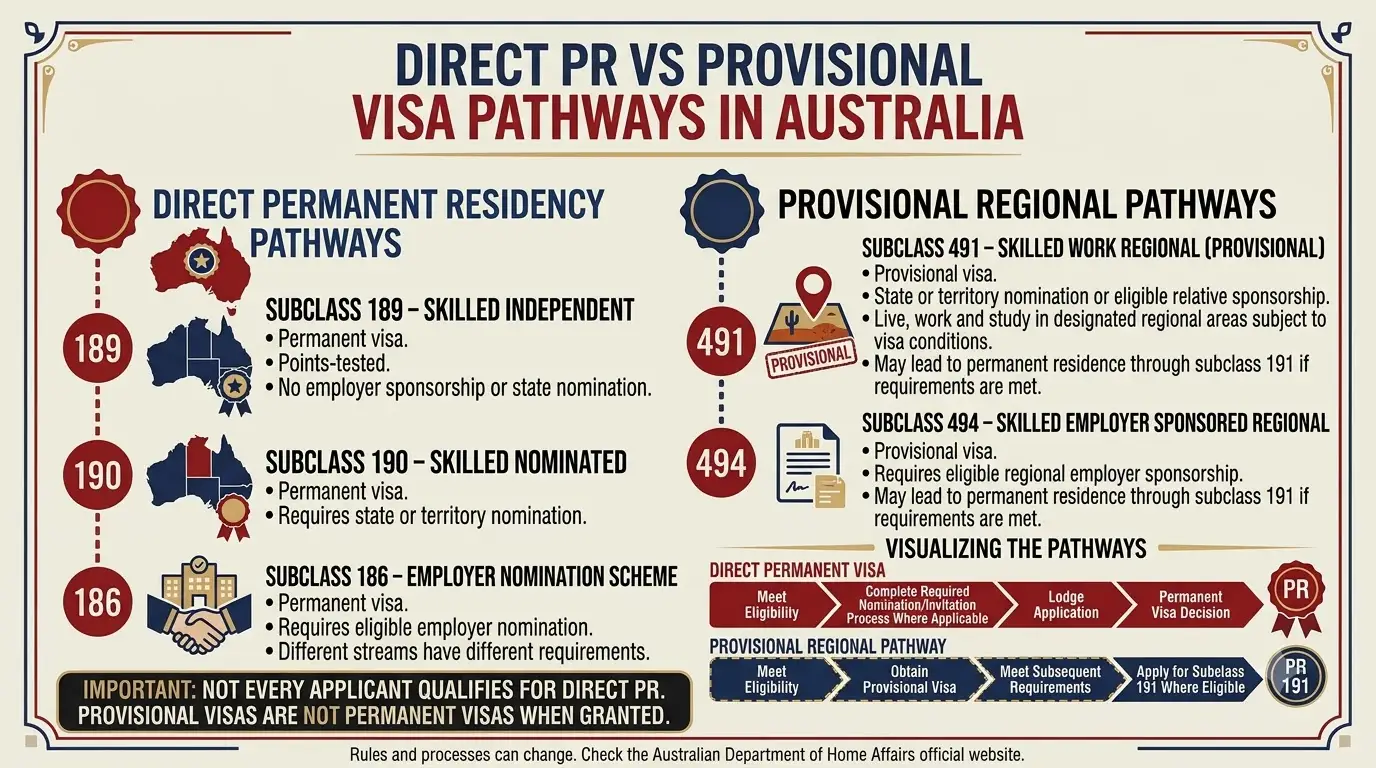
Australia offers several immigration pathways that can lead to permanent residence. Some visas grant permanent residency directly, while other provisional visas may provide a route to a permanent visa after the applicant meets additional conditions.
The following are some of the main Australia PR visa options to understand before choosing a pathway.
1. Skilled Independent Visa (Subclass 189)
The Skilled Independent visa (subclass 189), points-tested stream, is a permanent visa for eligible skilled workers who receive an invitation to apply. It does not require employer sponsorship or state or territory nomination.
This pathway may suit skilled professionals who want to apply for Australian permanent residency independently, provided their occupation and personal circumstances meet the applicable requirements.
Applicants generally need to:
Have an occupation that is eligible for the relevant visa stream.
Obtain a suitable skills assessment from the relevant assessing authority.
Meet the applicable English language requirements.
Meet the age requirement, generally being under 45 when invited to apply.
Meet the minimum points threshold and provide evidence for the points claimed.
Receive an invitation before lodging the visa application.
Satisfy health, character and other applicable visa requirements.
One important point is that meeting the minimum points requirement does not guarantee an invitation. The number of invitations, occupation priorities and selection arrangements can affect who is invited.
Applicants should also ensure that their points claims are accurate and supported by evidence. Incorrectly claiming points for employment, qualifications or English ability can create problems during the application process.
The Skilled Nominated visa (subclass 190) is a permanent visa for eligible skilled workers who receive nomination from an Australian state or territory government.
Unlike the subclass 189 pathway, this visa requires state or territory nomination. Applicants must therefore consider both the federal visa criteria and the nomination requirements of the state or territory they are interested in.
Depending on the relevant program, applicants may need an eligible occupation, a suitable skills assessment, competent English, sufficient points and an invitation. States and territories may also apply their own occupation priorities, work experience requirements, employment conditions or other selection criteria.
Meeting the general subclass 190 visa requirements does not automatically mean that a state or territory will nominate you. Each nomination program has its own process and available places.
This pathway may be worth investigating if your professional background matches the workforce priorities of a particular Australian state or territory.
The Employer Nomination Scheme visa (subclass 186) is a permanent employer-sponsored visa for eligible skilled workers nominated by an Australian employer.
This pathway may be relevant to professionals who have an eligible job opportunity with an Australian business that is willing and able to nominate them for a qualifying position.
The subclass 186 visa has different streams, including Direct Entry and Temporary Residence Transition. Their requirements are not identical.
Depending on the stream, applicants may need to meet requirements relating to:
An eligible nominated occupation and position.
Relevant qualifications and work experience.
English language ability.
A suitable skills assessment, where required.
Age requirements or an applicable exemption.
Employer nomination and business eligibility.
The Temporary Residence Transition stream generally involves eligible sponsored employment before the permanent visa application. The Direct Entry stream has separate requirements and may be relevant to applicants who meet its criteria without first completing the same temporary sponsored employment pathway.
A job advertisement or informal promise of employment is not the same as an approved employer nomination. Applicants should confirm that the employer, position and nomination meet the relevant rules.
4. Regional Pathways: Subclass 491 and Subclass 494
Some skilled workers may consider regional migration rather than applying directly for a permanent skilled visa. Regional pathways can provide an opportunity to live and work in designated regional areas, subject to the relevant visa conditions.
The Skilled Work Regional (Provisional) visa (subclass 491) is a provisional visa for eligible skilled workers. Applicants may qualify through state or territory nomination or sponsorship by an eligible relative, depending on the applicable criteria.
The Skilled Employer Sponsored Regional (Provisional) visa (subclass 494) is an employer-sponsored regional visa. It requires an eligible regional employer and a qualifying nominated position.
Neither subclass 491 nor subclass 494 grants permanent residence when the visa is first approved. Eligible holders may later qualify for permanent residence through subclass 191 if they satisfy the relevant requirements.
Applicants considering these options should understand the regional residence, work and other conditions before accepting a nomination or sponsored position.
Australian family-stream visas may provide permanent residence options for eligible partners, children, parents and certain other qualifying relatives of Australian citizens, permanent residents or eligible New Zealand citizens.
Partner visa applications generally require evidence of an eligible relationship. The applicant and sponsor must meet the relevant requirements, and the relationship evidence must support the application.
Parent and other family visa categories have their own eligibility conditions, sponsorship rules, costs and possible waiting periods. Not every relative living in Australia can sponsor another family member for permanent residence.
If you have a partner or eligible family member in Australia, identify the correct visa category before preparing an application. The relationship, sponsor status and individual circumstances will determine which options may be available.
Australia PR Visa Options: Comparison Table
The following table provides a general comparison of some major pathways. It is a starting point only; applicants must check the detailed requirements for the relevant visa stream.
Visa Subclass
Visa Type
Main Pathway
Permanent Residency
189
Skilled Independent
Points-tested skilled migration and invitation
Permanent visa
190
Skilled Nominated
State or territory nomination and invitation
Permanent visa
186
Employer Nomination Scheme
Eligible Australian employer nomination
Permanent visa
491
Skilled Work Regional
State or territory nomination or eligible relative sponsorship
Provisional visa; may lead to subclass 191
494
Skilled Employer Sponsored Regional
Eligible regional employer sponsorship
Provisional visa; may lead to subclass 191
Family and Partner
Family-stream migration
Eligible relationship and sponsorship
Depends on the specific visa category
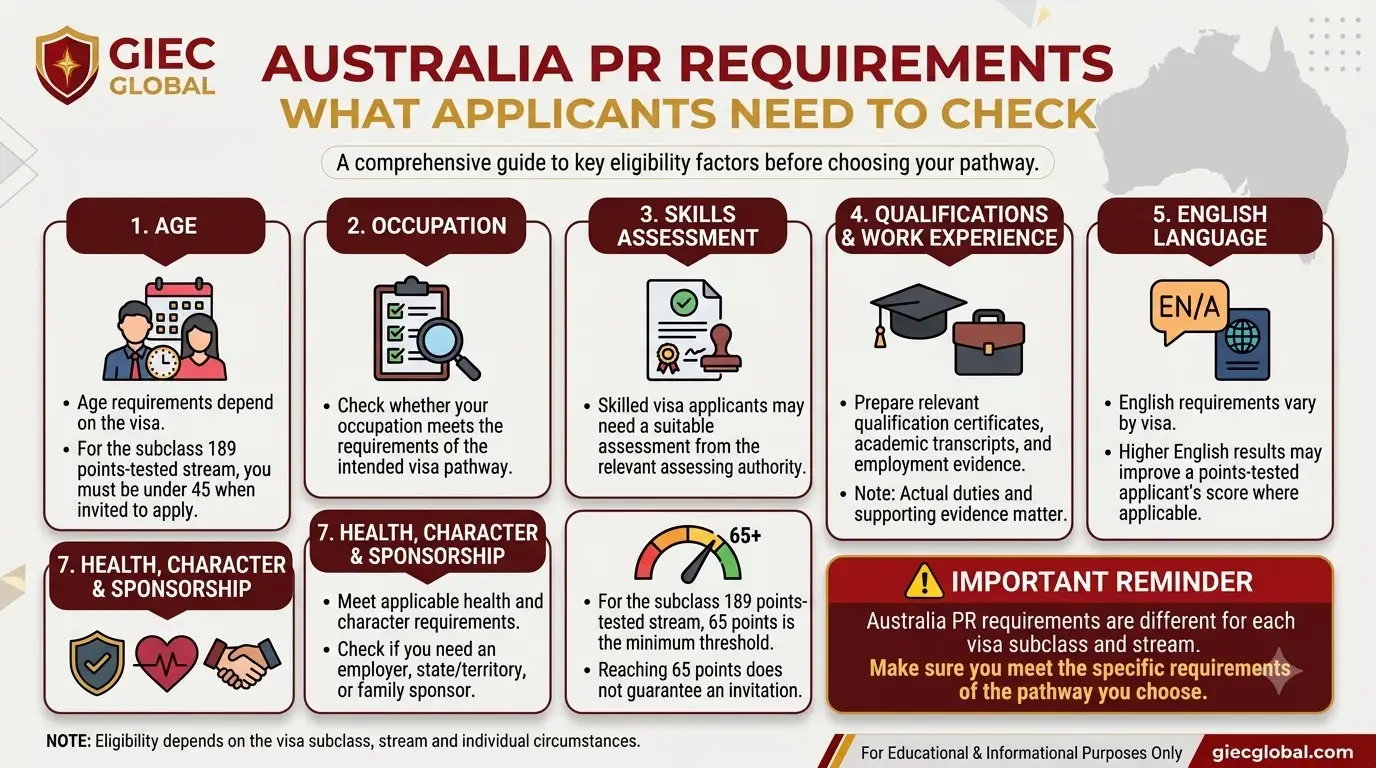
Australia PR Requirements
Australia PR requirements depend on the visa subclass and stream. There is no single eligibility checklist that applies to every applicant. However, people exploring skilled migration should review several important factors before starting the process.
1. Age Requirements
Age can play an important role in Australian skilled migration. For the points-tested subclass 189 stream, applicants generally need to be under 45 when invited to apply.
Age requirements can differ between visa subclasses and streams. Some employer-sponsored pathways may have different rules or exemptions for eligible applicants.
Check your age eligibility before spending money on skills assessments, English tests or other application preparation. If you are close to an applicable age limit, the timing of your assessment, invitation and application may be important.
2. Occupation and Skills Assessment
Your occupation is one of the first things to check when researching Australian permanent residency requirements. Skilled migration pathways generally require applicants to nominate an occupation that meets the relevant visa criteria.
A skills assessment may be required to establish whether your qualifications and work experience are suitable for the nominated occupation. The relevant assessing authority depends on your profession.
For example, different authorities assess different occupations, and each may have its own qualification, employment and document requirements. A qualification accepted for one occupation may not meet the criteria for another.
Do not rely only on your job title. Assessing authorities may examine your actual duties, responsibilities, qualifications and employment history.
3. Qualifications and Work Experience
Applicants may need to provide academic certificates, transcripts, employment references and other supporting documents. The exact evidence depends on the visa pathway and skills assessment requirements.
Employment references should accurately describe your position, duties, employment dates and working arrangements. Supporting evidence may also be needed to demonstrate that the employment was genuine and relevant.
Not every period of employment will automatically count as skilled work experience. The applicable visa and assessing authority rules determine which work experience can be recognised.
4. English Language Ability
English language requirements vary by visa subclass and stream. Some skilled pathways require a minimum English level, while higher test results may contribute additional points under a points-tested pathway.
Applicants should check which English tests are accepted, the required scores and how long test results remain valid for the relevant application stage.
If you are applying from the UK, do not assume that holding a British passport or having studied in an English-speaking country automatically removes every English requirement. Check the rules for your specific visa and circumstances.
5. Points and Invitation Requirements
Points-tested skilled migration uses factors such as age, English ability, skilled employment, qualifications and other eligible criteria. Your points score can affect your competitiveness, but it does not guarantee an invitation.
For the subclass 189 points-tested stream, 65 points is the minimum threshold stated in the points test. Reaching this threshold does not mean that you will automatically receive an invitation. The invitation process and selection outcomes can depend on the relevant occupation and program arrangements.
Applicants should calculate their points carefully and claim only the points they can support with evidence.
Applicants generally need to satisfy the health and character requirements that apply to their visa. This may involve medical examinations, police certificates and other information requested by the Department of Home Affairs.
Depending on the visa, family members included in the application may also need to meet relevant requirements or provide supporting information.
Follow the Department’s instructions about the timing and format of these checks. Submitting incomplete or incorrect information can lead to additional requests and delays.
7. Employer, State or Family Sponsorship
Some Australia PR pathways require a nomination or sponsorship, while others do not.
For example, subclass 190 requires state or territory nomination, while subclass 186 requires an eligible employer nomination. Certain regional pathways may involve state nomination or an eligible relative sponsor. Family-stream visas have their own sponsorship and relationship requirements.
Before proceeding, confirm who must nominate or sponsor you, what eligibility conditions apply and whether the nomination or sponsorship needs to be approved before you lodge your visa application.
Key Australia PR Eligibility Factors
This table summarises common eligibility areas for applicants exploring skilled permanent residency. It does not replace the detailed rules for an individual visa.
Eligibility Factor
What You Need to Check
Age
Whether you meet the age criteria for the chosen visa and stream.
Occupation
Whether your nominated occupation is eligible for the relevant pathway.
Skills Assessment
Whether a suitable assessment is required and which authority is responsible.
Qualifications
Whether your education and professional qualifications meet the applicable criteria.
Work Experience
Whether your employment history is relevant and supported by suitable evidence.
English Language
Whether you meet the required English level and accepted test conditions.
Points
Whether you meet the points threshold and can support your claimed points.
Nomination or Sponsorship
Whether your pathway requires an eligible state, territory, employer or family sponsor.
Health and Character
Whether you can meet the applicable health, character and document requirements.
How to Apply for Permanent Residency in Australia
The Australia PR application process depends on the visa subclass. A points-tested skilled visa, employer-sponsored visa and family visa do not follow exactly the same steps.
However, the following stages provide a general overview for people researching how to apply for Australian permanent residency.
Step 1: Identify the Right Visa Pathway
Start by reviewing your age, occupation, qualifications, work experience, English ability and family circumstances. Consider whether a skilled independent, state-nominated, employer-sponsored, regional or family pathway may be suitable.
Do not choose a visa simply because someone describes it as the easiest or fastest route. A pathway must match your actual eligibility and circumstances.
You can use the Australian Government’s Visa Finder to explore possible visa options.
Step 2: Check Your Occupation and Eligibility
If you are considering skilled migration, check whether your occupation is eligible for the visa pathway and identify the relevant assessing authority.
Review the assessment requirements before preparing documents. You may need to provide academic records, employment references, evidence of professional registration or other occupation-specific information.
If you are considering state nomination, check the current program conditions of the state or territory. If you are exploring employer sponsorship, confirm that the employer and nominated position meet the relevant requirements.
Step 3: Arrange Skills Assessments and English Tests
Depending on your pathway, you may need a positive skills assessment and an accepted English language test result before proceeding.
Follow the relevant authority’s instructions and ensure that your documents are accurate. Keep copies of test results, assessment outcomes and supporting records because you may need them later in the process.
Step 4: Calculate Your Points and Explore Nomination
For points-tested pathways, calculate your score using the official points criteria. Consider age, English ability, qualifications, skilled employment and other eligible factors.
If you are considering subclass 190 or a regional pathway, review the nomination requirements of the relevant state or territory. Each program may have different priorities and application procedures.
Do not claim points unless you can provide the required evidence. An inaccurate points claim can affect your eligibility.
Step 5: Submit an Expression of Interest or Complete the Relevant Sponsorship Process
Some skilled migration visas require an Expression of Interest through SkillSelect. An Expression of Interest allows you to provide information about your skills and circumstances for consideration under the relevant selection process.
An Expression of Interest is not a visa application. It does not guarantee an invitation or approval.
State-nominated pathways may require additional steps with the relevant state or territory. Employer-sponsored and family pathways follow different procedures, so not every applicant needs to submit an Expression of Interest.
Step 6: Prepare Your Visa Application
Once you are eligible to lodge your application, prepare the documents required for your visa. These may include:
Passport and identity documents.
Qualification certificates and academic transcripts.
Skills assessment results, where required.
English language test results, where required.
Employment references and supporting work evidence.
Nomination or sponsorship documents, where applicable.
Relationship and family documents, if relevant.
Police certificates and health-related information when requested.
Make sure that names, dates and other details are consistent across your documents. If any information needs explanation, provide accurate supporting details rather than leaving gaps or making assumptions.
Step 7: Pay the Applicable Fees and Lodge the Application
Visa application charges depend on the subclass, stream and number of applicants included in the application. Additional expenses may include skills assessments, English tests, medical examinations, police certificates and document translations.
Check the current charges before lodging your application. Submit the application through the official process for your visa and retain confirmation of submission and payment.
Step 8: Respond to Requests and Wait for a Decision
After lodgement, the Department of Home Affairs may request additional documents, medical examinations or further information. Respond within the stated deadline and keep your contact details updated.
Processing times vary. The time required can depend on the visa subclass, application completeness, individual checks and the number of applications being processed.
No adviser can guarantee an invitation, processing date or visa grant. The final decision rests with the Australian Government.
Australia PR Application Process at a Glance
Stage
What Happens
1. Initial Review
Review your age, occupation, qualifications, work experience and circumstances.
2. Pathway Selection
Identify a potentially suitable skilled, nominated, employer-sponsored, regional or family pathway.
3. Assessment and Testing
Complete any required skills assessment and English language test.
4. Points or Nomination
Calculate eligible points or complete the applicable nomination or sponsorship process.
5. Invitation or Eligibility to Lodge
Meet the relevant invitation or application requirements for the chosen visa.
6. Application Preparation
Collect identity, qualification, employment and other supporting documents.
7. Lodgement
Submit the application and pay the applicable government charges.
8. Decision
Respond to requests and wait for the Department’s decision.
How Much Does Australian Permanent Residency Cost?
The cost of Australian permanent residency varies according to the visa subclass, application stream and number of people included in the application. There is no single fixed price for every Australia PR application.
The total amount may include government visa charges and other expenses incurred before or during the application process.
Common Australia PR Costs
Cost Category
What It May Cover
Visa Application Charge
Government fee for the relevant visa application and additional applicants.
Skills Assessment
Assessment charges from the relevant occupation or professional authority.
English Language Test
Fees for an accepted English test, where required.
Medical Examination
Health examinations required as part of the visa process.
Police Certificates
Police clearance documents required for relevant applicants.
Document Preparation
Certified translations, document certification and other supporting paperwork.
Nomination-Related Expenses
Applicable state or territory program costs, where relevant.
Professional Advice
Optional assistance with eligibility reviews and application preparation.
Relocation
Flights, accommodation and other costs associated with moving to Australia.
If you are applying with a partner or children, your overall budget may increase because additional applicants can involve extra visa charges and other expenses.
Before committing to an application, use the Department of Home Affairs’ official Visa Pricing Estimator to check the current government charges.
Be careful with claims offering guaranteed Australian PR or unusually low fixed prices without reviewing your circumstances. A private consultancy cannot guarantee that the Australian Government will approve a visa.
How Long Does It Take to Get PR in Australia?
There is no single processing time for every Australian permanent residency application. The timeframe depends on the visa subclass, application stream, completeness of documents, health and character checks and the number of applications being processed.
For points-tested skilled visas, applicants may also need to wait for an invitation before they can submit a visa application. The time spent waiting for an invitation is separate from the processing time after lodgement.
State nomination and employer processes may involve additional stages. Applicants using a regional provisional pathway may also need to complete a qualifying period and satisfy other conditions before becoming eligible for a permanent visa.
For example, eligible holders of certain regional provisional visas may be able to apply for permanent residence through subclass 191 after meeting the relevant requirements, including the applicable three-year period.
Applicants should not make relocation plans based only on an estimated processing time. Check the official visa processing time guide and the detailed requirements of the relevant visa.
Benefits of Australian Permanent Residency
Australian permanent residency can offer several important benefits. The exact rights and entitlements depend on the visa conditions and the individual’s circumstances.
1. Live in Australia Indefinitely
A permanent visa generally allows the holder to remain in Australia indefinitely, provided they comply with the applicable visa conditions and immigration rules.
2. Work and Study in Australia
Permanent residents can generally work and study in Australia. This can provide greater flexibility when choosing an employer, changing careers or pursuing further education.
3. Access to Medicare if Eligible
Eligible Australian permanent residents can enrol in Medicare, Australia’s public healthcare system. Eligibility and access should be checked against the applicable government rules.
4. Sponsor Eligible Family Members
Permanent residents may be able to sponsor certain eligible family members for relevant visas. Sponsorship is subject to specific relationship, eligibility and visa requirements.
5. International Travel
Permanent residents can travel internationally while their permanent visa’s travel facility remains valid. If the travel facility expires while they are overseas, they may need a Resident Return visa or another appropriate visa to return as a permanent resident.
6. Potential Pathway to Australian Citizenship
Permanent residency may provide a pathway to Australian citizenship. However, citizenship is a separate application and requires applicants to meet the relevant residence, character and other legal requirements.
Direct PR vs Provisional Visa Pathways in Australia
One common question is whether applicants can get direct PR in Australia or must first hold a temporary visa.
Some Australian visas grant permanent residency directly when approved. Examples include the points-tested subclass 189, subclass 190 and eligible subclass 186 streams.
Other pathways involve a provisional or temporary visa first. For example, eligible holders of subclass 491 or subclass 494 may later qualify for permanent residence through subclass 191 if they satisfy the applicable requirements.
Direct PR does not mean skipping the eligibility process. Applicants must still meet the occupation, skills assessment, points, invitation, nomination, sponsorship or other requirements that apply to their chosen pathway.
Comparison Factor
Direct Permanent Visa
Provisional Pathway
Visa Status at Grant
Permanent, if the visa is approved
Temporary or provisional
Examples
189, 190 and eligible 186 streams
491 and 494
Additional Requirements
Must meet the permanent visa criteria before grant
Must meet the requirements for the later permanent visa
Regional Conditions
Depend on the visa and its conditions
Regional residence and work conditions may apply
Permanent Residence
Granted when the permanent visa is approved
May become available later if the applicant qualifies
If you are applying from the UK, your most suitable pathway depends on your profile rather than your country of residence alone. A careful review can help identify which options are worth exploring before you spend money on assessments or application preparation.
Common Mistakes to Avoid When Applying for Australia PR
Preparing an Australian permanent residency application requires accurate information and careful attention to the rules. The following mistakes can create unnecessary complications.
1. Choosing a Visa Based Only on Online Claims
Statements such as “easy PR”, “guaranteed invitation” or “fastest visa” should not replace an eligibility review. Always check the official visa requirements and confirm whether the pathway suits your circumstances.
2. Assuming 65 Points Guarantees an Invitation
The minimum points threshold for a relevant points-tested visa is not a guarantee of selection. Invitation outcomes depend on the applicable selection arrangements and other program factors.
3. Relying Only on Your Job Title
Your job title alone may not establish that you qualify under a skilled occupation. The assessing authority may examine your actual duties, qualifications and employment history.
4. Ignoring State Nomination Conditions
Applicants considering subclass 190 or regional nomination should review the current requirements of the relevant state or territory. A person may meet the general visa criteria but not meet a particular state’s nomination conditions.
5. Confusing a Sponsored Work Visa With Permanent Residency
A temporary sponsored work visa is not the same as a permanent employer-sponsored visa. Some temporary pathways may lead to permanent residence, but the applicant must meet the relevant requirements before applying.
6. Providing Unsupported Points or Employment Claims
Every claimed qualification, employment period, English result and points factor should be supported by suitable evidence. Inconsistent or inaccurate information can affect an application.
7. Underestimating the Total Cost
Applicants should consider more than the visa application charge. Skills assessments, English tests, medical examinations, police certificates, translations and relocation expenses may also need to be included in the budget.
How to Choose the Right Australia PR Pathway From the UK
Choosing an appropriate pathway is an important part of planning your move from the UK to Australia. The right option depends on your professional background, personal circumstances and the current visa requirements.
Before deciding, consider the following questions:
Are you within the applicable age range for your preferred skilled visa?
Is your occupation eligible for the pathway you are considering?
Do you need a skills assessment, and can you meet its requirements?
Does your English language ability meet the relevant criteria?
Can you meet the points threshold, where applicable?
Would state or territory nomination be a realistic option?
Do you have an eligible Australian employer willing to nominate you?
Do you have an eligible partner or family relationship in Australia?
Can you meet the financial and document requirements of the application?
These questions can help narrow down the available options. However, they do not replace a full review of the relevant visa criteria.
Applicants should also consider their longer-term plans. For example, a regional provisional visa may involve specific location and work conditions, while an employer-sponsored pathway depends on the nominated employment and the relevant visa stream.
Get Guidance on Your Australia PR Options
Planning for Australian permanent residency starts with understanding which visa pathway may match your circumstances. Skilled independent migration, state nomination, employer sponsorship, regional migration and family visas each have different eligibility requirements and application processes.
If you are considering Australia PR from the UK, reviewing your occupation, age, qualifications, work experience and English language ability can help you understand which options may be worth exploring.
GIEC Global UK can help you understand the available options and organise the next steps for your case. The purpose of an eligibility review is to help you understand the relevant pathway and supporting requirements. It is not a guarantee of nomination, invitation or visa approval.
To discuss your circumstances, contact GIEC Global UK and enquire about your Australian permanent residency options.
Official Australian Government Resources
Immigration requirements, visa charges and program arrangements can change. Always check the latest information from the Australian Department of Home Affairs before making an application.
Important: This article provides general information about Australian permanent residency. Visa eligibility, application procedures and government charges depend on the relevant rules and individual circumstances. Confirm the current requirements with the Department of Home Affairs before lodging an application.
Frequently asked questions
What is Australian permanent residency?
Australian permanent residency means holding a permanent visa that generally allows you to live in Australia indefinitely, subject to the visa conditions.
Can UK citizens apply for permanent residency in Australia?
Yes. British citizens and UK residents can apply for Australian permanent residency if they meet the eligibility requirements of an available visa pathway.
How can I get permanent residency in Australia from the UK?
You can explore skilled independent, state-nominated, employer-sponsored, regional or eligible family visa pathways. The right option depends on your age, occupation, qualifications, work experience and other eligibility factors.
What are the main Australia PR visa options?
The main pathways include the Skilled Independent visa (subclass 189), Skilled Nominated visa (subclass 190), Employer Nomination Scheme visa (subclass 186), regional pathways and eligible family visas.
What are the basic Australia PR requirements?
Requirements depend on the visa subclass but may include age criteria, an eligible occupation, skills assessment, English language ability, qualifications, work experience, points, nomination or sponsorship, and health and character checks.
What is the minimum points requirement for Australia PR?
The minimum points threshold for the points-tested subclass 189 pathway is generally 65 points. However, meeting this threshold does not guarantee an invitation to apply.
Can I get direct PR in Australia from the UK?
Yes. Eligible applicants may apply for permanent visas such as subclass 189, subclass 190 or certain subclass 186 streams, provided they meet all applicable requirements.
What is the difference between subclass 189 and subclass 190?
Subclass 189 is a skilled independent permanent visa that does not require state nomination. Subclass 190 is a permanent skilled visa that requires nomination from an Australian state or territory.
What is the Australia subclass 186 visa?
The Employer Nomination Scheme visa (subclass 186) is a permanent employer-sponsored visa for eligible skilled workers nominated by an Australian employer.
Do I need a job offer to apply for Australia PR?
Not all Australian permanent residency pathways require a job offer. Subclass 189 and subclass 190 have different skilled migration requirements, while subclass 186 requires an eligible employer nomination.
Is a skills assessment compulsory for Australia PR?
A suitable skills assessment is required for many skilled migration pathways. The assessing authority and evidence requirements depend on your nominated occupation and visa stream.
Do I need IELTS for Australian permanent residency?
English language requirements depend on the visa pathway. Some applicants may need to demonstrate a specified English level through an accepted test, while higher scores may contribute additional points.
Can I apply for Australia PR without work experience?
It depends on the visa subclass, occupation and individual eligibility criteria. Some skilled pathways require relevant skilled employment or other evidence, so you should check the requirements before applying.
How long does it take to get permanent residency in Australia?
Processing times vary according to the visa subclass, application stream, document completeness and individual checks. Applicants may also need to wait for an invitation or nomination before lodging a visa application.
How much does Australian permanent residency cost?
The cost depends on the visa subclass and number of applicants. Expenses may include government visa charges, skills assessments, English tests, medical examinations, police certificates, translations and professional advice.
Can I include my spouse and children in my Australia PR application?
Eligible family members may be included in certain visa applications, subject to the relevant visa rules and evidence requirements. Additional applicants may increase the total application cost.
What are the benefits of Australian permanent residency?
Permanent residents can generally live, work and study in Australia, access Medicare if eligible, sponsor certain eligible relatives and potentially apply for citizenship later if they meet the requirements.
Can Australian permanent residents travel outside Australia?
Yes. Permanent residents can travel internationally while their visa's travel facility is valid. If it expires while they are overseas, they may need a Resident Return visa to return as a permanent resident.
Can I get Australian citizenship after permanent residency?
Permanent residency may provide a pathway to Australian citizenship. However, you must separately meet the applicable residence, character and other citizenship requirements.
Can GIEC Global UK help with Australia PR applications?
GIEC Global UK can help you understand potential Australian visa pathways, review relevant eligibility factors and organise the next steps. Visa eligibility and approval depend on the applicable immigration rules and the Australian Government's decision.
University of Melbourne in Melbourne, Victoria, Australia. QS World University Rankings 2026: 19th in the world. Tuition: AUD $45,000 – AUD $52,000 per year.
University of New South Wales in Sydney, New South Wales, Australia. QS World University Rankings 2026: 20th in the world. Tuition: AUD $45,000 – AUD $52,000 per year.
The University of Sydney in Sydney, New South Wales, Australia. QS World University Rankings 2026: 25th in the world. Tuition: AUD $45,000 – AUD $53,000 per year.
Australian National University in Canberra, Australian Capital Territory, Australia. QS World University Rankings 2026: 32nd in the world. Tuition: AUD $44,000 – AUD $50,000 per year.
Monash University in Melbourne, Victoria, Australia. QS World University Rankings 2026: 36th in the world. Tuition: AUD $42,000 – AUD $48,000 per year.
The University of Queensland in Brisbane, Queensland, Australia. QS World University Rankings 2026: 42nd in the world. Tuition: AUD $42,000 – AUD $48,000 per year.
Australian permanent residency means holding a permanent visa that generally allows you to live in Australia indefinitely, subject to the visa conditions.
Can UK citizens apply for permanent residency in Australia?
Yes. British citizens and UK residents can apply for Australian permanent residency if they meet the eligibility requirements of an available visa pathway.
How can I get permanent residency in Australia from the UK?
You can explore skilled independent, state-nominated, employer-sponsored, regional or eligible family visa pathways. The right option depends on your age, occupation, qualifications, work experience and other eligibility factors.
What are the main Australia PR visa options?
The main pathways include the Skilled Independent visa (subclass 189), Skilled Nominated visa (subclass 190), Employer Nomination Scheme visa (subclass 186), regional pathways and eligible family visas.
What are the basic Australia PR requirements?
Requirements depend on the visa subclass but may include age criteria, an eligible occupation, skills assessment, English language ability, qualifications, work experience, points, nomination or sponsorship, and health and character checks.
What is the minimum points requirement for Australia PR?
The minimum points threshold for the points-tested subclass 189 pathway is generally 65 points. However, meeting this threshold does not guarantee an invitation to apply.
Can I get direct PR in Australia from the UK?
Yes. Eligible applicants may apply for permanent visas such as subclass 189, subclass 190 or certain subclass 186 streams, provided they meet all applicable requirements.
What is the difference between subclass 189 and subclass 190?
Subclass 189 is a skilled independent permanent visa that does not require state nomination. Subclass 190 is a permanent skilled visa that requires nomination from an Australian state or territory.
What is the Australia subclass 186 visa?
The Employer Nomination Scheme visa (subclass 186) is a permanent employer-sponsored visa for eligible skilled workers nominated by an Australian employer.
Do I need a job offer to apply for Australia PR?
Not all Australian permanent residency pathways require a job offer. Subclass 189 and subclass 190 have different skilled migration requirements, while subclass 186 requires an eligible employer nomination.
Is a skills assessment compulsory for Australia PR?
A suitable skills assessment is required for many skilled migration pathways. The assessing authority and evidence requirements depend on your nominated occupation and visa stream.
Do I need IELTS for Australian permanent residency?
English language requirements depend on the visa pathway. Some applicants may need to demonstrate a specified English level through an accepted test, while higher scores may contribute additional points.
Can I apply for Australia PR without work experience?
It depends on the visa subclass, occupation and individual eligibility criteria. Some skilled pathways require relevant skilled employment or other evidence, so you should check the requirements before applying.
How long does it take to get permanent residency in Australia?
Processing times vary according to the visa subclass, application stream, document completeness and individual checks. Applicants may also need to wait for an invitation or nomination before lodging a visa application.
How much does Australian permanent residency cost?
The cost depends on the visa subclass and number of applicants. Expenses may include government visa charges, skills assessments, English tests, medical examinations, police certificates, translations and professional advice.
Can I include my spouse and children in my Australia PR application?
Eligible family members may be included in certain visa applications, subject to the relevant visa rules and evidence requirements. Additional applicants may increase the total application cost.
What are the benefits of Australian permanent residency?
Permanent residents can generally live, work and study in Australia, access Medicare if eligible, sponsor certain eligible relatives and potentially apply for citizenship later if they meet the requirements.
Can Australian permanent residents travel outside Australia?
Yes. Permanent residents can travel internationally while their visa's travel facility is valid. If it expires while they are overseas, they may need a Resident Return visa to return as a permanent resident.
Can I get Australian citizenship after permanent residency?
Permanent residency may provide a pathway to Australian citizenship. However, you must separately meet the applicable residence, character and other citizenship requirements.
Can GIEC Global UK help with Australia PR applications?
GIEC Global UK can help you understand potential Australian visa pathways, review relevant eligibility factors and organise the next steps. Visa eligibility and approval depend on the applicable immigration rules and the Australian Government's decision.
Free consultation
Check your eligibility
A registered agent can review your profile and explain which pathway may suit you.
Book your free consultation
Thank you! Your enquiry has been received. A GIEC adviser will contact you shortly.