Travel Overseas and Return While Your Australian Visa Is Processed
A Bridging Visa B (subclass 020) lets you leave and re-enter Australia while you wait on a visa application. It costs AUD 575 from 1 July 2026, so a strong first application matters. Our immigration consultants help you get it right.
Bridging Visa B – subclass 020 (class WB, shown as WB 020)Visa
Leave and return to Australia while a visa application is processedPurpose
Bridging Visa A or Bridging Visa B holders in AustraliaWho can apply
AUD 575 from 1 July 2026 (AUD 190 in 2025–26)Cost
ImmiAccount, or Form 1006 through the urgent online formHow to apply
Usually between 2 weeks and 3 months before travelWhen to apply
No published standard – apply earlyProcessing time
Usually up to 3 months, longer in some casesTravel period
Multiple trips allowed within the travel periodEntries
Generally the same conditions as your BVA – check VEVOWork rights
Eligibility and documents
Hold a Bridging Visa A or a Bridging Visa B
Be in Australia when you apply and when the BVB is granted
Substantial reasons for travel (family event, family emergency, business or work commitment)
Evidence of the reason for travel – for example an invitation, medical letter, death certificate or employer letter
Travel itinerary or proposed travel dates
Completed BVB application in ImmiAccount or Form 1006
Passport valid for the whole trip
Payment of the AUD 575 visa application charge
Each person travelling needs their own BVB, including family members
Application process
1
Check your current visa
Confirm on VEVO that you hold a Bridging Visa A or B – other bridging visas cannot lead to a BVB.
2
Plan your dates
Apply between 2 weeks and 3 months before you travel, unless it is an emergency.
3
Gather evidence
Collect documents that show your substantial reason for travel and your proposed travel dates.
4
Apply and pay
Lodge the BVB in ImmiAccount (or through the urgent online form with Form 1006) and pay AUD 575.
5
Wait for the grant
Do not leave Australia until your BVB is granted – leaving on a BVA ends it.
6
Check your travel period
Read the grant letter for the date by which you must return.
7
Travel and return on time
Re-enter Australia before the travel period ends; you return on your BVA conditions.
Costs and fees
Bridging Visa B – application charge (from 1 July 2026)
AUD 575
Bridging Visa B – previous charge (2025–26)
AUD 190
Each additional BVB application
AUD 575 (each application is charged separately)
Bridging Visa A (granted with your main visa application)
Usually no separate charge
Evidence documents, translations, travel
Paid separately
Fees change. Check the official source before you pay.
Quick answer: A Bridging Visa B (BVB), subclass 020, is an Australian temporary visa that allows eligible people to leave Australia and return during a specified travel period while their substantive visa application or eligible review process is still underway. You generally need to hold a Bridging Visa A (BVA) or an existing BVB, have a valid reason to travel, and be in Australia when you apply and when the visa is granted. The current standard application charge is AUD 575.
If you are waiting for an Australian visa decision and need to travel overseas, understanding the Bridging Visa B rules is important. Leaving Australia while holding an in-effect Bridging Visa A can cause it to cease. A BVB may provide a way to travel and return, but you must receive the grant before departing.
What Is a Bridging Visa in Australia?
A bridging visa is a temporary Australian visa that can allow a person to remain lawfully in Australia while their immigration status is being resolved. It is commonly granted when someone has applied for another visa in Australia and their existing substantive visa is due to expire before a decision is made.
The type of bridging visa depends on the person’s immigration circumstances, the visa application they have lodged and whether they meet the relevant requirements.
For example, a person who applies for another eligible visa while holding a substantive visa may receive a Bridging Visa A. This can allow them to remain in Australia after their previous visa expires while the new application is being processed.
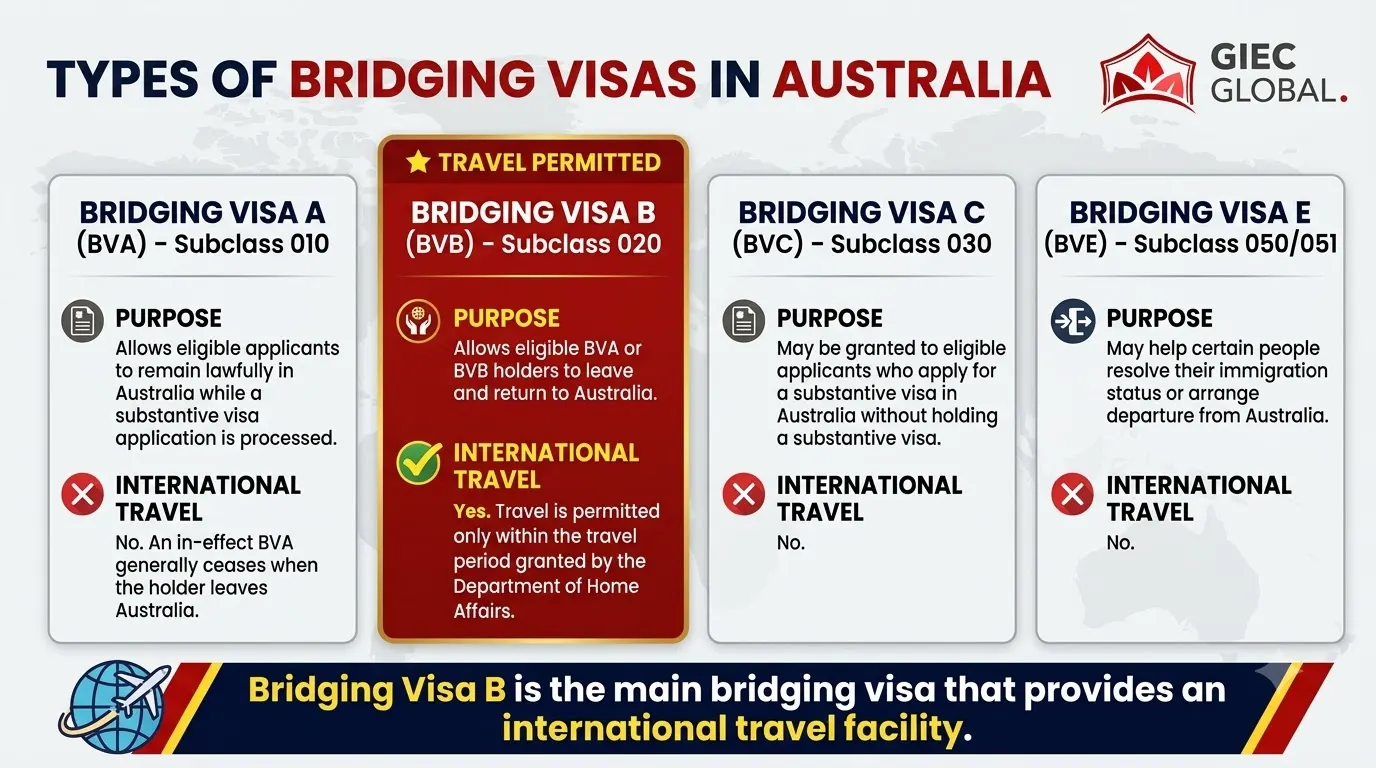
However, not every bridging visa allows international travel. If you leave Australia while an in-effect Bridging Visa A, C or E is your only relevant bridging visa, it will generally cease on departure. A Bridging Visa Australia is the main bridging visa that provides a travel facility allowing eligible holders to leave and return during a specified period.
Types of Bridging Visa in Australia
Australia has several bridging visa subclasses. The following table explains the main types and their general purpose.
Bridging Visa
Subclass Code
General Purpose
International Travel
Bridging Visa A (BVA)
WA 010
Allows eligible applicants to remain lawfully in Australia while a substantive visa application is processed
No – an in-effect BVA generally ceases on departure
Bridging Visa B (BVB)
WB 020
Allows eligible BVA or BVB holders to leave and return during a specified travel period
Yes – subject to the granted travel facility
Bridging Visa C (BVC)
WC 030
May be granted to eligible applicants who apply for a substantive visa in Australia without holding a substantive visa
No
Bridging Visa E (BVE)
WE 050/051
May help certain people resolve their immigration status or make arrangements to leave Australia
No
Other bridging visas, including Bridging Visa D, F and R, apply in more specific circumstances. Eligibility and conditions differ between subclasses, so you should check the relevant Department of Home Affairs information before making travel or visa decisions.
What Is Bridging Visa B (BVB) in Australia?
A Bridging Visa B, also known as a BVB or subclass 020 visa, is a temporary visa with a travel facility. It allows an eligible person to leave Australia and return within a travel period specified by the Department of Home Affairs.
It is generally relevant to people who are waiting for a decision on an eligible substantive visa application or certain review proceedings and need to travel overseas before the matter is finalised.
For example, you may have applied for an Australian permanent visa while in Australia and received a Bridging Visa A. If you need to visit your family overseas, attend an important event or meet an overseas work commitment, you may be able to apply for a Bridging Visa B.
The BVB does not guarantee that your main visa application will be approved. Its purpose is to provide a travel facility while your existing immigration matter remains unresolved.
Why Is a Bridging Visa B Important?
International travel: It can allow you to leave Australia for an approved period.
Return to Australia: It can allow you to re-enter before the travel facility expires.
Pending visa application: Your substantive visa application can continue to be processed while you are overseas, subject to the relevant visa requirements.
Important personal commitments: It may help eligible applicants attend significant family, personal or professional events overseas.
You must have the BVB granted before leaving Australia. Simply lodging an application does not give you permission to travel and return.
Bridging Visa A to B: Who Can Apply?
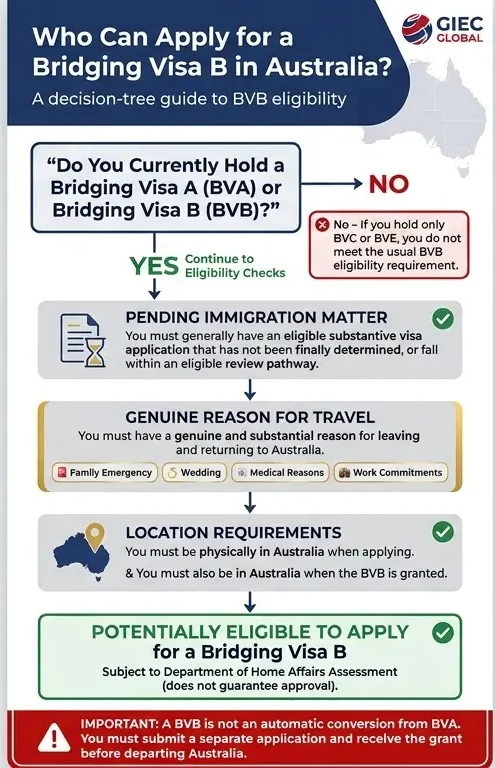
Many applicants search for “Bridging Visa A to B” because they currently hold a BVA and need permission to travel outside Australia. A BVB application is not an automatic conversion. You must meet the relevant eligibility requirements and receive a separate grant.
Generally, you may be eligible to apply for a Bridging Visa B if:
You currently hold a Bridging Visa A or Bridging Visa B.
You have made an eligible substantive visa application in Australia that has not been finally determined, or your circumstances fall within an eligible review pathway.
You have a genuine and substantial reason for leaving and returning to Australia.
You are physically in Australia when you apply.
You are in Australia when the BVB is granted.
The Department assesses the circumstances of each application. Meeting the basic requirements does not guarantee approval.
Can Bridging Visa C or E Holders Apply for a BVB?
A person holding only a Bridging Visa C or Bridging Visa E does not meet the usual BVB eligibility requirement of holding a BVA or BVB. A BVB is not a general travel permission available to every bridging visa holder.
If you hold a BVC or BVE and need to travel, seek advice about your specific immigration status before making plans. Do not assume that lodging a BVB application will allow you to depart and return to Australia.
Who Commonly Applies for a Bridging Visa B?
Bridging Visa B applications can arise in different immigration situations, including:
Applicants waiting for an Aged Parent visa (subclass 804).
Applicants waiting for a Contributory Aged Parent visa (subclass 864).
Eligible applicants waiting for an onshore skilled visa decision.
Eligible applicants waiting for a Temporary Graduate visa (subclass 485) decision.
Applicants with certain onshore partner or other substantive visa applications who hold a BVA or BVB and meet the travel requirements.
Eligibility depends on the exact visa application and bridging visa held. For example, some partner visa applicants may hold a substantive temporary partner visa that already permits travel. They should check their current visa conditions and travel rights rather than assume a BVB is necessary.
What Are Substantial Reasons for Bridging Visa B Travel?
One of the important parts of a Bridging Visa B application is explaining why you need to leave Australia and return while your main visa matter is pending. The Department considers your reason for travel and the likely timing of a decision on your substantive visa application.
Your explanation should be specific, credible and supported by relevant documents wherever possible.
Examples of Reasons for Travel
Family emergency: A close family member is seriously ill, requires support or has passed away.
Wedding or family event: You need to attend an important family occasion overseas.
Medical reasons: You need to attend an overseas medical appointment or support a close relative with a serious medical issue.
Employment commitments: You have an important work obligation, business meeting or professional commitment outside Australia.
Other significant personal reasons: There may be other circumstances that justify travel, depending on the evidence and your individual situation.
What Evidence Can Support a BVB Application?
The documents you provide should match the reason for travel. For example:
Medical reports or hospital letters for a serious medical situation.
A death certificate or funeral details where relevant.
Wedding invitations or official event documents.
Employer letters explaining an essential overseas work commitment.
Travel dates and a clear explanation of why the trip is necessary.
Other documents that support the circumstances described in your application.
There is no single document that guarantees approval. The Department considers the overall circumstances and the information provided.
Bridging Visa B Cost in Australia (2026–27)
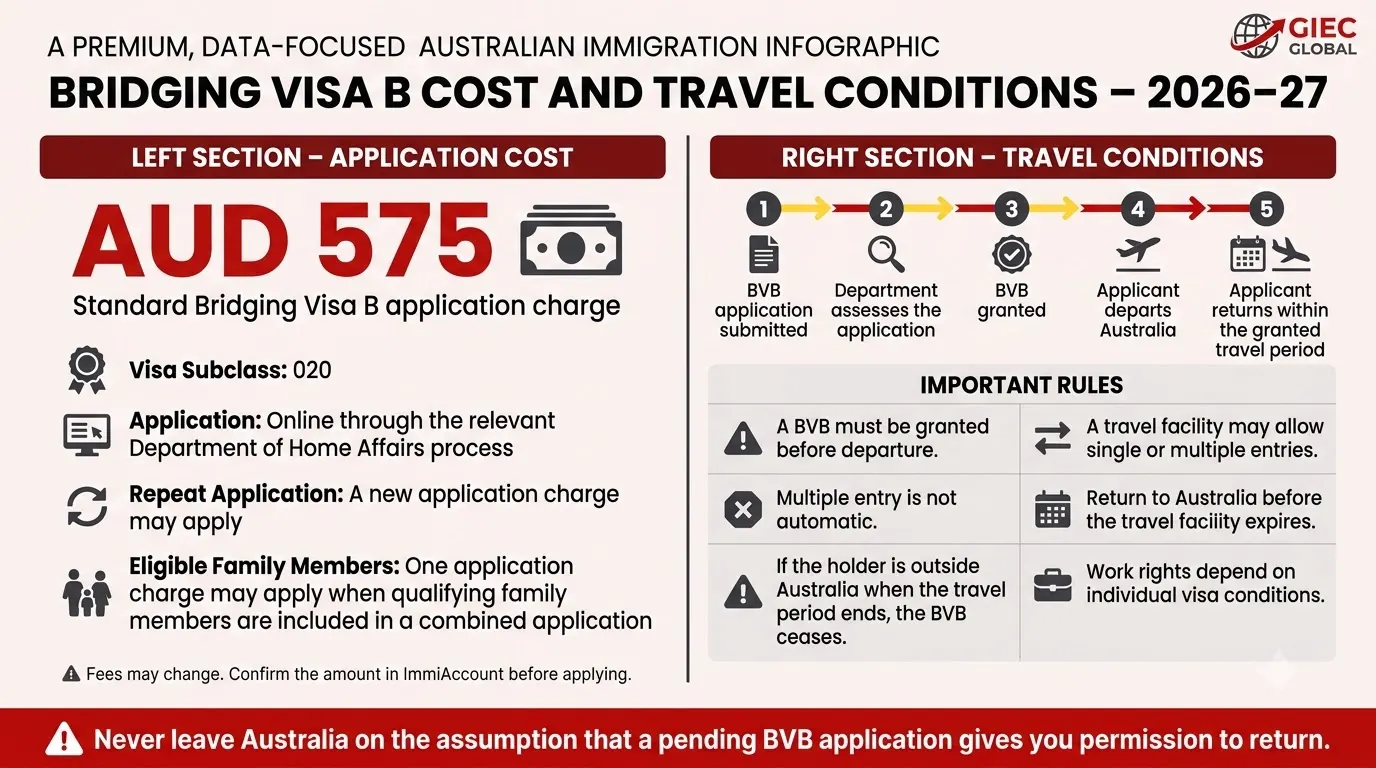
The current standard Bridging Visa B application charge is AUD 575. This is the charge listed by the Department of Home Affairs for subclass 020. Limited concessions may apply to eligible applicants from specified Pacific Island countries and Timor-Leste.
Fee Detail
Amount
Bridging Visa B standard application charge
AUD 575
Visa subclass
020
Payment method
ImmiAccount, before submitting the relevant application
Repeat application
A new application charge may apply
The amount can change when the Australian Government updates visa charges. Always confirm the amount displayed by Home Affairs or ImmiAccount on the day you apply.
Does Bridging Visa B Cost AUD 575 for Each Applicant?
The Department’s guidance allows eligible family members who are part of the same substantive visa application to be included in one BVB application in certain circumstances. The family members must each meet the relevant BVB requirements and have substantial reasons for needing to travel.
Where family members are included in a combined application, the Department states that one visa application charge applies to that application. Do not assume that every family member can be included automatically. Check the rules and payment details for your circumstances before lodging.
Is Bridging Visa B Free?
No. The standard BVB application charge is AUD 575. This is different from some other bridging visas, such as Bridging Visa A and Bridging Visa C, which are listed as having no application charge in the current fee information.
Bridging Visa B Processing Time
There is no standard published processing time for a Bridging Visa B. The Department of Home Affairs does not provide a guaranteed number of days or weeks for a decision.
Processing can depend on the details of the application, the supporting evidence, the Department’s workload and whether further information is required.
Home Affairs recommends applying no more than three months and no less than two weeks before your intended travel date. This is guidance for planning, not a promise that every application will be decided within that period.
How Long Does Bridging Visa B Take to Process?
Applicants often search for a fixed BVB processing time because they need to book flights or attend an important event. However, the Department does not publish a standard processing timeframe for this visa.
To reduce avoidable delays:
Apply within the recommended timeframe where possible.
Provide clear travel dates and explain why you need to travel.
Attach relevant supporting evidence when you lodge the application.
Check that your passport and personal details are correct.
Respond promptly if the Department requests further information.
Monitor your ImmiAccount and email for updates.
A complete application may help the Department assess your circumstances, but it does not guarantee faster processing or approval.
Urgent Bridging Visa B: Emergency Travel Applications
If you need to travel urgently because of a serious family or personal situation, you may be able to use the Department’s urgent online Bridging Visa B application process.
The urgent process is intended for applicants who need their circumstances considered urgently. It does not guarantee immediate processing or approval. You must still meet the visa requirements and provide accurate information.
How to Apply for an Urgent BVB
Prepare your application: Gather your travel details, passport information and documents explaining the urgent reason for travel.
Pay the application charge: Pay the BVB application charge through ImmiAccount before submitting the urgent online form.
Complete Form 1006: Complete the Application for a Bridging Visa B form and attach it as instructed.
Submit the urgent online form: Use the Department’s official urgent Bridging Visa B online service and provide the requested information.
Attach supporting evidence: Include relevant medical, family, employment or other documents supporting the urgency.
Monitor your application: Check your email and ImmiAccount for any communication from Home Affairs.
Important: The Department advises applicants not to submit another application simply because they are concerned about processing. A duplicate application can contribute to delays.
Bridging Visa B conditions are important because they determine when you can travel, how long you can remain outside Australia and whether you can work while the visa is in effect.
Your individual conditions are stated in your visa grant notice. You should also use Visa Entitlement Verification Online (VEVO) to check your current visa details.
1. Travel Period
A BVB is granted with a defined travel period. You must return to Australia before that period ends if you intend to re-enter using the BVB.
The travel period is not necessarily the same as the time remaining on your main visa application. The Department considers your reason for travel and when it expects to make a decision on your substantive visa application.
2. Single Entry or Multiple Entry
A Bridging Visa B may be granted with either a single-entry or multiple-entry travel facility. Multiple entry is not automatic.
If you need to make more than one overseas trip, explain this in your application and provide your intended travel details. Check the travel facility stated in your grant notice before making another journey.
3. Bridging Visa B Work Rights
A BVB does not automatically provide unrestricted work rights. Whether you can work depends on the conditions attached to your visa and the relevant immigration circumstances.
The Department explains that your work rights may depend on the substantive visa you held or the visa you applied for. If your visa conditions restrict work, those restrictions may continue to apply.
Check your grant notice and VEVO before starting or continuing employment. Do not rely on another person’s work conditions as confirmation of your own rights.
4. Study Conditions
Study rights should also be checked against the conditions attached to your visa. A BVB is primarily a travel facility and should not be treated as a separate permission to undertake unrestricted study.
5. Returning Before the Travel Facility Ends
You must return to Australia before the travel period stated in your BVB grant notice ends. If you are outside Australia when the travel period expires, the BVB will cease and you cannot use it to return.
What Happens If My Bridging Visa B Expires While I Am Overseas?
If you are outside Australia when the BVB travel period ends, your BVB will cease. You cannot return to Australia using that ceased BVB.
You will need to obtain another visa that allows you to enter Australia before travelling back. Whether another visa is available will depend on your circumstances and the requirements of the visa you originally applied for.
This can be particularly important where your substantive visa application requires you to be in Australia at the time of grant. Remaining overseas after the BVB travel period ends may affect your ability to meet those requirements.
Before travelling, check:
The final date of your BVB travel facility.
Your planned return flight date.
Whether your substantive visa application has any onshore requirements.
Whether your passport will remain valid for the journey.
Whether any changes to your circumstances need to be reported to Home Affairs.
Allow a reasonable margin before the travel facility ends. Do not plan to return on the final day if an unexpected flight cancellation or travel disruption could leave you overseas after expiry.
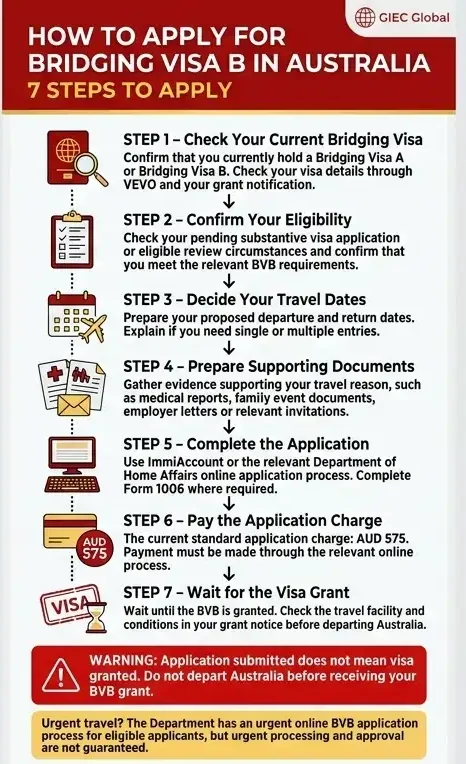
How to Apply for Bridging Visa B in Australia
Most BVB applications are made online. The correct application method depends on how you lodged your substantive visa application and whether your matter is connected to a review process.
Step 1: Check Your Current Bridging Visa
Before applying, confirm whether you currently hold a Bridging Visa A or Bridging Visa B. You can check your visa details through VEVO and review your grant notification.
Step 2: Confirm Your Eligibility
Check that your substantive visa application or review circumstances meet the BVB requirements. You should also confirm that you will be in Australia when you apply and when the visa is granted.
Step 3: Decide Your Travel Dates
Prepare your intended departure and return dates. If you need multiple trips, explain the proposed travel schedule and request an appropriate travel facility.
Step 4: Prepare Supporting Documents
Gather evidence that supports your reason for travelling. Depending on your circumstances, this may include medical documents, family event details, employer letters, invitations or other relevant records.
Step 5: Apply Through ImmiAccount or the Relevant Online Form
If your substantive visa application was lodged through ImmiAccount and you have not applied for review, the Department generally directs you to submit the bridging visa application through ImmiAccount.
In other eligible circumstances, you may be able to use the Department’s online bridging visa application form. For a BVB, Form 1006 must be completed and attached where the online form requires it.
Pay the applicable BVB charge through ImmiAccount before submitting the relevant application. Keep a copy of the payment confirmation for your records.
Step 7: Wait for the Grant Before Departing
Do not leave Australia simply because you have submitted a BVB application. You must receive the BVB grant and check its travel conditions before departing.
Can I Leave Australia on a Bridging Visa A Without a Bridging Visa B?
If your Bridging Visa A is in effect and you leave Australia, it will generally cease on departure. You will not be able to return using that BVA.
If you need to leave and return while your substantive visa application is pending, you should apply for and receive a BVB before departing Australia.
Do not assume that an application receipt, a pending BVB request or a previous bridging visa grant is sufficient permission to travel. Check the visa that will be in effect on your departure date and the travel facility in your grant notice.
Can I Change from a Tourist Visa to a Bridging Visa in Australia?
A person who holds an Australian Visitor visa may be able to apply for another substantive visa while in Australia, depending on the conditions of their current visa and the requirements of the visa they intend to apply for.
If an eligible substantive visa application is lodged before the Visitor visa expires, a bridging visa may be granted to cover the period after the Visitor visa ceases while the new application is being considered.
However, a Visitor visa with a No Further Stay condition may restrict the ability to lodge another substantive visa application in Australia. Any waiver request is subject to separate requirements and is not guaranteed.
If you receive a Bridging Visa A and later need to travel overseas, you may need to apply for a BVB before leaving Australia. The BVB is not automatically granted with the original visa application.
Read more about the Australia Visitor Visa and check your visa conditions before making another application.
Is There a Bridging Visa in the UK?
The UK does not have an Australian-style Bridging Visa A or Bridging Visa B. However, UK immigration law provides for section 3C leave in certain circumstances.
Section 3C of the Immigration Act 1971 may extend a person’s existing permission to stay where they make a valid application to extend or vary their leave before their current permission expires, and that permission expires before the application is decided.
Section 3C leave is subject to specific legal requirements. It does not apply automatically to every pending immigration application, and an invalid or late application may not provide this protection.
Importantly, section 3C leave generally lapses if the person leaves the UK. This is different from an Australian BVB, which can provide a defined travel facility for leaving and returning to Australia.
Bridging Visa A vs Bridging Visa B: What Is the Difference?
Although both visas are part of Australia’s bridging visa system, they serve different purposes. A Bridging Visa A generally allows eligible applicants to remain lawfully in Australia after their previous substantive visa ceases. A Bridging Visa B provides an additional travel facility.
Feature
Bridging Visa A (BVA)
Bridging Visa B (BVB)
Subclass
010
020
Main purpose
Remain lawfully in Australia while an eligible application is processed
Remain in Australia and travel overseas with permission
A BVB application should explain your travel requirements clearly. Avoiding common mistakes can help prevent unnecessary complications.
1. Leaving Australia Before the BVB Is Granted
Submitting an application does not mean you have permission to travel. If you leave while an in-effect BVA is your bridging visa, it may cease. Wait for the BVB grant before departure.
2. Providing Limited Travel Evidence
A short statement without supporting documents may not explain why the travel is important. Provide relevant evidence that supports the reason and dates of your trip.
3. Requesting the Wrong Travel Period
Think about all the trips you genuinely need to make. A BVB may have a single-entry or multiple-entry facility, and the Department decides the period granted. Do not assume that the travel period will cover every future trip.
4. Ignoring the Visa Grant Conditions
Check the travel facility, work conditions and other requirements in your grant notice. The conditions of another applicant’s BVB may be different from yours.
5. Applying Too Late
Home Affairs recommends applying no more than three months and no less than two weeks before the intended travel date. Last-minute applications can create uncertainty, especially where flights or important events are involved.
6. Submitting Duplicate Applications
If you are concerned about processing, do not automatically submit another application. Home Affairs warns that duplicate applications can contribute to delays. Follow the Department’s instructions for enquiries or additional information.
How GIEC Global’s Australian Immigration Consultants Can Help
Applying for a Bridging Visa B requires more than completing an online form. You need to understand your current bridging visa, the status of your substantive application, your travel requirements and the conditions that may apply after the BVB is granted.
GIEC Global supports applicants in the UK and internationally with Australian immigration guidance. Depending on your circumstances, our team can help you:
Review your current bridging visa and identify the relevant travel requirements.
Understand the general eligibility criteria for a Bridging Visa B.
Organise supporting documents for your proposed overseas travel.
Prepare a clear explanation of your travel reasons and intended dates.
Understand the application process, fee and urgent application procedure.
Review how international travel may affect your pending substantive visa application.
Every immigration matter is different. No consultant can guarantee a BVB grant or a particular processing time. The final decision rests with the Australian Department of Home Affairs.
A Bridging Visa B can be important if you need to travel outside Australia while waiting for an eligible visa application or review to be decided. It provides a defined travel facility, but you must meet the eligibility requirements, provide a genuine reason for travel and receive the grant before leaving Australia.
The current standard application charge is AUD 575, and the Department does not publish a guaranteed processing time. Apply within the recommended timeframe, provide complete supporting evidence and check your grant notice carefully before booking or taking an international trip.
For the latest requirements, always refer to the official Australian Department of Home Affairs website. Visa rules, charges and individual conditions can change.
Reviewed by the GIEC Global Australia immigration team. Information checked against Department of Home Affairs guidance and current published visa charges. Last reviewed: 6 November 2026. This article provides general information and is not a substitute for advice based on your individual immigration circumstances.
Frequently asked questions
What is Bridging Visa B?
A temporary visa that lets Bridging Visa A or B holders travel outside Australia and return while a visa application is processed.
What is a bridging visa in Australia?
A temporary visa that keeps you lawful between visas, usually while a new visa application is processed.
How much does a Bridging Visa B cost?
AUD 575 from 1 July 2026, up from AUD 190 in 2025–26.
What is the Bridging Visa B processing time?
There is no published standard. Apply 2 weeks to 3 months before you travel.
How do I apply for an urgent Bridging Visa B?
For an emergency, pay in ImmiAccount and lodge Form 1006 through the urgent BVB online form with evidence.
Can I apply for Bridging Visa B from Bridging Visa A?
Yes. A BVA holder in Australia can apply for a BVB with substantial reasons for travel.
Can I apply for Bridging Visa B outside Australia?
No. You must be in Australia to apply and when it is granted.
Is Bridging Visa B automatically granted?
No. You must apply, pay the fee and wait for a grant before leaving.
What are substantial reasons for a Bridging Visa B?
Family events, family emergencies, business commitments or other important reasons supported by evidence.
Is Bridging Visa B multiple entry?
Yes. You can make several trips within the travel period.
How long is a Bridging Visa B valid for?
The travel period is usually up to 3 months, though it can be longer in some cases.
Can I work on a Bridging Visa B?
A BVB generally has the same work conditions as your BVA. Check VEVO.
What happens if my BVB expires while I am overseas?
You cannot return on it and will need a new visa to enter Australia.
Can I leave Australia on a Bridging Visa A?
You can, but the BVA ends when you leave. You need a BVB to return.
Do 804 aged parent visa applicants need a Bridging Visa B?
Yes, if they hold a BVA and want to travel while waiting.
Do partner visa applicants need a BVB?
Not usually once the 820 is granted. Before that, a BVA holder needs a BVB.
How many Bridging Visa B applications can I make?
There is no fixed limit, but each application costs AUD 575.
What is the difference between Bridging Visa A and B?
A BVA keeps you lawful in Australia; a BVB also lets you travel and return.
Is there a bridging visa in the UK?
No. The UK uses section 3C leave to continue your permission while an in-time application is decided.
Why use an immigration consultant for a Bridging Visa B?
With an AUD 575 fee, a consultant helps you avoid refusals, prepare evidence and plan travel safely.
University of Melbourne in Melbourne, Victoria, Australia. QS World University Rankings 2026: 19th in the world. Tuition: AUD $45,000 – AUD $52,000 per year.
University of New South Wales in Sydney, New South Wales, Australia. QS World University Rankings 2026: 20th in the world. Tuition: AUD $45,000 – AUD $52,000 per year.
The University of Sydney in Sydney, New South Wales, Australia. QS World University Rankings 2026: 25th in the world. Tuition: AUD $45,000 – AUD $53,000 per year.
Australian National University in Canberra, Australian Capital Territory, Australia. QS World University Rankings 2026: 32nd in the world. Tuition: AUD $44,000 – AUD $50,000 per year.
Monash University in Melbourne, Victoria, Australia. QS World University Rankings 2026: 36th in the world. Tuition: AUD $42,000 – AUD $48,000 per year.
The University of Queensland in Brisbane, Queensland, Australia. QS World University Rankings 2026: 42nd in the world. Tuition: AUD $42,000 – AUD $48,000 per year.