
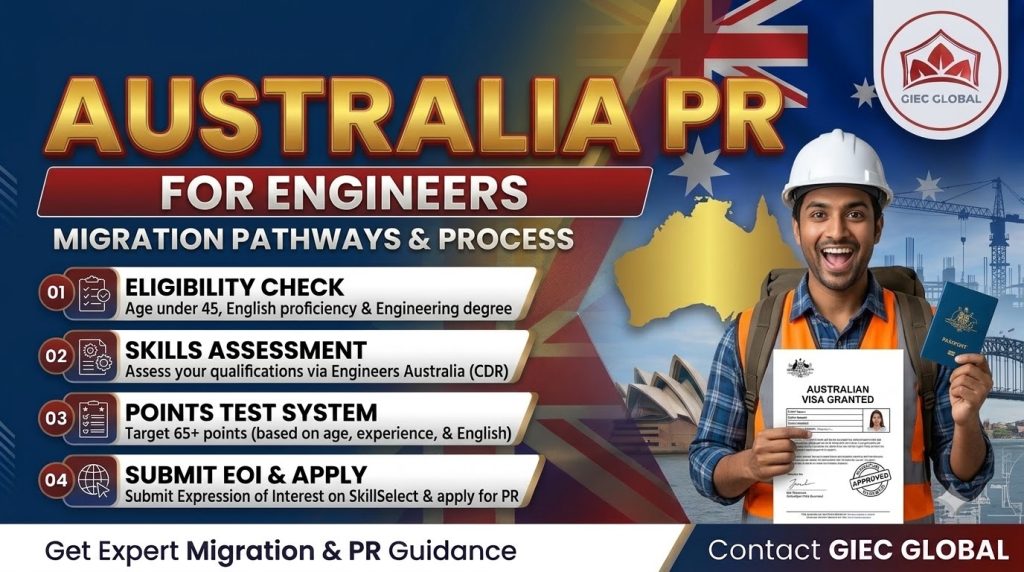
Australia is a popular destination for qualified engineers who want to develop their careers and explore long-term settlement opportunities. From civil and mechanical engineering to electrical, industrial and other specialist fields, skilled professionals may have several migration pathways to consider. However, Australia PR for engineers depends on more than holding an engineering degree. Your nominated occupation, qualifications, skills assessment, work experience, English proficiency and visa eligibility all matter.
For engineers living in the UK, understanding these requirements before starting an application can help you make informed decisions about your future. The right approach begins with checking your occupation, assessing your qualifications and comparing the available visa options against your individual circumstances.
GIEC Global UK can help prospective applicants understand the process, identify areas that need further assessment and prepare for the next steps in their Australian migration journey. Eligibility and visa outcomes are determined by the relevant Australian authorities, and no migration pathway guarantees an invitation or permanent residence.
Who can apply for Australia PR as an engineer?
Engineers may qualify for skilled migration if their occupation is eligible under the relevant visa programme and they satisfy its assessment and visa requirements. The first step is to identify your actual engineering occupation rather than relying only on the general title of engineer.
For example, a civil engineer, mechanical engineer, electrical engineer and industrial engineer may have different nominated occupations and assessment requirements. Your qualification, main duties and professional experience should align with the occupation you intend to nominate.
Applicants should review the relevant skilled occupation requirements for their chosen visa. An occupation being relevant to Australia’s engineering sector does not automatically mean it is eligible for every permanent residence pathway.
Before proceeding, consider the following:
-
Your highest engineering qualification and the institution that awarded it.
-
Your engineering specialisation and relevant employment history.
-
Whether your nominated occupation is eligible for the intended visa.
-
The applicable skills assessment requirements.
-
Your age and English language results.
-
Your potential points score and any state nomination or employer sponsorship options.
A structured eligibility review can help you identify missing documents or potential issues before investing time and money in an application.
Engineers Australia skills assessment
A skills assessment is an important part of many skilled migration applications. Engineers Australia is the designated assessing authority for a range of engineering occupations and assesses applicants’ qualifications, skills and competencies for migration purposes. The appropriate assessment pathway depends on your qualifications and nominated occupation.
Engineers Australia+1
Choosing the correct assessment pathway
Engineers Australia provides different assessment pathways, including options for recognised accredited qualifications and the Competency Demonstration Report (CDR) pathway. The correct route depends on factors such as where you studied, whether your programme is accredited under a relevant international agreement and whether your qualification aligns with the occupation you want to nominate.
Applicants with eligible accredited qualifications may be able to use the relevant accredited pathway. Engineers whose qualifications are not accredited, or whose nominated occupation differs from the occupation associated with their qualification, may need to consider a CDR assessment.
The CDR pathway evaluates evidence of your engineering knowledge, skills and competencies against the applicable standards. Applicants may need to prepare career episodes, a summary statement and supporting academic and professional documents, depending on the current requirements.
Do not assume that every overseas engineering degree automatically meets Australian migration standards. Check your exact qualification and assessment pathway using the official Engineers Australia guidance before preparing your submission.
Engineers Australia+1
Documents engineers should prepare
Your document checklist will depend on your assessment route and personal circumstances. It may include:
-
Degree certificates and academic transcripts.
-
Evidence of the qualification and institution.
-
Detailed employment references describing your duties and dates of employment.
-
Evidence of relevant professional experience.
-
Identity documents and any required translations.
-
Competency reports or other evidence required by your assessment pathway.
-
English language test results, where applicable.
Documents should be accurate, consistent and supported by evidence. Employment letters that provide only a job title, without explaining the actual duties performed, may not adequately demonstrate how your experience relates to the nominated occupation.
Australia PR pathways for engineers
There is no single visa route that suits every engineering professional. The main options to investigate may include points-tested skilled visas and employer-sponsored pathways. Your occupation, circumstances and the rules in force at the time of application determine which options are available.
Skilled Independent visa (subclass 189)
The Skilled Independent visa is a permanent visa pathway for eligible skilled workers who receive an invitation to apply. It does not require state nomination or employer sponsorship under its points-tested stream. Applicants must meet the applicable requirements, including occupation eligibility, a suitable skills assessment, age requirements and the points test.
Immigration and citizenship Website+1
For engineers, the key consideration is whether the nominated occupation and personal profile make this pathway suitable. A strong qualification or several years of work experience alone does not guarantee an invitation.
Skilled Nominated visa (subclass 190)
The Skilled Nominated visa is another permanent residence pathway. It involves nomination by an Australian state or territory and requires applicants to meet the applicable visa criteria.
Engineers considering the subclass 190 route should investigate the nomination requirements of the relevant state or territory. These may differ according to occupation, professional background and the state’s migration priorities.
State nomination should not be treated as automatic. Check the current criteria and occupation requirements before deciding whether to pursue this pathway.
Skilled Work Regional visa (subclass 491)
The subclass 491 visa is a provisional skilled visa for eligible applicants nominated by a state or territory government or sponsored by an eligible relative under the relevant rules. It is designed for regional Australia and has its own occupation, skills assessment, invitation and points requirements.
Immigration and citizenship Website+1
This option may be worth researching if you are open to living and working in an eligible regional area. It is not itself a permanent visa, although eligible visa holders may later have a pathway to permanent residence if they satisfy the requirements that apply at that time.
Employer-sponsored options
Some engineers may be able to explore employer-sponsored migration if an Australian employer is willing and eligible to sponsor them for an appropriate position. Employer-sponsored visas have separate occupation, employer, position and applicant requirements.
An engineering job offer does not automatically provide permanent residence. The employer and applicant must satisfy the rules of the particular visa pathway. Engineers should also distinguish between a temporary work visa and a permanent employer-sponsored option.
For this reason, compare employer-sponsored routes with points-tested options instead of assuming that one is always faster or easier.
Australia PR for civil, mechanical and electrical engineers
The phrase engineering PR covers several different professional backgrounds. The best pathway depends on your actual duties, qualifications and nominated occupation rather than the broad engineering discipline alone.
Civil engineering PR
Civil engineers working in areas such as infrastructure, construction, structural projects and transport may wish to investigate relevant skilled occupations. However, civil engineering PR eligibility depends on the specific occupation and visa requirements.
Prepare evidence that explains your responsibilities, project involvement, technical expertise and employment history. If you are considering state nomination, research the current requirements of the state or territory where you may wish to live.
Mechanical engineering PR
Mechanical engineers may work in manufacturing, maintenance, energy, industrial systems, design or related technical areas. Applicants should check how their qualifications and employment duties align with the nominated occupation.
A mechanical engineering degree does not automatically establish eligibility for a particular skilled visa. Confirm the relevant skills assessment route and occupation criteria before submitting an expression of interest.
Electrical engineering PR
Electrical engineers may have experience in power systems, electrical design, industrial automation, control systems or related fields. For electrical engineering PR, the nominated occupation, qualification and assessment requirements need to be considered together.
Keep detailed evidence of your responsibilities, technical projects and employment history. This can help you prepare a more complete skills assessment application and support claims made during the visa process.
Industrial and other engineering specialisations
Industrial engineering and other specialist fields should be assessed individually. Do not select a nominated occupation simply because its title sounds similar to your current role.
Review the official occupation information and the assessing authority’s criteria. Where your duties span more than one specialisation, a careful comparison of the available occupations can help you determine which one most accurately reflects your professional background.
Points requirements for Australian skilled migration
Points-tested visa pathways assess factors such as age, English language proficiency, skilled employment and qualifications. Additional points may be available for certain eligible circumstances, including particular study or nomination arrangements. The points awarded depend on the applicable rules and the evidence provided.
Immigration and citizenship Website+1
Meeting the minimum points threshold does not guarantee an invitation. The outcome can depend on invitation arrangements, occupation eligibility and other programme requirements.
Engineers should calculate their potential score carefully rather than relying on an estimate based only on age and work experience. Check whether your employment can be counted, whether your English result qualifies for the points claimed and whether your qualifications meet the relevant criteria.
Before submitting an expression of interest, make sure your claims can be supported by documentary evidence. An inaccurate points claim can create problems during the assessment or visa process.
Can UK-based engineers apply for Australian PR?
Yes, being based in the UK does not automatically prevent an eligible engineer from pursuing an Australian skilled migration pathway. However, you must still satisfy the requirements of the visa you choose.
If you are a UK citizen or hold another form of UK residence, your immigration status in the UK does not itself determine your eligibility for Australian permanent residence. Your age, qualifications, nominated occupation, skills assessment, English proficiency and other visa criteria remain important.
UK-based engineers should consider how their existing qualifications and work experience can be documented. Obtain accurate employment references, keep copies of academic records and check whether any required assessment or English test needs to be completed before proceeding.
If you are exploring engineering jobs in Australia with visa sponsorship, research employers and vacancies that match your professional experience. Confirm the proposed role and sponsorship arrangements carefully. A job advertisement or recruitment conversation alone is not evidence that you qualify for a particular visa.
How to apply for Australia PR as an engineer
A clear process can help you avoid common mistakes and focus on the requirements that apply to your circumstances.
Step 1: Identify your nominated occupation. Compare your engineering qualifications and day-to-day duties with the relevant occupation descriptions. Confirm that the occupation is eligible for the visa you are considering.
Step 2: Check your skills assessment pathway. Review the official Engineers Australia requirements and identify whether an accredited qualification pathway or CDR assessment may apply to you.
Step 3: Gather supporting documents. Collect your academic records, employment evidence, identity documents and other material required for your assessment. Ensure that the details are consistent across all documents.
Step 4: Review your English and points profile. Check the accepted English requirements and calculate your potential points under the current rules. Do not claim points unless you can meet the relevant criteria.
Step 5: Compare suitable visa pathways. Consider the subclass 189, subclass 190, subclass 491 and applicable employer-sponsored routes. Check their current requirements before choosing a strategy.
Step 6: Submit an expression of interest where required. The SkillSelect process is used for relevant points-tested visas. An expression of interest is not a visa application and does not guarantee an invitation.
Immigration and citizenship Website+1
Step 7: Respond to an invitation and prepare the visa application. If invited, follow the instructions and deadlines stated by the Department of Home Affairs. Provide the requested documents and ensure that your application accurately reflects your circumstances.
The exact order and requirements may differ between visa pathways, so follow the official instructions for the specific route you choose.
Common mistakes to avoid
Engineers can lose time and money when they begin the process without checking the applicable rules. Common mistakes include choosing an occupation based only on its title, using an unsuitable skills assessment pathway, submitting incomplete employment evidence and assuming that the minimum points threshold guarantees an invitation.
Other risks include relying on outdated occupation lists, misunderstanding state nomination criteria or confusing a temporary sponsored visa with permanent residence.
Avoid making claims that cannot be verified. If your qualification, work history or nominated occupation is unclear, obtain suitable advice before lodging an assessment or visa application.
Plan your Australia PR journey with GIEC Global UK
If you are an engineer based in the UK and considering a move to Australia, start with an assessment of your profile rather than choosing a visa based on general online advice.
GIEC Global UK can help you understand the stages involved, identify the information needed for an eligibility review and explore relevant migration options. Your initial preparation should focus on your engineering specialisation, qualifications, professional experience, English language results and preferred visa pathway.
For a more useful consultation, prepare your CV, qualification details, employment history and any existing skills assessment or English test results. This allows your circumstances to be reviewed more clearly and helps identify the next steps to investigate.
Ready to explore Australia PR for engineers? Contact GIEC Global UK to discuss your profile and the available options. Eligibility, invitations and visa decisions remain subject to Australian government requirements and individual assessment.
Frequently asked questions
How can engineers get PR in Australia?
Engineers may qualify through suitable skilled migration or employer-sponsored pathways. The process depends on occupation eligibility, skills assessment, qualifications, English proficiency and the requirements of the selected visa.
What are the requirements for Australia PR for engineers?
Requirements vary by visa pathway but may include an eligible occupation, a suitable skills assessment, relevant qualifications, English language proficiency, age criteria, points requirements and an invitation or nomination where applicable.
Is Engineers Australia skills assessment mandatory for engineering PR?
Many skilled migration applicants need a suitable assessment from Engineers Australia for their nominated engineering occupation. The exact assessment requirements depend on the occupation and visa pathway.
How does electrical engineering PR work in Australia?
Electrical engineers should check their nominated occupation, Engineers Australia assessment pathway and the relevant visa requirements. Their qualifications and professional duties must align with the occupation they intend to nominate.
Can civil engineers apply for PR in Australia?
Civil engineers may be eligible for skilled migration if their nominated occupation and personal circumstances meet the requirements of the relevant visa. A suitable skills assessment may also be required.
What is the process for mechanical engineering PR in Australia?
Mechanical engineers should identify an eligible occupation, check the applicable skills assessment requirements, calculate their potential points if relevant and compare suitable skilled or employer-sponsored visa pathways.
How many points do engineers need for PR in Australia?
The minimum points threshold for relevant points-tested skilled visas is generally 65, but meeting it does not guarantee an invitation. The required points and invitation prospects depend on the visa rules and selection process.
Can UK-based engineers apply for Australian permanent residence?
Yes. Engineers living in the UK may apply if they meet the requirements of an eligible Australian visa pathway. Their UK residence or citizenship does not automatically establish eligibility.
What is the easiest way to get Australian PR for engineers?
There is no single easiest route for every engineer. The most suitable option depends on occupation eligibility, skills assessment, points, state nomination opportunities and whether an eligible employer can sponsor the applicant.
Can engineers get Australian PR without a job offer?
Some points-tested pathways, including the Skilled Independent visa subclass 189, do not require an employer sponsor. Applicants must still meet the applicable eligibility criteria and receive an invitation.
Can engineering jobs in Australia with visa sponsorship lead to PR?
Some employer-sponsored pathways may lead to permanent residence, depending on the visa, employer and applicant's eligibility. A sponsored job does not automatically guarantee permanent residence.
What documents are needed for an engineering skills assessment?
Depending on the assessment pathway, applicants may need academic certificates, transcripts, employment references, identity documents and competency evidence such as a Competency Demonstration Report.
Does an engineering degree guarantee Australian PR?
No. An engineering degree alone does not guarantee eligibility, an invitation or permanent residence. Applicants must satisfy the requirements of their chosen migration pathway.