Ontario specialists
University and college options across Toronto, Ottawa, Waterloo and London ON.
Ontario

Study Abroad · Canada
Programme selection, PAL, proof of funds and study permit support from study in Canada consultants who explain the 2026 rules clearly.
Studying in Canada from UK can give international students access to a wide range of universities, colleges, specialist programmes and career-focused qualifications. However, before travelling, you need to understand the Canadian study permit process, admission requirements, financial evidence and the conditions attached to studying and working in Canada.
If you are a UK-based student considering a Canadian qualification, the first step is to select a suitable Designated Learning Institution (DLI) and obtain an offer of admission. You will generally need a Canadian study permit if your programme lasts longer than six months. Depending on your circumstances and programme, you may also need a provincial or territorial attestation letter (PAL/TAL) when submitting your application.
Many students search online for a Canada student visa consultant or study in Canada consultants because the process involves more than receiving an offer letter. Applicants need to check whether their chosen programme meets their academic goals, whether the institution is eligible to enrol international students, how much money they must demonstrate and whether the programme may qualify for a Post-Graduation Work Permit (PGWP).
GIEC Global UK provides education and admission guidance to students exploring Canadian study options from the United Kingdom. This guide explains the process, with particular attention to Ontario, study permit requirements, financial planning and the questions you should ask before choosing an education consultant.
Canada offers a broad selection of higher education options, including universities, public colleges, polytechnic institutions and specialist training providers. Students can explore undergraduate degrees, postgraduate qualifications, master’s programmes, doctoral research and career-oriented courses.
For students living in the UK, studying in Canada may be an opportunity to experience a different education system while gaining an internationally recognised qualification. The right choice depends on the subject, institution, course structure, tuition fees, location and long-term career plans.
Canadian institutions offer programmes across areas such as business, engineering, information technology, healthcare, hospitality, finance, science, education and creative industries. Students should compare individual course modules, entry requirements, practical learning opportunities and graduate outcomes rather than choosing an institution based only on its name.
Students can consider provinces and cities with different academic environments and living costs. Ontario is a major destination for international education, while British Columbia, Alberta, Quebec, Manitoba, Nova Scotia and other provinces also offer a range of study options.
Some Canadian programmes include placements, co-operative education or practical projects. These opportunities vary by institution and course. Students should check whether a placement is part of the academic programme, whether a separate co-op work permit is required and what restrictions apply.
Some graduates may qualify for a Post-Graduation Work Permit (PGWP), but eligibility is not automatic. It depends on the institution, programme, study history and other requirements in force when the student applies. A student should check PGWP eligibility before paying a tuition deposit rather than assuming that every Canadian qualification provides a post-study work route.
The terms “Canada student visa” and “Canada study permit” are often used interchangeably in online searches. However, they refer to different immigration documents.
A study permit is the document that authorises an eligible foreign national to study in Canada under specified conditions. A visitor visa or electronic travel authorisation (eTA), where required, is an entry document used for travel to Canada. The document required for travel depends on the applicant’s nationality and circumstances.
Most applicants who intend to study in Canada for more than six months need a study permit. There are limited exceptions, so applicants should check the official requirements for their particular course and situation.
For a UK-based applicant, the process generally involves obtaining admission from a Canadian DLI, preparing the required supporting documents and submitting an online study permit application. If an eTA or visitor visa is required, the relevant travel document is generally issued as part of the approval process where applicable.
Read the official Canadian study permit guidance before submitting an application.
International students generally need a study permit to study in Canada when their course lasts longer than six months. A student planning a short course of six months or less may not need a study permit in certain circumstances, provided the course can be completed within the period authorised for their stay.
However, choosing a short course without considering future study plans can create complications. If you intend to continue studying after completing the initial course, you should understand the relevant immigration requirements before travelling.
The final requirement depends on the programme, its duration and the applicant’s circumstances. Always verify the position through Immigration, Refugees and Citizenship Canada (IRCC).
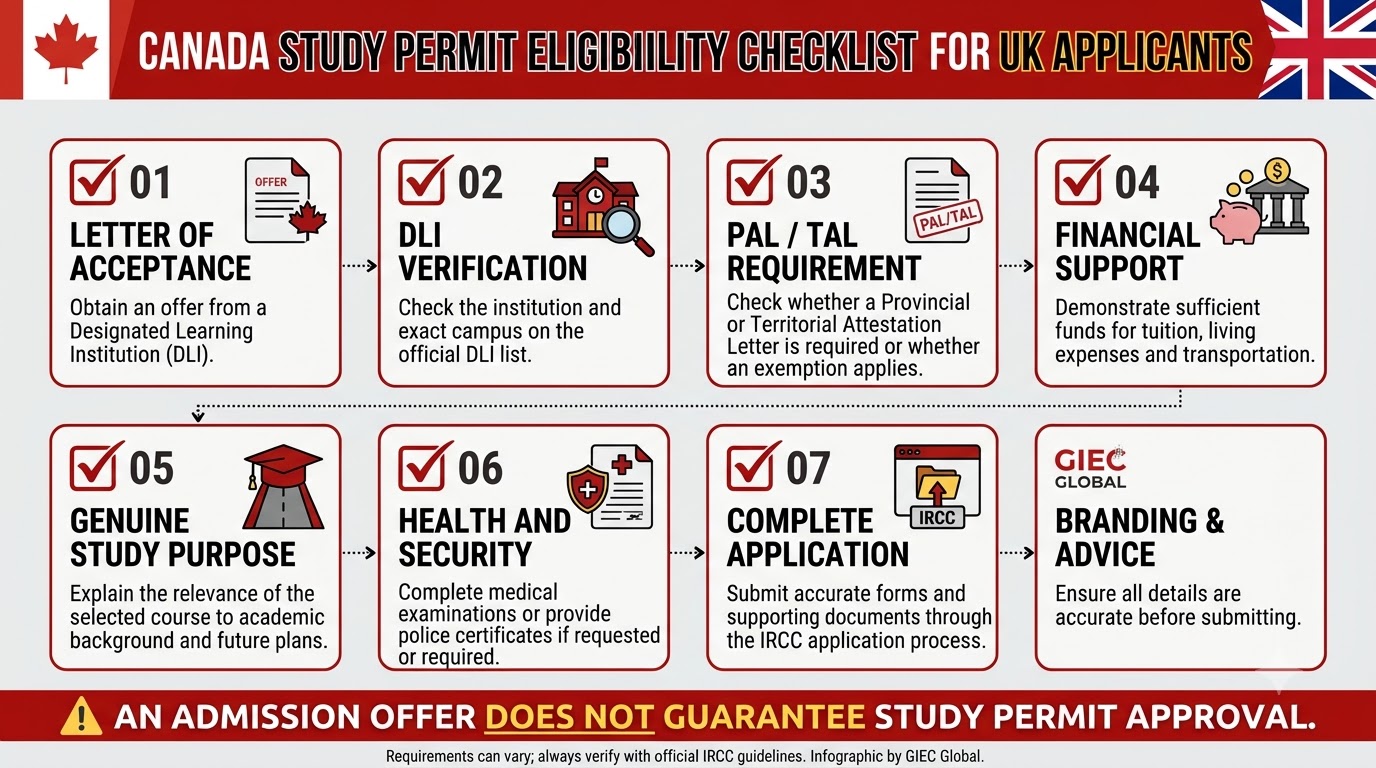
Applicants must satisfy the relevant study permit requirements. Having an offer from a Canadian institution is an important first step, but it does not automatically mean that a study permit will be approved.
You generally need a valid Letter of Acceptance (LOA) from a Designated Learning Institution. A DLI is an institution authorised by a provincial or territorial government to enrol international students.
Before accepting an offer, verify the institution using the official Designated Learning Institutions list. Check the exact campus and programme details, not simply the institution’s brand name.
Also confirm whether the specific programme is eligible for a PGWP if post-study work opportunities are important to your plans. DLI status alone does not mean every programme at that institution qualifies.
Many study permit applicants need a Provincial Attestation Letter (PAL) or Territorial Attestation Letter (TAL). This document is issued through the relevant provincial or territorial process and confirms that the student’s application is included within the applicable allocation framework.
There are exemptions. From 1 January 2026, students admitted to a degree-granting master’s or doctoral programme at a public designated learning institution are among the categories exempt from the PAL/TAL requirement. Other exemptions may also apply depending on the applicant’s circumstances.
Do not assume that every postgraduate student is exempt. The exemption depends on the precise programme and institution. Check the current PAL/TAL requirements before applying.
You must demonstrate that you have enough money to pay your tuition fees, living expenses and transportation costs. You should be able to explain how your studies and living costs will be funded without depending on finding employment after arriving in Canada.
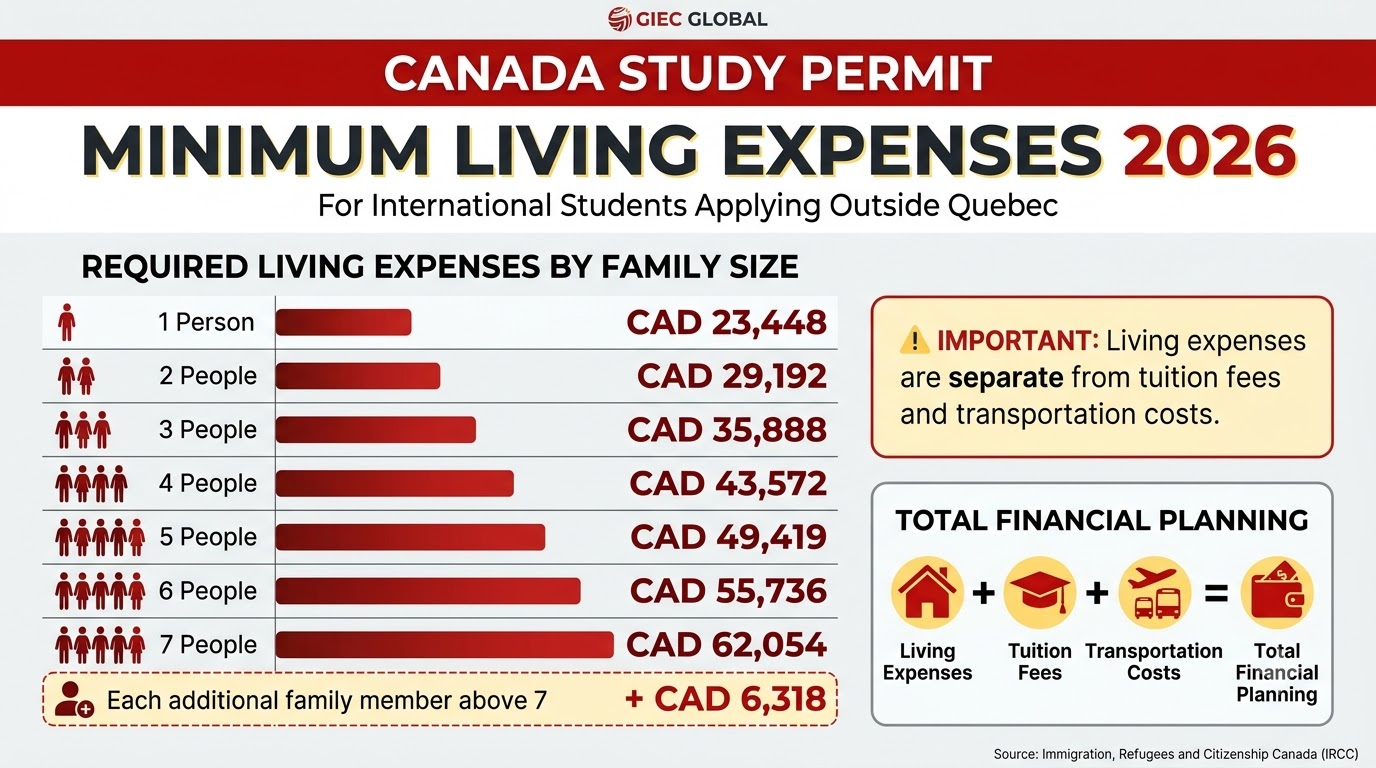
IRCC updated the minimum living-expense amount for study permit applications received on or after 1 September 2026. For applicants studying outside Quebec, the living-cost requirement for one person is CAD 23,448. This amount is separate from tuition fees and transportation costs.
The following table shows the living-cost amounts for different family sizes. These figures are for living expenses only and do not include tuition or travel.
| Family Members | Required Living Expenses (CAD) |
|---|---|
| 1 person | 23,448 |
| 2 people | 29,192 |
| 3 people | 35,888 |
| 4 people | 43,572 |
| 5 people | 49,419 |
| 6 people | 55,736 |
| 7 people | 62,054 |
| Each additional family member above 7 | 6,318 |
For example, a single student applying for a programme outside Quebec must account for the applicable living-expense amount, first-year tuition fees and transportation costs. If family members are accompanying the student, the relevant family-size amount must also be considered.
For programmes lasting longer than one year, applicants should also provide a credible explanation of how they will finance the remaining period of study. Meeting the minimum amount does not guarantee approval; the overall financial evidence must be credible and consistent with the application.
Documents should be genuine, clear and consistent. Large unexplained deposits, borrowed funds presented as personal savings or incomplete sponsor evidence can raise questions about the source and availability of money.
See the official proof of financial support requirements for the latest rules.
Your application should explain why you have selected the programme and how it relates to your previous education, professional experience or future plans. A clear study plan can help an officer understand the purpose of your application.
Consider explaining:
All information must be truthful. A study permit application should not contain invented employment history, false financial evidence or misleading statements about future plans.
Depending on your circumstances, IRCC may require a medical examination, police certificate or additional supporting documents. The requirements can vary according to nationality, travel history, intended activities and the length or nature of the stay.
Applicants should follow the document checklist generated for their own application rather than relying on a general list alone.
Students should budget for immigration application charges in addition to tuition fees, accommodation, living expenses and travel. The main government charges commonly relevant to a study permit application are the study permit processing fee and, where required, the biometrics fee.
| Application Item | Fee (CAD) | Important Information |
|---|---|---|
| Study permit application | 150 | Standard processing fee for a study permit application. |
| Biometrics fee – individual | 85 | Payable when biometrics are required and have not already been provided for a valid period. |
| Biometrics – eligible family group | Maximum 170 | Family-group maximum may apply to eligible family members applying together. |
These are government application charges, not university fees or consultancy service charges. Other costs may apply depending on your circumstances. Always confirm the current fees through the official IRCC fee schedule before payment.
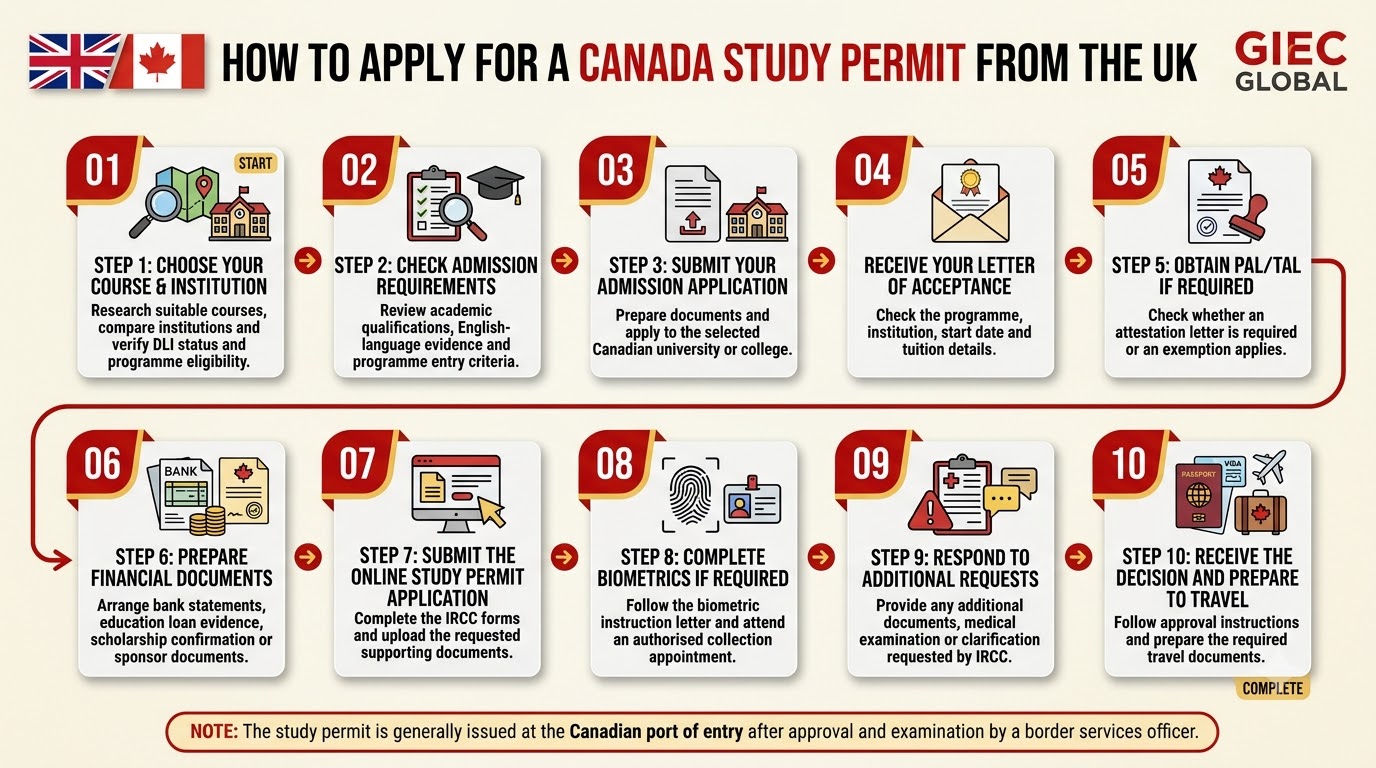
The application process should be planned carefully. A student should not make a decision based only on an offer letter or an advertised course fee. Institution eligibility, programme suitability, financial evidence and immigration requirements all need to be considered.
Start by identifying courses that match your previous education and future objectives. Compare entry requirements, course duration, tuition fees, teaching structure, location and available student support.
Check that the institution is a DLI and confirm whether the exact programme is eligible for a PGWP if that is relevant to your plans. You can explore available institutions through GIEC Global’s universities in Canada guide.
Each institution sets its own admission criteria. Requirements may include academic transcripts, certificates, English-language evidence, a personal statement, references, a portfolio or professional experience.
UK qualifications may be considered by Canadian institutions, but acceptance and equivalency are determined by the institution. Do not assume that every UK qualification automatically meets the entry requirements of every Canadian programme.
Prepare the documents requested by the institution and submit the admission application through its official process. Make sure names, dates, academic records and other details are consistent across your documents.
If you receive a conditional offer, understand which conditions must be met before the institution can issue the final Letter of Acceptance. Check deposit deadlines, refund rules and any requirements for confirming your place.
Once the institution has accepted you and you have met the required conditions, it will provide a Letter of Acceptance. Review the programme name, start date, tuition information and institution details carefully.
Post-secondary institutions are subject to IRCC’s LOA verification process. If the institution cannot validate the letter as required, it may affect the study permit application.
Check whether your application requires a provincial or territorial attestation letter. If you need one, follow the relevant process and ensure that the document is valid for your application. If you qualify for an exemption, check the official rules and prepare any evidence needed to demonstrate that exemption.
Calculate the total cost of your first year, including tuition, living expenses and travel. Prepare bank statements, loan evidence, scholarship documents or sponsor evidence as appropriate.
Your financial documents should show that the funds are genuinely available to you. Avoid relying on possible part-time earnings in Canada to meet the minimum proof-of-funds requirement.
Most applicants apply online through the IRCC system. Complete the application accurately and upload the documents requested by the system. Answer every question truthfully and review the information before submitting it.
Where relevant, include a clear study plan explaining the connection between your academic history, chosen programme and future objectives. Follow the official study permit application instructions.
After submission, you may receive a biometric instruction letter. If you are required to provide fingerprints and a photograph, follow the instructions and attend an authorised collection appointment within the specified period.
IRCC may request further documents, an interview, a medical examination or clarification. Monitor your account and respond within the deadline provided. An incomplete response or missed deadline may affect the application.
If your application is approved, follow the instructions in the approval correspondence. Depending on your circumstances, you may receive a letter of introduction and the relevant travel authorisation, such as an eTA or visa, where required.
The study permit itself is generally issued when you arrive in Canada and present the required documents to the border services officer. Approval does not remove the need to meet entry requirements when travelling.
Ontario is one of Canada’s major education destinations and offers a diverse selection of universities, colleges and specialist institutions. Students considering study visa experts in Ontario should look beyond general university rankings and compare the course, campus, fees, admission requirements and career relevance of each option.
Ontario may be suitable for students interested in business, technology, engineering, healthcare, finance, research, arts and other academic areas. The province includes large metropolitan centres as well as smaller cities with different campus environments and living costs.
These locations have different tuition fees, accommodation costs and transport arrangements. Students should compare the total cost of studying in each city rather than assuming that all Ontario locations have similar expenses.
When comparing institutions, review the following points:
Students can also review GIEC Global’s information about Ontario Provincial Nominee Program options if they want to understand the province’s separate immigration pathways. However, a study permit and a provincial nomination are different processes. Studying in Ontario does not automatically lead to permanent residence or a provincial nomination.
Searches for “study visa experts in Ontario” and “Canada student visa consultant Ontario” often come from students who want help understanding admission and immigration requirements. Choosing a consultant should involve more than comparing advertising claims or service fees.
A suitable education adviser should explain the admission process, help you compare programmes and make sure you understand the documents required by the institution. If immigration advice is being provided, you should also establish whether the person giving that advice is legally authorised to do so under Canadian rules.
An education consultant should be able to explain differences between universities, colleges, public institutions and private institutions. They should help you compare programmes based on academic suitability rather than recommending a course simply because an institution has an available intake.
Ask how the consultant will help with applications, document preparation, offer letters, tuition deposits and communication with institutions. You should understand which services are included and which services may involve separate charges.
A consultant should distinguish between admission requirements and immigration requirements. An institution can offer admission, but IRCC makes the study permit decision. No education consultant can guarantee that a permit will be approved.
If you intend to work in Canada after graduation, ask for the exact programme’s current PGWP position before paying a deposit. The institution’s DLI status alone is not enough to establish that every course is PGWP-eligible.
Request a written explanation of the service fee, payment stages, refund policy and responsibilities. Be cautious about claims of guaranteed admission, guaranteed visas, guaranteed jobs or guaranteed permanent residence.
Canadian immigration advice and representation are regulated. Where a person provides paid Canadian immigration advice or representation, check whether they are authorised under the applicable rules. This may include a member in good standing of the College of Immigration and Citizenship Consultants (CICC), a Canadian lawyer or Quebec notary who is a member in good standing of the relevant law society or professional body, or another person who is legally exempt.
You can verify the relevant professional status through the appropriate regulator. An education consultancy’s experience with university applications should not be treated as proof that every member of its team is authorised to provide Canadian immigration representation.
GIEC Global UK supports students who are exploring overseas education options and need guidance with course selection, institution research and admission preparation. Students considering Canada can discuss their academic background, preferred subject, study budget and intended intake with the team.
Our education guidance is intended to help applicants make informed decisions about their study options. The support required will depend on the student’s profile, chosen institution and stage of the application process.
Choosing the right course is an important part of the planning process. Students can compare institutions, course content, entry requirements, tuition fees and available intakes before deciding where to apply.
Applicants may need help understanding university application requirements, preparing academic documents and responding to institution requests. Guidance can help students organise their application and identify missing information before submission.
Students should prepare academic records, identity documents, financial evidence and other supporting information carefully. The documents required will depend on the institution and the immigration application. All information must be accurate and genuine.
Applicants should understand the study permit checklist, financial requirements, PAL/TAL rules and application stages. Immigration advice or representation, where required, should be provided only by an appropriately authorised professional. IRCC remains responsible for assessing and deciding study permit applications.
Once a student has received the necessary approval, practical preparation becomes important. Students should understand their travel documents, accommodation arrangements, tuition payment schedule, insurance requirements and the conditions attached to their stay in Canada.
To discuss your education options, visit the GIEC Global UK contact page.
Eligible international students may work while studying in Canada, subject to the conditions of their study permit and the rules in force. This can help students gain work experience, but employment should not be treated as a guaranteed source of income or as a substitute for the funds required for a study permit application.
Eligible students may work up to 24 hours per week off campus during regular academic sessions. Students must meet the applicable conditions, including the requirements relating to their study permit and full-time enrolment in an eligible programme.
Eligible students may work unlimited hours during scheduled breaks, such as a regular summer or winter holiday, provided they meet the applicable requirements. The break must be a scheduled break in the academic calendar and not simply a period when the student has chosen not to attend classes.
Read the official IRCC guidance on working off campus for the current eligibility conditions.
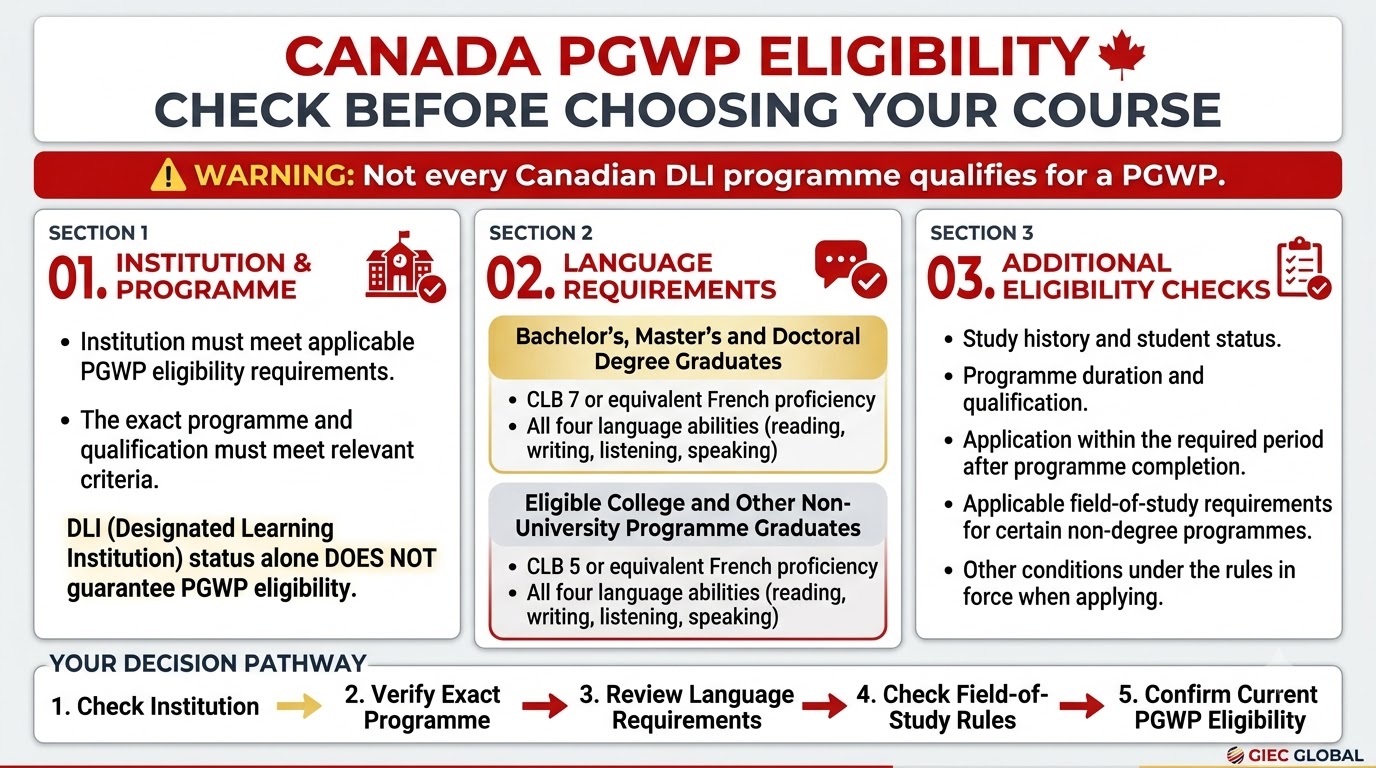
The Post-Graduation Work Permit is an important consideration for students comparing Canadian institutions. It may allow eligible graduates to gain work experience in Canada after completing their studies. However, not every institution or programme qualifies.
PGWP eligibility depends on several factors, including the institution, programme, course length, study history and applicable language or field-of-study requirements. Rules can change, so students should check the official criteria for their intended programme before accepting an offer.
Under the current framework, graduates of bachelor’s, master’s and doctoral degree programmes generally need to demonstrate language proficiency at Canadian Language Benchmark (CLB) level 7 or the equivalent in French across all four language abilities.
Graduates of eligible college or other non-university programmes generally need to demonstrate CLB 5 or the equivalent in French across all four language abilities. Other programme categories may have their own requirements. Applicants should check the exact rule that applies to their qualification.
Some graduates of non-degree programmes must complete an eligible field of study to qualify for a PGWP. This requirement depends on the type of programme and the date of the study permit application. It is therefore important to check the current field-of-study list and the rules relevant to your application.
Students should not rely on an institution’s general statement that it is PGWP-eligible. Confirm the exact campus, programme and qualification. You can read the official PGWP eligibility requirements and the separate field-of-study requirements.
The length of a PGWP depends on the qualification and the applicable immigration rules. It is not correct to assume that every graduate receives a three-year work permit.
For eligible programmes, the permit length may be linked to the duration of the completed programme. Certain master’s degree graduates may qualify for a longer permit under the applicable rules, even where the programme is shorter than two years. Other qualifications have different conditions.
Passport validity can also affect the period issued. A PGWP cannot be treated as a guaranteed outcome of studying in Canada. Students should review the official eligibility rules and make their course decision with a clear understanding of the limitations.
Some international students may be able to include eligible family members in their plans to travel to Canada. However, the immigration status and work rights available to a spouse or partner depend on the current rules and the student’s programme.
Spousal open work permit eligibility is restricted to specified categories of international students. It should not be assumed that the spouse of every student can obtain an open work permit. Check the current IRCC eligibility criteria before making financial or travel arrangements.
Family members may also need to provide identity documents, relationship evidence, financial information and other supporting documents, depending on the application type.
The total cost of studying in Canada depends on the institution, programme, city, accommodation type and personal spending habits. There is no single tuition figure that applies to every international student.
Before accepting an offer, prepare a realistic budget that covers the full first-year cost. Consider tuition, accommodation, food, local transport, study materials, health coverage where required, travel and other personal expenses.
Students comparing Ontario institutions should calculate the cost of living in the specific city. Accommodation and transport costs can vary significantly between Toronto, Ottawa, Waterloo, Hamilton, London and other locations.
Canadian institutions offer different admission periods, and the available intakes depend on the university, college and programme. September is a common starting period for many courses, while January and May intakes are available for selected programmes.
There is no single application deadline for all Canadian institutions. Some programmes close earlier because of limited places, competitive admission or additional document requirements. International students should check the institution’s own application calendar.
| Planning Stage | Suggested Action |
|---|---|
| 8–12 months before the intended intake | Research courses, compare institutions and check entry requirements. |
| 6–9 months before the intended intake | Prepare academic documents, English-language evidence and submit applications where appropriate. |
| 4–6 months before the intended intake | Review offers, compare fees, confirm the programme and follow the institution’s deposit process. |
| After receiving the required admission documents | Check PAL/TAL requirements, prepare financial evidence and organise the study permit application. |
| Before travelling | Follow the immigration decision instructions and prepare accommodation, travel and arrival documents. |
This is a planning guide, not a fixed processing schedule. Start earlier if your programme has competitive admission, portfolio requirements, additional tests or limited places.
Even when an applicant has a suitable academic profile, mistakes in course selection, financial evidence or application preparation can create difficulties. A careful review before submission can help identify avoidable problems.
A course should make sense in relation to your academic background and future objectives. If you are changing subjects or applying for a qualification at a different academic level, explain the reason clearly and provide supporting information where appropriate.
DLI status and PGWP eligibility are not the same. Check the exact programme and campus against the current rules. This is particularly important when comparing private institutions, college programmes and public-private partnership arrangements.
Bank statements alone may not explain the source of funds or demonstrate that the money is genuinely available. If a parent or another sponsor is funding your studies, provide the requested relationship and financial evidence.
Some applicants overlook the attestation letter requirement or assume that an exemption applies to them. Check the rules for your programme and institution before submitting the study permit application.
Work rights are subject to eligibility conditions and hourly limits during academic sessions. A student should not depend on finding a job after arrival to satisfy the initial financial requirement.
Never submit altered bank statements, false academic records, invented employment details or misleading information. Inaccurate information can result in refusal and may have further immigration consequences.
Admission, PAL/TAL arrangements, financial preparation and study permit processing all take time. Apply early enough to manage document requests and unexpected delays. Check IRCC’s live application processing time tool rather than relying on a fixed processing estimate.
Study permit processing times can change and may vary according to the country from which the application is made, application volume, completeness of documents and whether additional checks are required.
There is no reliable universal processing period that applies to every UK-based applicant. Students should use IRCC’s official processing-time tool and check it again during the application process.
Submitting a complete application and responding promptly to requests can help avoid delays caused by missing information. However, no consultant can guarantee a decision date or approval outcome.
Use the following checklist to review the main stages before submitting your application.
| Requirement | What to Check |
|---|---|
| Course selection | The programme matches your academic background and study objectives. |
| Institution | The institution is listed as a DLI. |
| Programme eligibility | Check the exact course’s PGWP position if post-study work is important to you. |
| Letter of Acceptance | The LOA contains accurate programme and institution details. |
| PAL/TAL | Obtain the attestation letter if required or confirm that an exemption applies. |
| Financial evidence | Funds cover tuition, living expenses and transportation. |
| Study plan | Your course choice and academic progression are explained clearly. |
| Application forms | All answers and supporting information are accurate and consistent. |
| Biometrics | Check whether biometrics are required and follow the instruction letter. |
| Travel documents | Follow the approval instructions and confirm the required entry document. |
Students searching for Canada education consultants, Canada study abroad consultants or a consultancy for study in Canada should compare the service being offered with their actual needs. Some students may need help identifying suitable universities, while others may already have an offer and need guidance with the next steps.
Before appointing a consultant, ask for a clear explanation of the services, fees, timelines and responsibilities. You should know whether the service covers course research, admission applications, document organisation, study permit preparation or pre-departure support.
A responsible consultant should explain both the opportunities and limitations of a study plan. Be cautious of anyone promising guaranteed admission, guaranteed visa approval, guaranteed employment or guaranteed permanent residence.
Some students who study in Canada later explore employment or immigration options. These are separate processes, and eligibility depends on the relevant programme, work experience, qualifications and immigration criteria at the time of application.
For general information, you can explore the following GIEC Global resources:
These resources cover separate immigration and employment topics. Completing a Canadian study programme does not automatically make a person eligible for permanent residence, Express Entry or a work permit.
Studying in Canada requires careful planning, from selecting the right institution to preparing a complete study permit application. Students should compare courses based on academic relevance, institution status, tuition fees, living costs and future opportunities. Those considering Ontario should also compare individual cities and programmes rather than choosing a location based only on popularity.
Before paying a deposit, confirm that the institution is a DLI, check the exact programme’s PGWP eligibility if relevant, understand whether you need a PAL/TAL and prepare a realistic financial plan. Keep in mind that study permit rules, financial thresholds and work conditions can change, so always use the latest IRCC guidance.
GIEC Global UK can help students explore Canadian education options and understand the admission preparation process. If you are planning to study in Canada from UK, you can discuss your academic background, preferred course and intended intake with the team to understand the next steps.
Explore your options with GIEC Global UK: Contact our team to discuss Canadian university and college admission guidance.
Requirements vary by course and institution. Check the official guidance.
Study permit conditions decide this. Check the official source.
University and college options across Toronto, Ottawa, Waterloo and London ON.
Ontario
We confirm post-study work eligibility before you accept an offer.
Career
Clear evidence and a study plan that fits your profile.
Visa
Express Entry and PNP options explained early.
Future
Check PGWP eligibility before you accept.
Apply for admission and accept your offer.
Usually arranged by your institution.
Bank statements, GIC, loans or scholarships.
Upload documents and pay CAD 150 + CAD 85.
At a visa application centre by the deadline.
Show your port of entry letter at the border.
| Study permit | CAD 150 |
|---|---|
| Biometrics | CAD 85 |
| Living funds (1 person) | CAD 23,448 |
| Living funds (2 people) | CAD 29,192 |
| Living funds (3 people) | CAD 35,888 |
| Official source | canada.ca (IRCC), reviewed 31 October 2026 |
Fees change. Check the official source before you pay.
Requirements vary by course and institution. Check the official guidance.
Study permit conditions decide this. Check the official source.
Last updated 6 November 2026. Immigration rules change, so always confirm with the official source.
Free consultation
Tell us your goals and we will explain courses, colleges and the student visa process.
Thank you! Your enquiry has been received. A GIEC adviser will contact you shortly.
Thank you! Your enquiry has been received. A GIEC adviser will contact you shortly.
Thank you! Your enquiry has been received. A GIEC adviser will contact you shortly.