
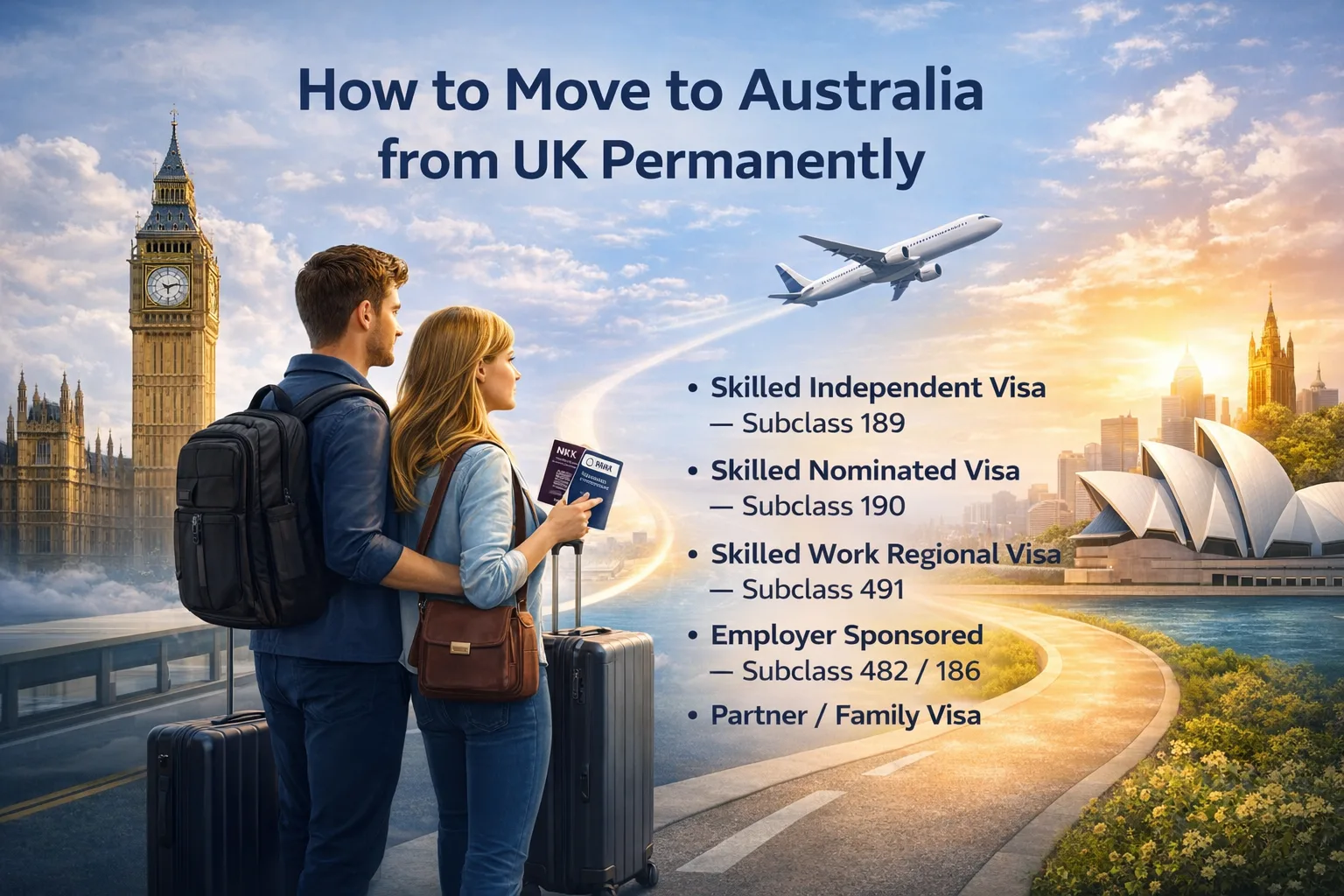
How to Move to Australia from UK Permanently
How to Move to Australia from the UK Permanently
Moving to Australia from the UK permanently can be an exciting opportunity to build a new life, advance your career and enjoy a different lifestyle. However, understanding Australian immigration rules, choosing the right visa pathway and preparing accurate documents are essential steps before making the move.
If you are planning to move to Australia from the UK permanently, your eligibility will depend on factors such as your occupation, qualifications, work experience, age, English language ability, family circumstances and whether an Australian employer or state government can support your application. Visa requirements, invitation rounds and processing times can change, so it is important to check the latest rules before applying.
There are several pathways that may allow British citizens and other eligible UK residents to settle in Australia. These include skilled migration visas, employer-sponsored pathways and partner or family visas. The best option depends on your individual circumstances, and not every applicant will qualify for every visa.
Main Visa Pathways to Move to Australia Permanently
1. Skilled Independent Visa (Subclass 189)
The Skilled Independent visa (subclass 189) is a points-tested permanent visa for eligible skilled workers who do not require state or employer nomination under this pathway. Applicants generally need an eligible occupation, a suitable skills assessment, the required English ability and sufficient points to receive an invitation.
Submitting an Expression of Interest (EOI) does not guarantee an invitation. Invitation outcomes depend on factors including occupation, ranking and the requirements of the relevant invitation round.
2. Skilled Nominated Visa (Subclass 190)
The Skilled Nominated visa (subclass 190) is a permanent residency pathway for eligible skilled workers nominated by an Australian state or territory. In addition to meeting the visa criteria, applicants must satisfy the relevant nomination requirements.
Each state or territory can have its own occupation priorities and selection criteria. If you are applying from the UK, research the nomination requirements of the state where you intend to live and work.
3. Skilled Work Regional Visa (Subclass 491)
The Skilled Work Regional visa (subclass 491) is a provisional visa for eligible skilled workers who receive qualifying state or territory nomination or family sponsorship. It allows eligible holders to live and work in designated regional areas, subject to visa conditions.
This is not a permanent visa at the time of grant. Eligible holders may be able to apply for permanent residence through the relevant pathway if they meet the applicable requirements.
4. Employer-Sponsored Visas (Subclass 482 and 186)
Employer sponsorship may be an option if an Australian employer is willing and eligible to sponsor you for an appropriate role.
The Skills in Demand visa (subclass 482) is a temporary work visa, whereas the Employer Nomination Scheme visa (subclass 186) is a permanent visa for eligible applicants. Depending on the circumstances, subclass 482 employment may be relevant to a later permanent residency pathway, but moving from one visa to another is not automatic.
Before pursuing employer sponsorship, check the occupation requirements, sponsorship arrangements, qualifications, experience and other criteria relevant to your chosen pathway.
5. Partner and Family Visas
Partner and certain family visa pathways may be available if you have an eligible Australian citizen, permanent resident or other qualifying family sponsor. Eligibility depends on the specific visa category and the relationship or family circumstances.
For partner visas, applicants generally need to provide evidence that their relationship meets the applicable requirements. Having a relative in Australia does not automatically make someone eligible for permanent residency.
Can British Citizens Keep Their UK Citizenship After Moving to Australia?
Yes. The UK and Australia both allow dual citizenship, so eligible people who eventually become Australian citizens can generally retain their British citizenship. However, obtaining an Australian visa or permanent residency does not automatically make someone an Australian citizen.
Permanent residency, temporary visa status and citizenship have different rights and requirements. Check the official government guidance to understand the pathway that applies to your circumstances.
How to Start Planning Your Move
Before applying, assess your occupation, qualifications, work experience, English language ability and likely visa options. Check the current eligibility criteria, gather supporting documents and review any skills assessment or nomination requirements that apply to your chosen pathway.
A carefully planned application can help you understand your options and avoid preventable mistakes. However, no visa pathway guarantees approval, and you should verify current requirements before paying application fees or making major relocation decisions.
Can British Citizens Move to Australia Permanently?
Yes, British citizens can move to Australia permanently if they qualify for an eligible visa. The right strategy starts with choosing a suitable immigration pathway, checking the latest eligibility criteria and preparing a well-supported application.
Skilled migration is one potential pathway to Australian permanent residency for eligible UK professionals. Nurses, engineers, teachers and IT professionals may have options depending on their nominated occupation, qualifications, work experience, skills assessment and the visa requirements in force at the time of application. However, working in an occupation that is in demand does not guarantee an invitation or visa approval.
British applicants may benefit from their English-language ability and qualifications gained in the UK. However, English points depend on meeting the applicable evidence and test requirements, while overseas qualifications must be assessed where required by the relevant Australian assessing authority.
With careful planning and an understanding of the available visa options, British citizens can identify a pathway that fits their circumstances and work towards their goal of living permanently in Australia.
What Is Aus PR — and What Does It Actually Give You?
Australian permanent residency (PR) allows eligible visa holders to live in Australia indefinitely, work and study, and access certain government services. However, permanent residents do not have exactly the same rights as Australian citizens, and some benefits depend on individual circumstances.
Here is what Australian permanent residency can mean for British citizens planning to settle in Australia:
Live and work in Australia: Permanent residents can generally live and work anywhere in Australia without the restrictions associated with many temporary work visas.
Access Medicare: Eligible permanent residents living in Australia can enrol in Medicare, Australia’s public healthcare system.
Sponsor eligible family members: You may be able to sponsor qualifying relatives for a visa, subject to the relevant sponsorship and visa requirements.
Education for children: Children may have access to public schooling and subsidised education, depending on the applicable state or territory rules and eligibility criteria.
Travel outside Australia: The travel facility attached to a first permanent visa is usually valid for five years. After it expires, you may need a Resident Return visa to re-enter Australia as a permanent resident.
Apply for Australian citizenship: You may become eligible to apply for citizenship after meeting the residence and other legal requirements. The general residence rule includes four years living in Australia on a valid visa immediately before applying, including at least the final 12 months as a permanent resident, with limits on time spent overseas.
Permanent residency is a significant step towards settling in Australia, but it is important to understand the differences between PR and citizenship before planning your move.
Dual Citizenship: You May Keep Your British Citizenship
The UK and Australia generally permit dual citizenship. This means eligible British citizens who later become Australian citizens can usually retain their British citizenship and hold both passports.
However, obtaining Australian permanent residency does not automatically grant Australian citizenship or an Australian passport. You must first meet the applicable citizenship requirements and complete the citizenship process.
For British citizens planning to move to Australia permanently, understanding these differences can help with long-term planning for work, family, travel and settlement.
The Main Visa Routes to Australia PR from UK
There is no single route to Australian permanent residency (PR) that suits everyone. The right option depends on your occupation, age, qualifications, work experience, English language ability and personal circumstances.
Before choosing a visa, use the Australia PR Points Calculator to estimate your points score. Remember that meeting the minimum points threshold does not guarantee an invitation or visa approval. Here is an overview of the main pathways for British citizens planning to move to Australia permanently.
1. Skilled Independent Visa (Subclass 189)
The Skilled Independent visa (subclass 189) is a permanent, points-tested visa for eligible skilled workers. It does not require state or territory nomination or employer sponsorship. If granted, it allows you to live and work in Australia permanently, subject to the applicable rules.
Applicants generally need an eligible occupation, a suitable skills assessment, the required English language ability and an invitation to apply. Although a job offer is not generally required for this points-tested pathway, receiving an invitation depends on your eligibility and ranking in the relevant invitation round.
2. Skilled Nominated Visa (Subclass 190)
The Skilled Nominated visa (subclass 190) is a permanent visa for eligible skilled workers nominated by an Australian state or territory. State nomination can add 5 points to your score under the points test.
Each state and territory sets its own nomination priorities and criteria. You should review the requirements for your occupation and be prepared to demonstrate a genuine intention to live and work in the nominating state or territory. The exact commitments and expectations vary by jurisdiction.
3. Skilled Work Regional Visa (Subclass 491)
The Skilled Work Regional visa (subclass 491) is a provisional visa for eligible skilled workers nominated by a state or territory, or sponsored by an eligible family member, under the relevant regional pathway. Eligible applicants receive 15 additional points for qualifying nomination or sponsorship.
This is not an immediate permanent residency visa. Holders may be eligible to apply for the Permanent Residence (Skilled Regional) visa (subclass 191) after holding an eligible visa for at least three years and meeting the applicable requirements. The subclass 191 pathway currently does not have a minimum income requirement, although applicants must provide the required Australian Taxation Office notices of assessment and meet other visa conditions.
4. Employer-Sponsored Visas (Subclass 482 and 186)
If an Australian employer is willing and eligible to sponsor you, employer-sponsored migration may be worth exploring, particularly if a points-tested pathway is not suitable.
The Skills in Demand visa (subclass 482) is a temporary work visa. Eligible holders may later apply for permanent residency through the Employer Nomination Scheme visa (subclass 186), provided they meet the relevant requirements and have the necessary employer nomination.
The subclass 186 visa has different pathways, including the Temporary Residence Transition and Direct Entry streams. For example, applicants using the Temporary Residence Transition stream generally need at least two years of eligible sponsored employment, along with the other applicable criteria. A subclass 482 visa does not automatically convert into permanent residency.
These pathways may be relevant to eligible professionals in healthcare, engineering, information technology, trades and other occupations, depending on the occupation rules, employer requirements and current visa criteria.
5. Partner and Family Visas
If your spouse or de facto partner is an Australian citizen, Australian permanent resident or eligible New Zealand citizen, you may be able to apply through a partner visa pathway. Applicants must provide evidence that their relationship meets the relevant requirements.
For applicants applying from outside Australia, the partner visa process commonly involves subclasses 309 and 100. For eligible applicants applying in Australia, subclasses 820 and 801 may apply. The temporary and permanent stages are generally assessed separately, and the permanent stage is usually considered two years after the combined application was lodged, subject to the applicable rules.
Other family visa options may be available in specific circumstances. Having a family member in Australia does not, by itself, guarantee eligibility for a visa.
Which Australian PR Pathway Should You Choose?
The most suitable route depends on your profile. Skilled independent migration may suit eligible applicants with competitive points, state nomination may provide another option, and employer sponsorship or partner migration may be more appropriate for others.
Compare the eligibility criteria, occupation requirements, costs and processing information before deciding. Immigration rules can change, so verify the latest official requirements before lodging an application.
Best Cities in Australia
for UK Migrants
Where you settle matters as much as the visa you choose. Here's an honest, city-by-city breakdown — costs in GBP, job markets, and what each city genuinely feels like for a British migrant.
| City | Best For | Avg. Rent (1-bed) | UK Vibe |
|---|---|---|---|
| 🌉 Sydney New South Wales | Finance, tech, media; iconic lifestyle | £1,400 – £2,000 per month | 🌐 Cosmopolitan |
| ☕ Melbourne Victoria | Arts, culture, coffee scene; varied industries | £1,100 – £1,700 per month | 🏙️ European feel |
| 🌞 Perth Western Australia | Mining, engineering, healthcare; largest UK expat community | £900 – £1,400 per month | 🇬🇧 Most British |
| 🌿 Brisbane Queensland | Outdoor lifestyle, growing tech; popular with families | £1,000 – £1,500 per month | 🌱 Relaxed & growing |
| 🍷 Adelaide South Australia | Affordable lifestyle, great for families; accessible state nomination | £800 – £1,200 per month | 💰 Best value |
Perth has the highest concentration of UK-born residents of any Australian city and often feels most familiar to British migrants — many describe it as the easiest cultural transition of any city on this list.
Adelaide is increasingly popular for its affordability and quality of life — and South Australia's state nomination program has been relatively accessible for a range of occupations, making it a smart strategic choice as well as a genuinely great place to live.
UK Departure Checklist
Moving to Australia permanently involves more than choosing a visa and booking your flight. There are several UK administrative tasks you should handle before leaving, particularly if you have a UK pension, student loan, property or financial accounts.
Use this checklist to prepare for your move and reduce the risk of missing important obligations.
1. Notify HMRC About Your Move
If you are leaving the UK to live abroad permanently, you should notify HM Revenue and Customs (HMRC). Depending on your circumstances, you may need to complete form P85. If you normally submit a Self Assessment tax return, you will generally report your departure through the relevant residence section instead.
Moving abroad does not automatically end every UK tax obligation. Your tax residence, UK income, property ownership and other circumstances can affect what you owe. Check the official guidance or consult a qualified tax adviser before you leave.
2. Check Your UK State Pension
If you have built up UK National Insurance contributions, you may be entitled to a UK State Pension when you reach State Pension age, subject to the eligibility rules.
However, the UK State Pension is generally not increased annually for people living in Australia. This means the amount you receive may remain frozen while you live there. Contact the International Pension Centre to understand your entitlement, payment arrangements and the effect of moving overseas.
3. Plan Your Healthcare Transition
Before leaving the UK, arrange continuity of care for any ongoing medical needs. Ask your GP or other healthcare providers how to obtain copies of your medical records and prescriptions, and check what arrangements you need to make when leaving their services.
After arriving in Australia, check your eligibility for Medicare and enrol through Services Australia if you qualify. You will generally need to be living in Australia and provide the required identity and visa documents. Do not assume Medicare covers every healthcare service or expense.
4. Inform the Student Loans Company
If you have an outstanding UK student loan and will live overseas for more than three months, you must tell the Student Loans Company (SLC) and update your employment details.
You may need to provide evidence of your income in Australia. Overseas repayment thresholds and requirements can differ from those in the UK, and failing to provide the requested information may result in arrears. Check the repayment rules for your specific loan plan before moving.
5. Speak to Your UK Bank
Contact your UK bank before relocating and explain that you intend to become an overseas resident. Ask whether you can keep your current account, what address and tax-residency details need updating, and whether any services will be restricted.
Keeping an account may be useful for receiving outstanding UK payments or managing existing financial commitments, but account policies vary. Also consider setting up an Australian bank account and keeping secure access to both accounts during the transition.
6. Check Australian Driving Licence Requirements
If you intend to drive after moving to Australia, check the licence-transfer rules for the state or territory where you plan to live. Deadlines and testing requirements differ by location and may depend on your visa or residency status and the licence you hold.
For example, eligible permanent residents in New South Wales generally have three months to transfer an overseas licence, while Victoria generally requires eligible new residents to convert their licence after six months. Check the relevant local licensing authority for the rules that apply to you.
7. Review UK Property and Tax Obligations
If you own property in the UK, get professional advice before deciding whether to rent it out or sell it. Rental income may remain subject to UK tax, and non-resident landlord rules may apply. Selling property can also create capital gains tax obligations, depending on your circumstances.
Keep records of rental income, expenses, purchase costs and any sale documents. Your move may affect your tax position, so do not assume that becoming non-UK resident removes every UK property-related liability.
8. Plan Your GBP-to-AUD Currency Transfer
If you need to transfer savings from pounds sterling (GBP) to Australian dollars (AUD), compare exchange rates, transfer
Should You Use an Australia PR Agent?
Choosing the Right Australian Migration Agent
Australian immigration rules can be complex and change over time. A qualified migration professional can help you understand the visa options available to you, assess your eligibility, prepare supporting documents and navigate the application process.
For British citizens planning to apply for Australian permanent residency, professional guidance may be particularly helpful when comparing skilled migration visas, state nomination requirements and employer-sponsored pathways. An experienced adviser can help you understand how your points score is calculated and identify areas where you may be able to improve your eligibility lawfully. However, no agent can guarantee an invitation or visa approval.
How to Choose an Australian PR Agent
If you decide to use an Australian migration agent, check that they are registered with the Office of the Migration Agents Registration Authority (OMARA). You can verify their registration status and Migration Agent Registration Number (MARN) through the official register.
Before engaging an agent, consider the following:
Verify registration: Check their current status on the official OMARA register.
Review relevant experience: Ask about their experience with your intended visa subclass and occupation.
Understand the fees: Request a written agreement outlining professional fees, services and any additional costs.
Check communication and support: Make sure you understand who will manage your application and how updates will be provided.
Avoid guaranteed outcomes: Be cautious of anyone promising guaranteed visas, invitations or unusually fast processing.
Using a registered migration agent is not compulsory for every visa application. Australian legal practitioners and certain exempt people may also be authorised to provide immigration assistance under the relevant rules. If you choose professional help, verify the person’s authority and credentials before paying for services.
For official verification, visit the OMARA Register of Migration Agents.
Meet Australia PR Consultant
At GIEC Global UK, we help skilled professionals, including engineers, explore Australian immigration pathways based on their qualifications, work experience and individual circumstances. From an initial profile assessment to document preparation and application support, our team can guide you through the key stages of your Australian permanent residency journey.
Choosing the right visa pathway and preparing an accurate application can help you avoid common mistakes and understand the requirements before applying. While eligibility and outcomes depend on your individual profile and current immigration rules, professional guidance can help you make informed decisions.
Planning to move to Australia from the UK permanently?
Book a consultation with GIEC Global UK to discuss your eligibility, potential visa options, estimated timelines and the next steps for your profile.
Take the first step towards your Australian PR goal today.

Suman Prem
Registered Migration Agent specializing in Australian immigration law. Providing expert guidance for visa applications, permanent residency, and citizenship matters.
 MARN Certified
 MARA Registered
Book Your Consultation
Fill out the form below and we'll get back to you shortly.
Thank You!
Your consultation request has been submitted successfully. We'll contact you soon.
Apply for Australia PR
FAQs
Yes – via skilled independent (189) or state-nominated (190/491) visas if you score enough points.
It’s competitive but realistic if you have in-demand skills and meet points. Many Brits succeed every year.
Under 45 for most skilled visas. WHV has its own age rules (usually under 35 for Brits).
From starting your skills assessment to receiving your visa grant, the process typically takes 12 to 36 months. The most variable part is waiting for an Invitation to Apply — which can be quick for high-demand occupations or lengthy for oversubscribed fields. The best thing you can do is start your skills assessment and English test as early as possible.
You can legally apply without one. But given the non-refundable visa fees, the documentation complexity, and the impact of errors on future applications, most people benefit significantly from using a MARA-registered Australia PR agent.
It depends on your job, budget, and lifestyle preferences. Perth has the most established British expat community and often feels most familiar to UK migrants. Adelaide is the most affordable capital city with excellent quality of life. Brisbane is popular with young families. Sydney and Melbourne offer the most career opportunities but at a higher cost of living.
You’ll still receive your UK State Pension at pension age — but there’s an important catch. Australia and the UK do not have a pension uprating agreement, which means your UK pension is likely to be frozen at the rate it was when you first claimed it, rather than increasing each year with inflation. Get independent financial advice on this before you leave.
No. Brexit had no impact on UK-Australia immigration. The process for British nationals applying for Australia PR is governed entirely by Australian law and is identical to what it was before Brexit.
Look for a MARA-registered migration agent — verify their registration at mara.gov.au. Check for independent client reviews (not just testimonials on their own website), ask specifically about their experience with UK applicants in your occupation, and ensure the fee structure is clear and in writing.

Mr. Suman Prem is the Founder and CEO of GIEC Global United Kingdom an international education and migration consultancy. With extensive experience in the education and migration industry, he leads GIEC Global in helping students, professionals, and families explore study abroad, visa, and migration opportunities.
Under his leadership, GIEC Global has expanded its services across multiple international destinations, providing guidance on education admissions, scholarships, student visas, immigration pathways, and related services. His focus is on delivering reliable, transparent, and professional guidance to clients throughout their international journey.