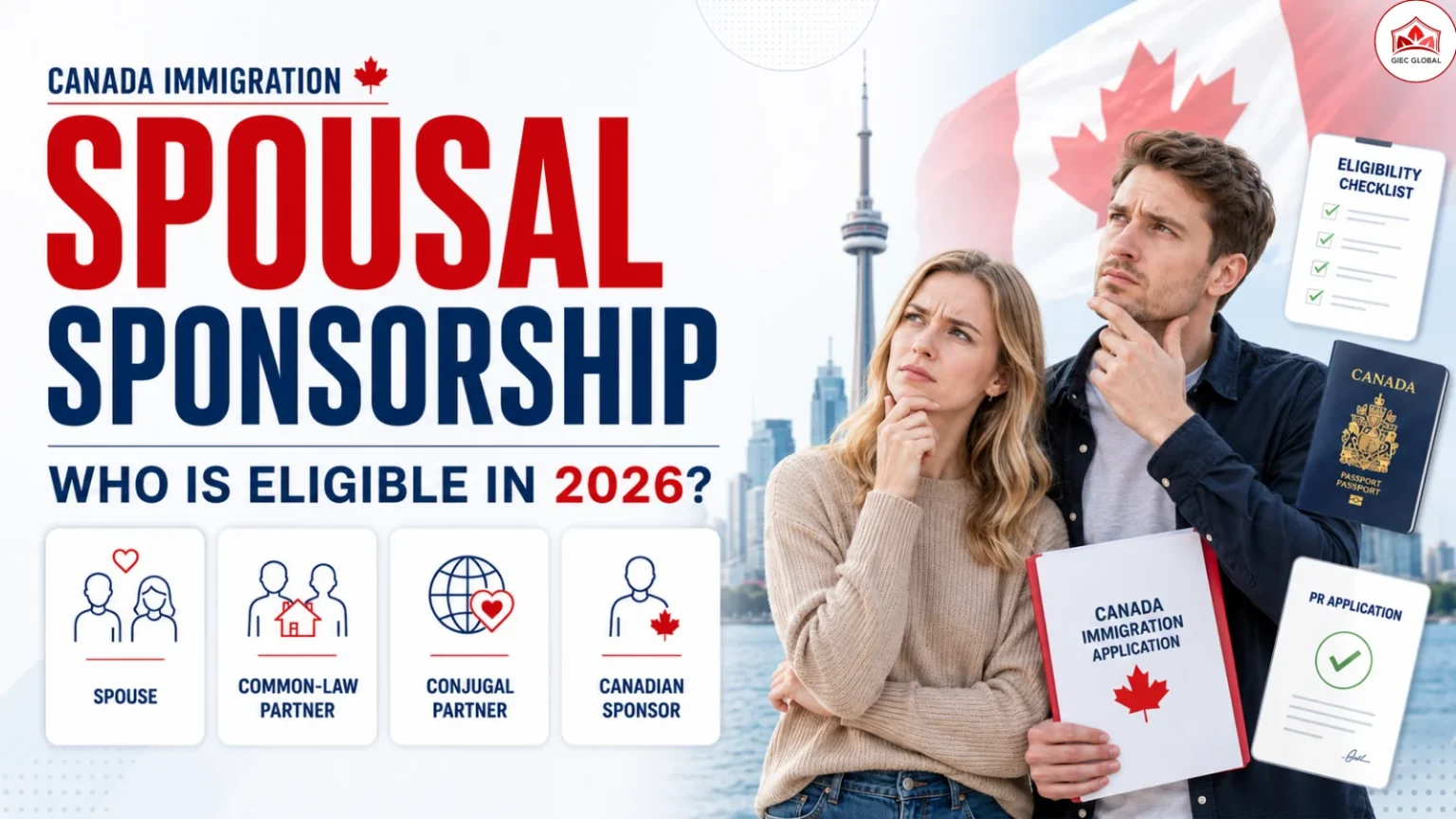
Who Is Eligible for Spousal Sponsorship in Canada 2026?
Are you hoping to reunite with your love, or your partner is already in Canada on a temporary visa? Most likely, spousal sponsorship is the fastest way to have your partner move home for good. It’s what most people are actually looking for when searching for a “Canada spouse visa” – despite not having an actual “spouse visa” the country technically.
That said, you can’t just apply if you love anyone and the sponsor / person applying requirements vary greatly. Before you rush to get your documents ready, it’s time for a plain language overview of who you need to be to be eligible for spousal sponsorship. This article is the perfect primer on the realities of a spousal visa in Canada and what you can expect with respect to documentation.
At GIEC Global UK, you can be confident to have the best advice in immigration, our consultants possess vast knowledge and years of experience in providing success in visa processing to numerous clients.
Don't get caught in the trial and error — allow our GIEC Global UK team to assess your eligbility and guide you step by step on how everything works. Know where your stood before starting.
Check My Eligibility →Who Can Sponsor a Spouse or Partner in Canada?
The spousal sponsorship class isn’t just about being legally married. Canada counts three different kinds of relationships as ‘spousal’; the first stage of deciding whether or not you can come to Canada under this scheme is by identifying exactly where in this bracket you belong.
The first one listed here is the spouse; somebody who you are married to under a valid marriage recognised under Canadian law, no matter where in the world you were married. Secondly, a common-law partner is someone with whom you have lived on a continuous basis in a conjugal partnership for a minimum of 12 months; in essence, someone whom most people in your country of residence can consider a ‘spouse’, albeit just not legally married. An unusual case; a conjugal partner relationship involves two individuals who have been in an intimate relationship for over one year but they live separately due to reasons such as immigration challenges, restrictive laws where they reside or comparable unique reasons.
Regardless of whether your chosen category is a legal spouse, common-law or a conjugal partner, it is first necessary to check whether or not the potential sponsor meets specific criteria with regards to the sponsor, before considering their relationships at all.
Relationship Categories for Canada Spousal Sponsorship
| Relationship Type | What It Means | Minimum Time Together |
|---|---|---|
| Spouse | Legally married, marriage valid under Canadian law | No minimum, but must be legally married |
| Common-law partner | Living together continuously in a conjugal relationship | 12 continuous months |
| Conjugal partner | Committed relationship, unable to live together or marry | 12 months, with proof of the barrier |
Eligibility Requirements for Spousal Sponsorship in Canada
There are eligibility requirements to sponsor your spouse. Just as you, as the sponsor, need to satisfy one set of criteria, the person being sponsored needs to satisfy a different one.
As the sponsor, you will need to…
Be at least 18 years old
Be a Canadian citizen, permanent resident or Indian under the Canadian Indian Act
Reside in Canada, OR be a Canadian citizen living outside the country who declares an intention to reside in Canada upon a permanent residentsponsorshipof the spouse
(The spouse can NOT be a permanent resident living outside of Canada)Be out of prison, undischarged bankrupt or subject to removal
Not have defaulted on any previous sponsorship undertaking, or any immigration loan
Not be in receipt of a social assistance because of reasons not related to the persons’ disabilities
Not be Sponsoring a new spouse if you were previously Sponsored as a spouse or common-law partner during the last 5 years.
As the sponsored person you need…
To be in a relationship, marriage or common-law-conjugal partnership with the Sponsor.
To pass medical, criminal and security examinations.
To not be a inadmissible under any part of Canadian Immigration Law.
With almost all other family sponsor categories but not with spousal sponsorship outside Quebec, there is no income requirement. Evidence that the relationship is genuine is what is key. You should meet sponsor condition.
Documents Required for a Canada Spouse Visa
After determining you qualify, get together a strong package. Delayed documents cause many people to miss loan deadlines, so be prepared by reading the requirements.
| Document | Why It's Needed |
|---|---|
| Passport and identity documents | Confirms identity of both sponsor and applicant |
| Proof of relationship (marriage certificate or proof of cohabitation) | Establishes the relationship category |
| Photos, messages, and shared bills or leases | Shows the relationship is genuine, not just on paper |
| Sponsor's proof of status (citizenship certificate or PR card) | Confirms sponsor is legally eligible to sponsor |
| Police certificates | Required for admissibility screening |
| Medical exam results | Confirms the applicant meets health requirements |
| Completed application forms (IMM forms) | Official paperwork IRCC requires to open the file |
Important Points to Remember
Surprising aspects about the specifics of Canadian Spousal Sponsorship once people learn them:
Canada is NOT accepting “fiancé” visas. The couple needs to be formally married, a common-law or conjugal relationship, before the application can be processed, if engaged but not yet married.
You can be an inland, or outland, sponsorship case. Inland being where the couple is already living together in Canada and the other process being completed through a visa office in another country that can process regardless of whether the applicant is outside, or inside of Canada.
The applicant can get an open work permit while sponsoring, as long as they live together and are already in Canada, once an Acknowledgement of Receipt has been issued by IRCC.
Sponsorship processing averages twelve months for inland applications, while outland applications tend to be a bit longer in terms of processing, it depends entirely on individual circumstances though.
Official government fees for this type of application total almost $1400. This covers application/sponsorship fee, right of permanent residence, as well as biometrics. Costs are separate for police certificates and medical examination.
It does not matter where else of Canada you are sponsoring from – application rules are federal. One exception of Quebec; there’s an extra municipal step and provincial fee to the process there.
The sponsor will be signing an undertaking and agreeing to support their partner, monetarily for twelve to ten years once they become a permanent resident – and be very aware of that obligation.
Frequently Asked Questions
No there is not a specific income requirement to sponsor a spouse (outside of Quebec) of this nature. What you need to show is that you will not be a burden on the social system but there are no set amounts of income that must be demonstrated similar to other sponsorship types.
There is no fianc visa in Canada. Once you are legally married or deemed a common-law or conjugal partner, your spouse or partner is eligible for Family Class sponsorship of immigration. This only works once you get married.
For inland applications it’s now taking about a year and sometimes longer for an outland application. It depends on where you application gets sent to and if everything is submitted at one time, so check the processing times to see if they are on track when you’re planning.
No. To sponsor your spouse or partner you must reside in Canada. Only Canadian citizens residing outside Canada can sponsor.
You will need proof of your relationship, identity, finances and status documents, Police certificates, medical exam, and IRCC forms application. The exact documents depend whether you are sponsoring as husband/wife/common-law or conjugal.
If your spouse is in Canada while your sponsorship application is being processed, your spouse may be eligible for an open work permit if IRCC has approved your application. The other route involves you being an international student. In that case, your spouse could have accompanied you as a dependant and may be eligible for work. This depends on the type of study program you have-check to see that this option is still applicable in your case.

Mr. Suman Prem is the Founder and CEO of GIEC Global United Kingdom an international education and migration consultancy. With extensive experience in the education and migration industry, he leads GIEC Global in helping students, professionals, and families explore study abroad, visa, and migration opportunities.
Under his leadership, GIEC Global has expanded its services across multiple international destinations, providing guidance on education admissions, scholarships, student visas, immigration pathways, and related services. His focus is on delivering reliable, transparent, and professional guidance to clients throughout their international journey.