
Migration · Australia
417 Visa Australia
Check who can apply for the 417 Working Holiday visa, what it costs in 2026, how long you can stay and how UK citizens can reach a second and third year.
Pathway at a glance
Eligibility and documents
- Valid passport From an eligible 417 country
- Age Must meet the age limit on the day you lodge
- Location Outside Australia when you apply and when granted (first visa)
- Proof of funds About A$5,000 plus onward or return fare
- No previous first visa Not held a first 417 or 462 visa before
- No dependent children Children cannot travel on this visa
- Health and character :: Medicals or police certificates if requested
- ImmiAccount :: Required to lodge online
- Payment card :: To pay the visa application charge
Application process
- 1
Step 1
Confirm your passport is on the 417 list and check your age limit
- 2
Step 2
Collect your passport details and proof of funds
- 3
Step 3
Create an ImmiAccount on the Home Affairs website
- 4
Step 4
Complete the 417 application and answer all questions honestly
- 5
Step 5
Pay the A$840 visa application charge
- 6
Step 6
Provide health or biometric information if requested
- 7
Step 7
Receive your decision and note your entry date
- 8
Step 8
Plan your second year, third year or next visa before the first one ends
Costs and fees
| First 417 visa :: A$840 | |
|---|---|
| Second or third 417 visa :: A$1,000 | |
| Proof of funds :: About A$5,000 plus return or onward fare (savings, not a fee) | |
| Medicals and police certificates :: Charged separately if requested | |
| Health or travel insurance :: Strongly recommended, cost varies | |
| Flights and accommodation :: Your own travel costs |
Fees change. Check the official source before you pay.
The 417 visa, officially known as Australia’s Working Holiday visa (subclass 417), allows eligible young adults to travel, live and work in Australia for up to 12 months on each visa. It is particularly popular with British passport holders because UK applicants can apply between the ages of 18 and 35 and may be eligible for up to three separate Working Holiday visas without completing specified regional work.
If you are researching a working holiday visa Australia for UK citizens, understanding the subclass 417 requirements is an important first step. You should know the age limit, application cost, financial requirements, work conditions and rules for applying for a second or third visa before making travel arrangements.
This guide explains the 417 visa in straightforward language, with particular attention to UK passport holders. It also explains the difference between the 417 and 462 visas, so you can understand which Australian Working Holiday visa is relevant to your nationality.
Last reviewed: 3 November 2026. Visa requirements and charges can change. Always check the latest Department of Home Affairs information before applying.
If you are exploring longer-term options as well as a working holiday, visit our Australia migration to learn about other Australian visa pathways.
Quick Answer: What Is the 417 Visa?
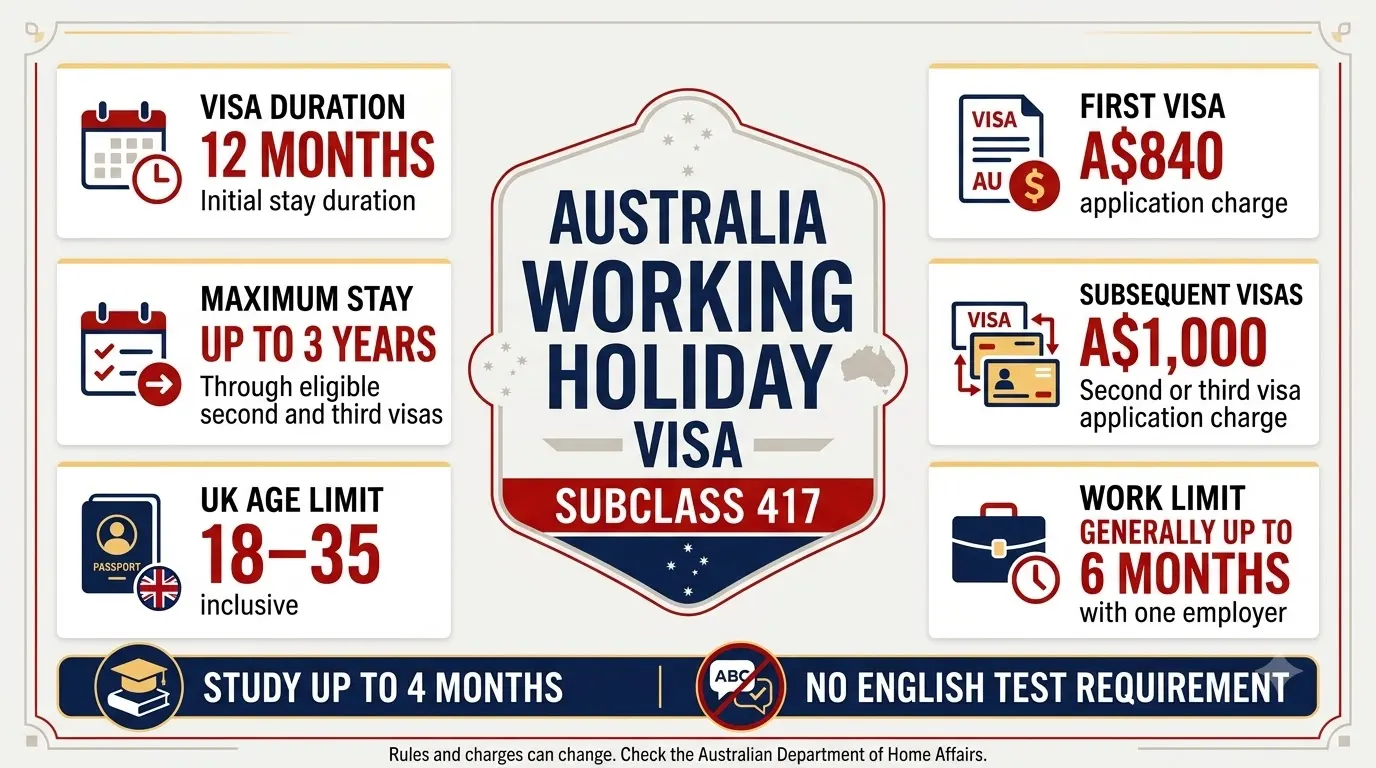
The subclass 417 Working Holiday visa is a temporary Australian visa for eligible passport holders who want to enjoy an extended holiday while working to help fund their stay. The first visa generally allows a stay of up to 12 months.
- Visa name: Working Holiday visa (subclass 417).
- Initial stay: Up to 12 months.
- UK age limit: 18 to 35 years inclusive at the time of application.
- First visa application charge: A$840 from 1 July 2026.
- Second or third visa application charge: A$1,000 from 1 July 2026.
- English test: No general English test requirement for the 417 visa.
- Education requirement: No general education qualification requirement for UK applicants.
- Work: Work is permitted, subject to visa conditions, including the usual six-month limit with one employer.
- Study: Study or training is generally permitted for up to four months.
UK passport holders can apply for a second and third subclass 417 visa without completing specified work, provided they apply using their UK passport on or after 1 July 2024 and meet the other requirements.
Who Can Apply for the 417 Working Holiday Visa?
The Australia Working Holiday visa 417 is available to citizens who hold a valid passport from an eligible country or jurisdiction. The applicant must also meet the age, financial, health and character requirements.
For a first 417 visa application, the main requirements generally include:
- Holding a valid passport from an eligible subclass 417 country or jurisdiction.
- Being within the applicable age range when lodging the application.
- Applying from outside Australia and being outside Australia when the first visa is granted.
- Not having previously held a first Working Holiday visa or a Work and Holiday visa, subject to the applicable rules.
- Having sufficient funds to support the initial stay and pay for departure from Australia.
- Not being accompanied by dependent children during the stay.
- Meeting the applicable health and character requirements.
Home Affairs commonly refers to approximately A$5,000 as an indication of funds for the initial stay, together with money for an onward or return journey. This is not a visa application fee. The Department may request evidence depending on the circumstances of the application.
Unlike the subclass 462 Work and Holiday visa, the subclass 417 visa does not have a general English test or education qualification requirement. However, applicants must still satisfy all the requirements applying to their passport country and individual circumstances.
417 Visa for UK Citizens
The Working Holiday visa Australia for UK citizens is the subclass 417 visa. The United Kingdom is one of Australia’s eligible Working Holiday partner countries, and British passport holders benefit from specific arrangements under the Australia-UK Free Trade Agreement.
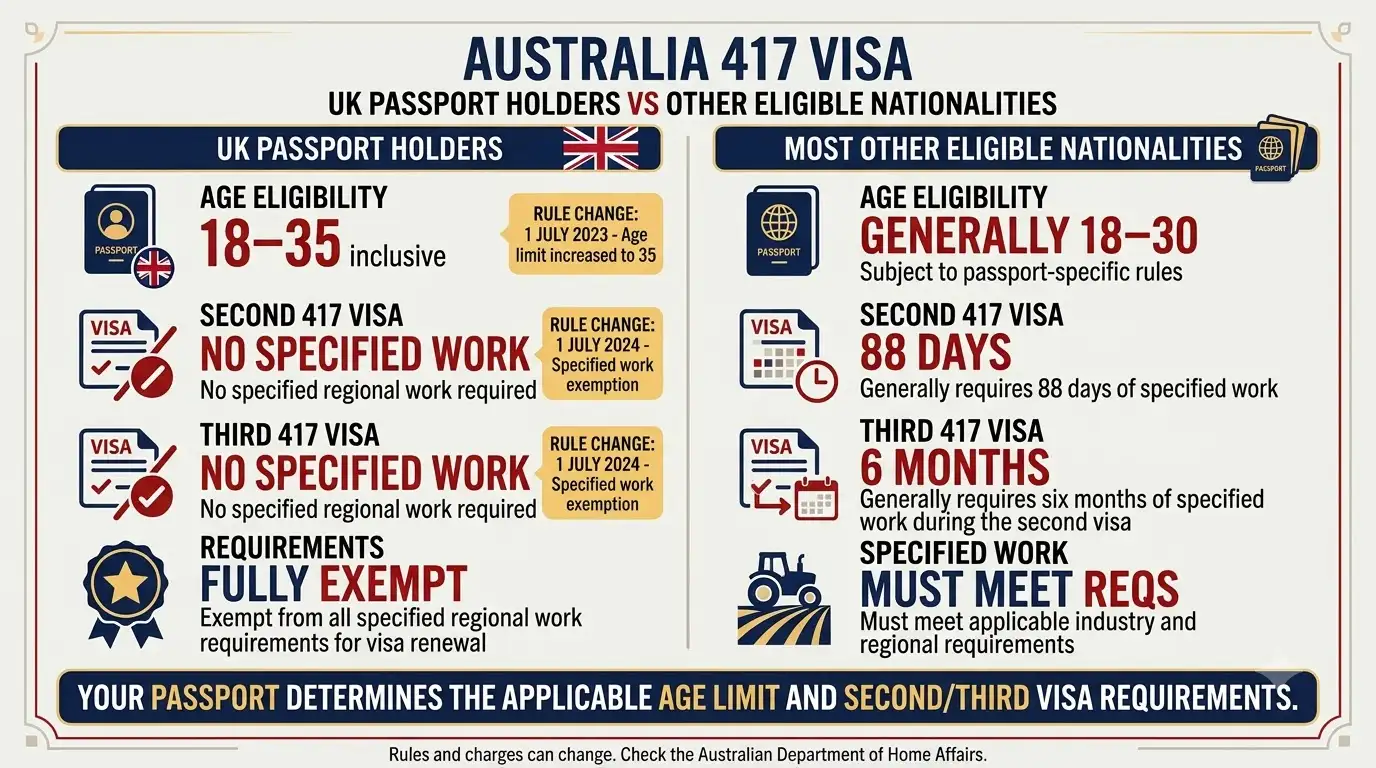
UK passport holders can apply for the 417 visa from age 18 until they are 35 years old inclusive. You must lodge your application before turning 36. The Department’s deadline is based on Australian Eastern Standard Time or Australian Eastern Daylight Time, as applicable, rather than the time zone where you are submitting your application.
What Changed for UK Passport Holders?
Two important changes were introduced for UK passport holders under the Australia-UK arrangements:
- From 1 July 2023: The eligible age range increased to 18–35 years inclusive.
- From 1 July 2024: UK passport holders became eligible to apply for second and third subclass 417 visas without completing the usual specified work requirement, provided they apply using their UK passport and meet the other conditions.
This means an eligible British applicant may be able to spend up to three separate 12-month periods in Australia through first, second and third Working Holiday visas. The visas do not have to be held consecutively.
UK applicants should remember that the exemption applies when they use a passport issued by the United Kingdom of Great Britain and Northern Ireland to apply. This includes British National (Overseas) passport holders under the Department’s arrangements.
Read the official Working Holiday arrangements for UK passport holders before applying for a second or third visa.
Eligible Countries for the 417 Visa
The subclass 417 Working Holiday programme is available to eligible passport holders from 19 countries and jurisdictions. The current list includes:
- Belgium
- Canada
- Republic of Cyprus
- Denmark
- Estonia
- Finland
- France
- Germany
- Hong Kong Special Administrative Region
- Republic of Ireland
- Italy
- Japan
- Republic of Korea
- Malta
- Netherlands
- Norway
- Sweden
- Taiwan
- United Kingdom
Age limits are not identical for every country. Some nationalities have an age limit of 30, while others can apply up to age 35. Always check the current country-specific rules before lodging your application.
If your passport country is not included in the subclass 417 programme, you may want to check whether the Work and Holiday visa (subclass 462) is available for your nationality. The two visa subclasses have different eligible country lists and application requirements.
Difference Between 417 and 462 Visa Australia
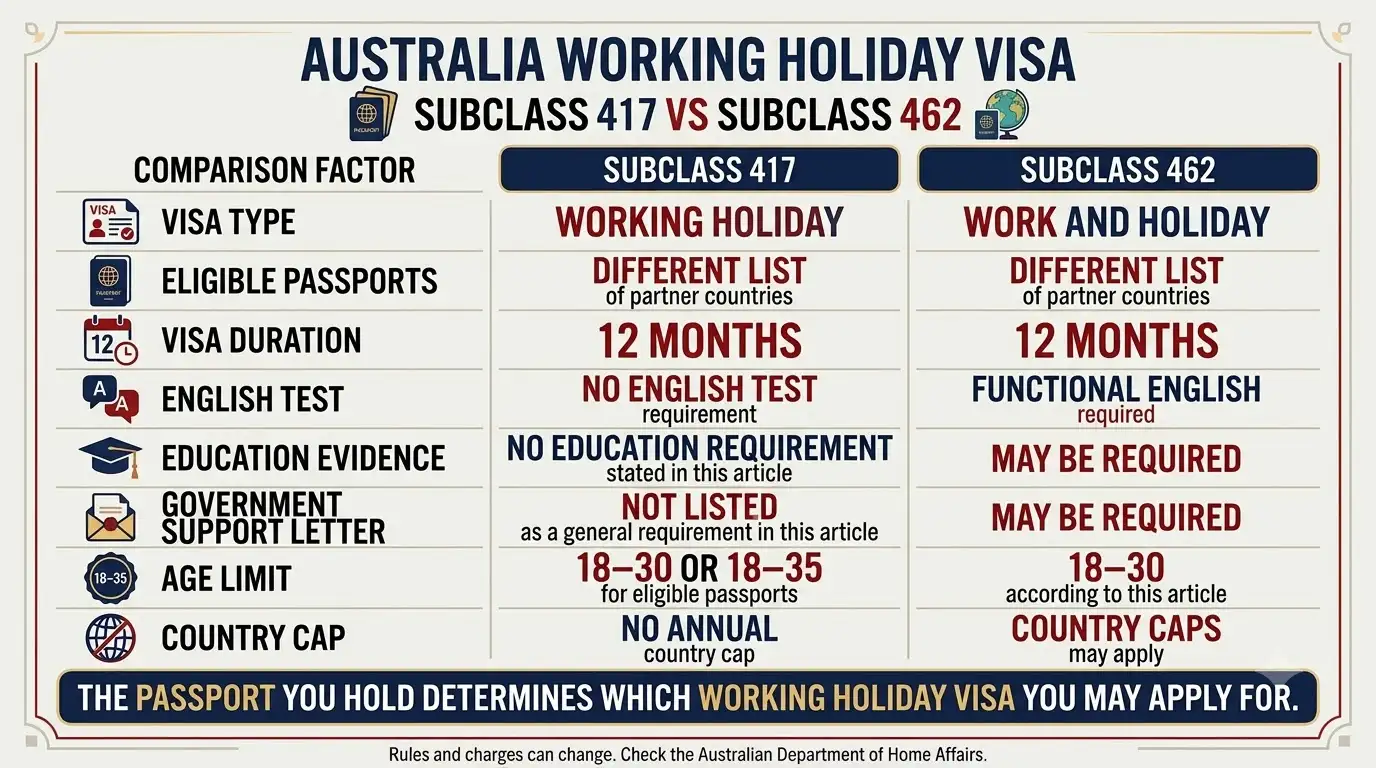
One of the most common questions about Australia’s Working Holiday programme is: What is the difference between 417 and 462 visa? Both visas allow eligible young adults to travel and work in Australia for an extended holiday. However, they are designed for different passport countries and have different eligibility conditions.
The subclass 417 is called the Working Holiday visa, while the subclass 462 is called the Work and Holiday visa. Your passport nationality determines which programme you may be eligible to use.
| Comparison Factor | Subclass 417 | Subclass 462 |
|---|---|---|
| Official name | Working Holiday visa | Work and Holiday visa |
| Purpose | Extended holiday with permission to work | Extended holiday with permission to work |
| Eligible countries | 417 partner countries and jurisdictions | 462 partner countries |
| General age range | Usually 18–30, with 18–35 available for certain countries | Generally 18–30, subject to applicable country arrangements |
| UK passport holders | Eligible, up to age 35 inclusive | UK is not a 462 partner country |
| English requirement | No general English test requirement | Functional English requirement applies |
| Education requirement | No general education requirement | Education requirements apply to certain passport countries |
| Government support letter | Not a general requirement | May be required for certain countries |
| First visa stay | Up to 12 months | Up to 12 months |
| Work rights | Work permitted subject to visa conditions | Work permitted subject to visa conditions |
| Study | Generally up to four months | Generally up to four months |
| Second and third visa | Specified work generally required, with exemptions including UK passport holders | Specified work requirements apply for further visas |
Important: The requirements for subclass 462 can vary depending on the applicant’s passport country. Education evidence, government support letters, ballot arrangements and other conditions do not apply identically to every nationality. Check the current rules for your country before applying.
Which Visa Should UK Citizens Choose: 417 or 462?
If you hold a valid UK passport, the subclass 417 is the relevant Working Holiday visa pathway. The UK is not included in the subclass 462 eligible country list, so a British passport holder should not select subclass 462 simply because it is another Australian working holiday programme.
For people holding passports from other countries, the correct option depends on the eligible country lists and the requirements of each subclass. Dual nationals should also consider which passport they intend to use and the rules concerning previous Working Holiday visas.
For the latest details, compare the official subclass 417 Working Holiday visa and subclass 462 Work and Holiday visa requirements.
417 Visa Requirements and Documents
Preparing your documents before applying can help you complete the online application accurately. The exact documents requested may depend on your nationality, travel history and personal circumstances.
Applicants should generally prepare:
- A valid passport and personal identity details.
- Evidence of sufficient funds, such as recent bank statements, if requested.
- Details of previous travel and visa history.
- Information about health and character circumstances.
- A payment method for the visa application charge.
- An ImmiAccount for submitting and managing the online application.
Home Affairs may also request police certificates, medical examinations, biometrics or further information. If you receive a request, follow the instructions and provide the documents within the stated timeframe.
417 Visa Cost in 2026
The subclass 417 visa application charge depends on whether you are applying for your first, second or third Working Holiday visa. From 1 July 2026, the standard charges are:
These are the standard government application charges. They do not include other possible expenses such as medical examinations, police certificates, travel insurance, flights, accommodation or bank charges.
Visa application charges can change, generally with annual updates. Check the Department’s current visa pricing information before making payment.
417 Visa Conditions: Work, Study and Travel
The 417 Working Holiday visa provides flexibility to travel around Australia and undertake different types of work. However, visa holders must follow the conditions attached to their visa.
Working in Australia
You can work in a range of industries while holding a valid subclass 417 visa. Common opportunities include hospitality, retail, tourism, agriculture, seasonal work, events, cleaning, administration and other temporary roles.
You must follow Australian workplace laws, including applicable minimum pay rates, employment conditions and workplace safety requirements. Holding a Working Holiday visa does not remove your employment rights.
Six-Month Work Limitation
A usual condition of the Working Holiday visa is that you cannot work for the same employer for more than six months unless an exemption or permission applies. There are specific exceptions and arrangements for certain types of work and circumstances.
Do not assume that the visa automatically allows you to remain with one employer for the full 12 months. Check your visa conditions and the Department’s current rules before accepting a longer employment arrangement.
Study and Training
Subclass 417 visa holders can generally study or undertake training for up to four months. If you intend to complete a longer course, you should check whether another visa is more suitable.
Travel and Re-entry
The visa generally allows multiple travel movements while it remains valid. You can leave Australia and return during the visa period, provided you continue to meet the relevant visa conditions.
Family Members and Dependants
You cannot include dependent children in a subclass 417 application or be accompanied by dependent children during your stay on this visa. A partner who wants to travel to Australia will generally need to qualify for and apply for their own visa.
How to Apply for the 417 Visa Australia
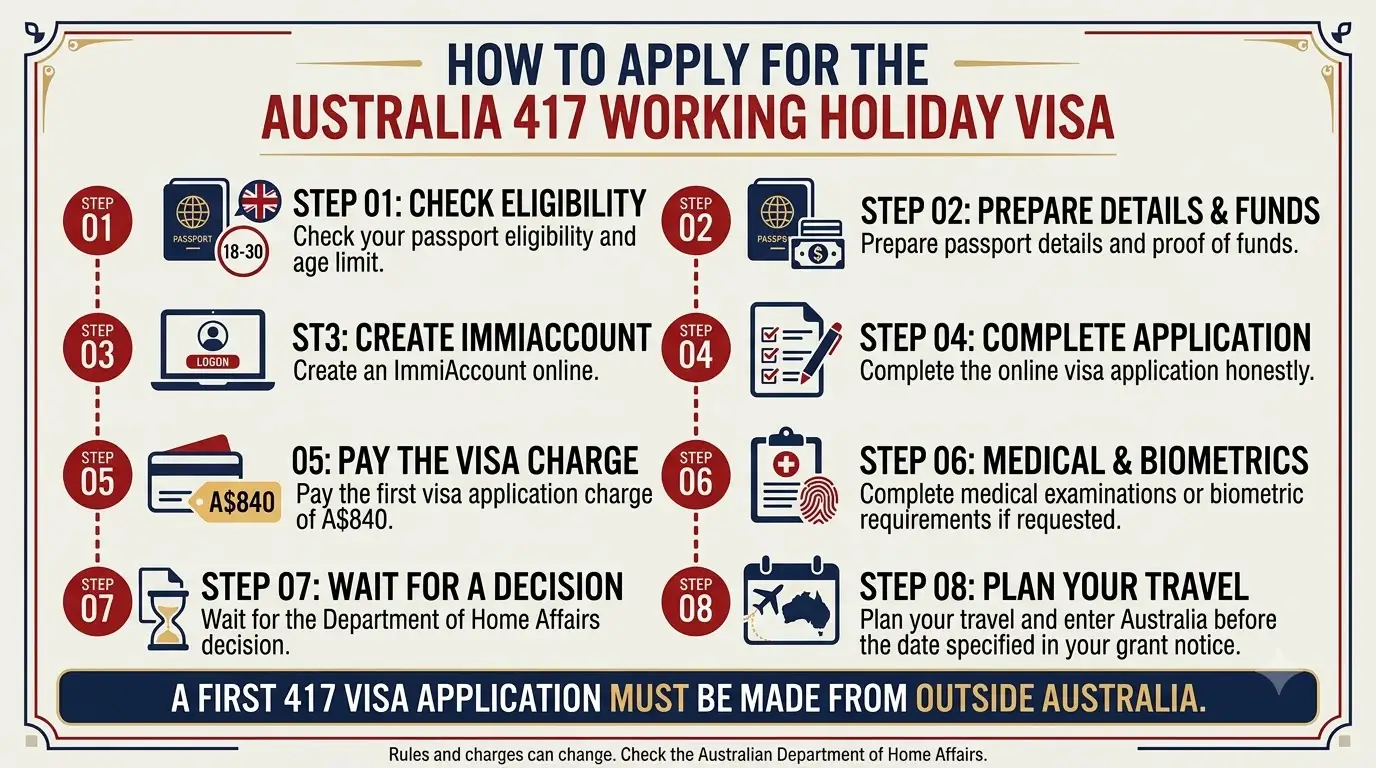
The subclass 417 application is lodged online through the Australian Department of Home Affairs. Before applying, confirm that your passport is eligible and that you meet the age and other requirements.
- Check your passport eligibility: Confirm that your passport is from a country or jurisdiction participating in the subclass 417 programme.
- Confirm your age: Check the age limit for your passport and make sure you lodge before the relevant deadline.
- Prepare your documents: Gather your passport details, financial evidence and any other information that may be requested.
- Create an ImmiAccount: Use the official Home Affairs online system to manage your application.
- Complete the application: Enter your personal, travel and background information accurately.
- Pay the application charge: Pay the applicable fee for your first, second or third visa.
- Respond to further requests: Complete any health examinations, biometrics or document requests issued by Home Affairs.
- Wait for a decision: Monitor your ImmiAccount and email for updates from the Department.
- Plan your travel after grant: Check the visa grant notice, entry deadline and conditions before booking your trip.
Processing times can vary. Home Affairs publishes processing information based on recently decided applications, but this is only a guide and does not guarantee how quickly an individual application will be decided. Avoid making non-refundable travel, work or study commitments before the visa is granted.
Apply through the official Australian Department of Home Affairs website.
Second and Third 417 Visa: How They Work
There is no simple extension that automatically adds another year to a subclass 417 visa. Instead, eligible applicants may apply for a second and then a third Working Holiday visa, with each visa generally allowing a further stay of up to 12 months.
Second 417 Visa
For many eligible nationalities, a second Working Holiday visa requires at least three months of specified subclass 417 work completed while holding the first visa. The work must meet the Department’s definition and location requirements.
UK passport holders are treated differently. They can apply for a second subclass 417 visa without completing the usual specified work requirement if they apply on or after 1 July 2024 using their UK passport and satisfy the other conditions.
Third 417 Visa
For many eligible nationalities, a third Working Holiday visa requires six months of specified work completed while holding the second visa. Again, the work must meet the relevant requirements.
UK passport holders can also access the specified-work exemption for a third subclass 417 visa when applying on or after 1 July 2024 using their UK passport, provided they meet the remaining requirements.
UK applicants do not need to spend three years in Australia continuously. They may apply for the available visas at different times, subject to the age and other eligibility requirements. The maximum number of separate subclass 417 visas available under the programme is generally three.
For the detailed rules, read the Department’s official information about new arrangements for UK passport holders.
Jobs You Can Do on a 417 Visa
There is no single occupation list that restricts all work under the subclass 417 visa. Working Holiday visa holders may work in different industries, provided the employment is lawful and complies with the visa conditions.
Common employment areas include:
- Hospitality, restaurants, cafés and hotels.
- Retail and customer service.
- Farm, harvest and seasonal work.
- Tourism and travel-related roles.
- Events and temporary support work.
- Cleaning and warehouse positions.
- Office administration and short-term business support.
- Some professional roles, where the applicant meets the relevant requirements.
Can Nurses Work on a 417 Visa?
A person holding a 417 visa may be able to work in the Australian health sector, but the visa itself does not provide professional registration. Anyone intending to practise as a nurse must meet the applicable Australian registration requirements before undertaking work that requires registration.
Similarly, regulated occupations such as certain trades may require Australian licences, registrations or additional checks. Check the professional requirements before relying on a particular job opportunity.
Can You Work in FIFO or Mining Jobs?
Some Working Holiday visa holders look for fly-in fly-out (FIFO), mining, construction or regional employment. These jobs may have additional requirements, including safety training, medical checks, licences, relevant experience or site-specific approvals.
Check the employer’s requirements before accepting a position. A 417 visa does not automatically provide the qualifications or licences needed for regulated or safety-sensitive work.
Common Mistakes to Avoid When Applying for a 417 Visa
Although the subclass 417 application is generally straightforward, mistakes can lead to delays, refusal or problems after arrival. Be careful about the following:
- Applying too late: UK applicants must lodge before the applicable deadline on the day before their 36th birthday in Australian time.
- Choosing the wrong subclass: A UK passport holder should generally consider subclass 417, not subclass 462.
- Using outdated fee information: Check the current application charge rather than relying on old articles.
- Assuming there are no work restrictions: The usual six-month employer limitation still applies unless an exception or permission is available.
- Ignoring financial requirements: Prepare to demonstrate sufficient funds if requested.
- Booking travel too early: Wait for the visa decision before making non-refundable commitments.
- Assuming the visa provides permanent residence: The 417 is a temporary visa and does not automatically lead to permanent residency.
- Ignoring professional registration: Check registration and licensing rules before accepting regulated work.
What Happens After Your 417 Visa?
The subclass 417 visa is designed for a temporary working holiday. If you want to remain in Australia after your Working Holiday visa ends, you should investigate other visa options well before your current visa expires.
The most suitable option will depend on your qualifications, occupation, employment history, age, English language ability and personal circumstances.
1. General Skilled Migration
If you have a skilled occupation and meet the relevant requirements, you may be able to explore Australia’s General Skilled Migration pathways. These include points-tested options such as subclasses 189, 190 and 491.
Our General Skilled Migration guide explains the main pathways. You can also use the Australia PR Points Calculator to estimate your potential points score.
Remember that meeting the minimum points threshold does not guarantee an invitation or visa approval. Occupation eligibility, skills assessment, nomination and other requirements must also be considered.
2. Temporary Graduate Visa (Subclass 485)
Some applicants who complete eligible Australian study may be able to consider the Temporary Graduate visa (subclass 485). This pathway has specific study, age, qualification and other requirements. A Working Holiday visa alone does not make someone eligible for a subclass 485 visa.
Read our Temporary Graduate visa 485 guide to understand the pathway and its eligibility requirements.
3. Training Visa (Subclass 407)
The Training visa (subclass 407) may be relevant to applicants undertaking an eligible occupational training or professional development programme. It is not a general work visa, and the training arrangement and sponsorship requirements must be met.
Learn more through our subclass 407 Training visa guide.
4. Temporary Work Visa (Subclass 400)
The Temporary Work (Short Stay Specialist) visa (subclass 400) may suit certain short-term, highly specialised work activities. It is not a general alternative for anyone who wants to continue working in Australia after a Working Holiday visa.
Read our subclass 400 short-term work visa information to understand its purpose and conditions.
5. Temporary Activity Visa
Some people may qualify for a Temporary Activity visa for specific approved activities, events or work arrangements. Eligibility depends on the activity and the relevant stream.
See our Temporary Activity visa guide for further information.
These visa options have different requirements and should not be treated as automatic extensions of the 417 visa. Check your circumstances and the current government criteria before choosing another pathway.
When You Do Not Need a 417 Visa
If you only intend to visit Australia for a holiday, tourism or a short family visit, you may not need a Working Holiday visa. Depending on your passport and travel purpose, another visitor pathway may be more appropriate.
For eligible passport holders, the Electronic Travel Authority (subclass 601) or eVisitor (subclass 651) may be relevant. These visitor visas do not provide permission to work in Australia.
- Australia ETA visa information
- Australia eVisitor visa subclass 651 guide
- Australia visitor visa information
Check the visa conditions carefully. A visitor visa is not a substitute for a Working Holiday visa if your intention is to undertake employment.
Practical Tips Before Applying for the Australia Working Holiday Visa
Planning ahead can make your move to Australia more manageable. Before submitting a 417 visa application, consider these practical steps:
- Check your passport’s eligibility and the age deadline in Australian time.
- Prepare evidence of funds and a realistic first-month budget.
- Check the current visa application charge before paying.
- Research accommodation and employment options in your intended destination.
- Arrange suitable travel or health insurance for your circumstances.
- Keep digital copies of your passport, visa grant notice and important documents.
- Understand Australian workplace rights, tax obligations and superannuation arrangements.
- Check any professional registration or licence requirements for the job you want to undertake.
- Do not make non-refundable travel plans until your visa has been granted.
- If you may want to stay longer, research other visa pathways before your current visa expires.
Why Speak to GIEC Global UK?
Choosing the correct Australian visa is an important part of planning your move. GIEC Global UK provides information and guidance to people exploring Australian visa options, including Working Holiday arrangements and possible longer-term migration pathways.
Our team can help you understand the differences between visa subclasses, identify the requirements you may need to check and consider what questions to resolve before making an application.
If you are a UK passport holder considering a Working Holiday in Australia, it is important to confirm that the subclass 417 suits your plans and that you understand its conditions. If your longer-term objective is to work or settle in Australia, you may also need to explore a different visa pathway.
Contact GIEC Global UK to discuss your Australian visa options and the next steps based on your circumstances.
Official Australian Government Resources
For accurate and up-to-date information, always refer to the Department of Home Affairs. The following official resources explain the main visa requirements:
- Working Holiday visa (subclass 417)
- Work and Holiday visa (subclass 462)
- Working Holiday arrangements for UK passport holders
- Current Australian visa application charges
Important disclaimer: This article provides general information and is not a guarantee of visa eligibility, approval or employment. Australian immigration requirements, application charges and visa conditions can change. Always check the current Department of Home Affairs requirements before lodging an application.
Frequently asked questions
What is the 417 visa in Australia?
The 417 visa is the Working Holiday visa. It lets eligible young people from partner countries holiday in Australia for 12 months and work to help fund their trip.
Who can apply for the 417 visa?
You must hold a valid passport from one of the 19 partner countries, meet the age limit, be outside Australia when you apply, have enough funds, and meet health and character requirements.
Can UK citizens apply for the 417 visa?
Yes. The United Kingdom is a 417 partner country, and UK passport holders can apply from age 18 up to age 35.
What is the age limit for the 417 visa?
Most nationalities must be 18 to 30. UK citizens and several other passports can apply up to age 35. You must meet the limit on the day you lodge.
How much does the 417 visa cost in 2026?
From 1 July 2026, the first 417 visa costs A$840, and a second or third visa costs A$1,000. Check the Home Affairs website before paying, because fees are indexed each year.
How long can I stay in Australia on a 417 visa?
Each 417 visa lasts 12 months. Eligible applicants can apply for a second and third visa, so up to three years in total.
I thought the visa was 2 years. Is that correct?
A single 417 visa is 12 months. You may reach two or three years by applying for a second and third visa, if you meet the requirements and pay the fee each time.
Do UK citizens need farm work for a second or third 417 visa?
No. UK passport holders who apply on or after 1 July 2024 do not need to complete specified regional work for a second or third visa.
Do I need an English test for the 417 visa?
No. The 417 visa does not require an English test. The 462 visa does.
How much money do I need for a 417 visa?
Home Affairs usually expects about A$5,000 for your initial stay, plus enough money for your fare to leave Australia.
How long does 417 visa processing take?
It varies by country and season. Recent published figures for UK applicants showed most decisions within about two months, but check Home Affairs for current times.
Can I apply for the 417 visa from inside Australia?
Not for your first visa. You must be outside Australia when you apply and when it is granted. A second or third visa can be applied for from inside Australia.
Can I work for one employer for the whole year on a 417 visa?
Generally no. You can usually work for the same employer for up to six months, with limited exceptions. Check your visa conditions.
Can I study on a 417 visa?
Yes, usually for up to four months. For a longer course you will need a student visa.
Can I bring my partner or children on a 417 visa?
You cannot bring dependent children. A partner would normally need to apply for their own eligible visa.
Can I work as a nurse on a 417 visa?
You can apply for the visa and work, but nursing requires Australian professional registration before you can practise. The visa does not remove that requirement, so start the registration process early.
Can I do fly-in fly-out or mining work on a 417 visa?
The visa has no occupation ban, but many employers require safety tickets, medicals and experience. Check the requirements for each role.
Which countries are eligible for the 417 visa?
There are 19 partner countries, including the UK, Ireland, Canada, Germany, France, Italy, Japan and South Korea. Confirm the current list on the Home Affairs website.
What is the difference between the 417 and 462 visa?
Both are 12-month working holiday visas, but they are for different passports. The 462 adds functional English, education conditions and sometimes a government support letter.
Does the 417 visa lead to permanent residency?
No. It is a temporary visa. To stay long term, you need another pathway such as skilled migration, a graduate visa after study, or employer sponsorship.
Free consultation
Check your eligibility
A registered agent can review your profile and explain which pathway may suit you.
Book your free consultation
Thank you! Your enquiry has been received. A GIEC adviser will contact you shortly.