
University of Melbourne
Melbourne, Victoria, Australia
Public University
University of Melbourne in Melbourne, Victoria, Australia. QS World University Rankings 2026: 19th in the world. Tuition: AUD $45,000 – AUD $52,000 per year.

Migration · Australia
Learn who can apply for the 407 Training visa, what your sponsor must do first, the 2026 costs and how the training plan works.
Decide your training type (occupational, professional development, or registration and capacity building)
Find an organisation that is or can become an approved Temporary Activities Sponsor
Build a structured training plan with the sponsor
Sponsor lodges the nomination with the training plan
Wait for sponsor and nomination approval before you lodge
Lodge your 407 visa application with English, health insurance and identity documents
Complete medicals, police checks and biometrics if requested
Receive your decision and start training under your visa conditions
Plan your next visa early if you want to stay after the program
| Main applicant visa charge | A$535 |
|---|---|
| Additional applicant 18 or over | A$535 |
| Additional applicant under 18 | A$135 |
| Sponsor application fee | Paid by sponsor; confirm current amount with Home Affairs |
| Nomination fee | Paid by sponsor; confirm current amount with Home Affairs |
| English test | Charged by the test provider |
| Medicals, police certificates, translations | Charged separately |
| Health insurance | Required for the whole stay, cost varies |
Fees change. Check the official source before you pay.
The 407 visa Australia, officially known as the Training visa (subclass 407), allows eligible people from overseas to participate in structured workplace-based occupational training in Australia. It is designed for individuals who want to improve their professional skills, gain practical experience in their field or complete training connected with registration, qualifications or professional development.
Unlike a general employment visa, the 407 training visa is based on a genuine training programme. Applicants need an eligible Australian organisation to sponsor them and provide a suitable training arrangement. The programme must have clear objectives, relevant activities and appropriate supervision. It should help the applicant develop skills rather than simply fill an ordinary job vacancy.
The Australian Government changed the application process in 2026. Sponsor approval and nomination approval generally need to be in place before an applicant can lodge a valid visa application. Another important change is scheduled for 12 November 2026, when applicants will need to be outside Australia both when applying and when the visa is granted.
This guide explains the Australia 407 visa requirements, sponsorship process, training categories, occupation list, English language requirements, documents, costs, work conditions and application steps. It also explains how the subclass 407 compares with other Australian visa options.
If you are exploring other Australian migration options, you can also visit our Australia migration services page.
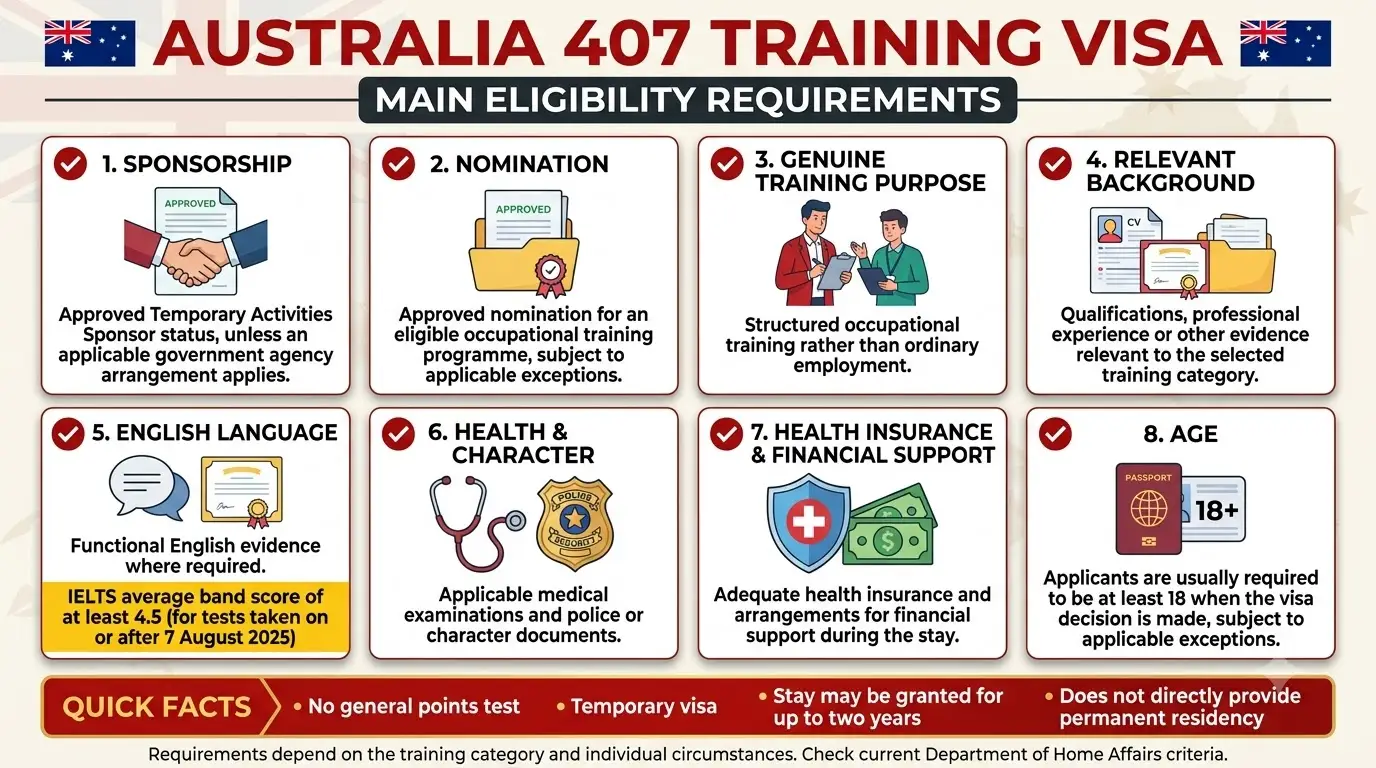
The Training visa (subclass 407) is a temporary Australian visa that allows eligible applicants to take part in structured workplace-based occupational training. The visa may be granted for up to two years, depending on the approved programme and the applicant’s circumstances.
Applicants generally need an approved Temporary Activities Sponsor, an approved nomination, a genuine training programme, functional English evidence where required, adequate health insurance and documents meeting health and character requirements. The visa is not designed for general employment and does not directly provide permanent residency.
The 407 training visa is intended for people who already have relevant skills, qualifications, employment experience or professional knowledge and want to improve their abilities through a structured programme in Australia.
The visa may be relevant to applicants whose training is connected with their current occupation, tertiary studies, professional field or an overseas capacity-building programme. The proposed training must fit one of the permitted categories and satisfy the relevant nomination requirements.
Having a qualification or work experience does not automatically make someone eligible. The proposed programme, sponsor, nomination and applicant’s circumstances must all meet the applicable rules.
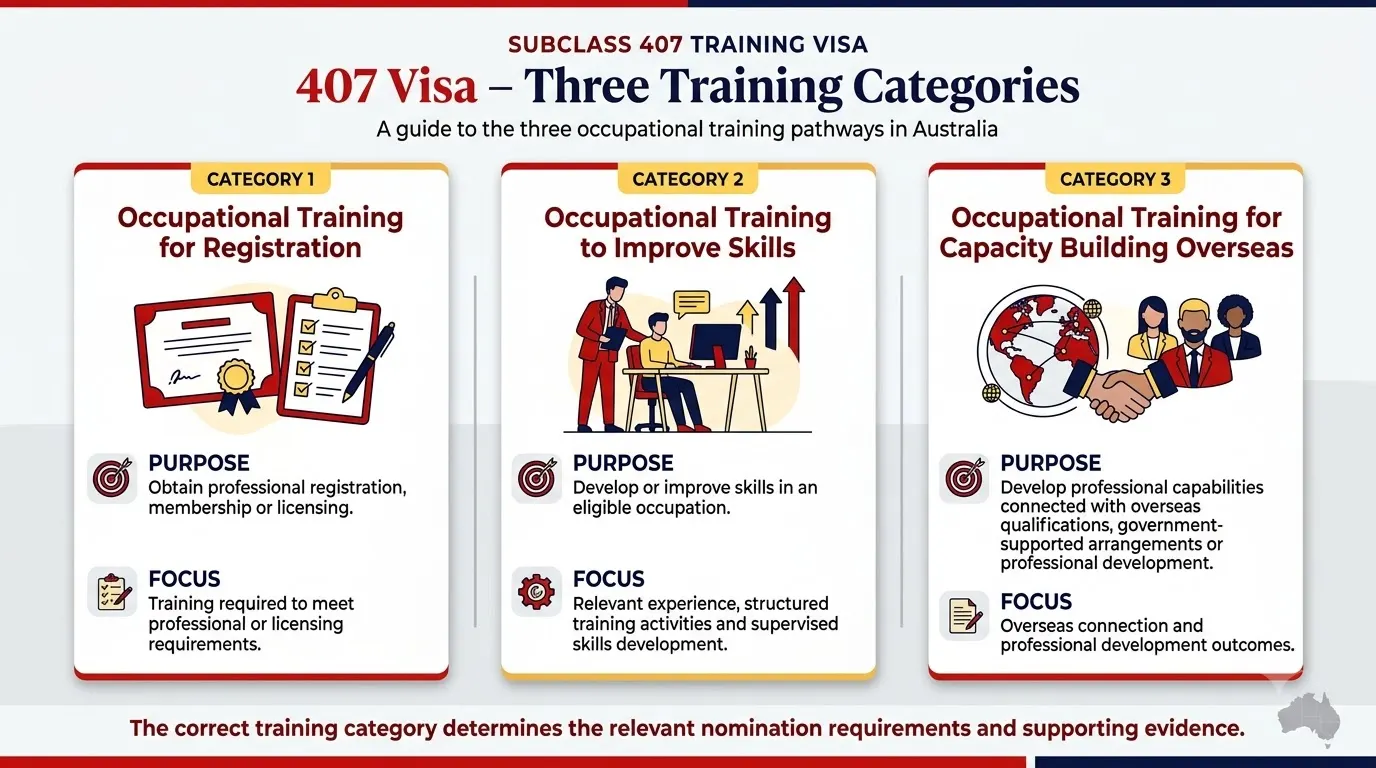
Understanding the training category is one of the first steps when planning an Australia 407 visa application. The sponsor must identify the appropriate category and provide evidence that the proposed programme meets its requirements.
| Training category | Purpose | What the programme should demonstrate |
|---|---|---|
| Occupational training for registration | Training required to obtain registration, membership or a licence to work in an occupation. | How the proposed training relates to the relevant professional registration or licensing requirements. |
| Occupational training to improve skills | Developing or improving skills in an eligible occupation. | Relevant experience, occupation eligibility, structured activities and a genuine plan for skills development. |
| Occupational training for capacity building overseas | Training connected with overseas qualifications, government-supported arrangements or professional development. | The purpose of the programme, its overseas connection and how the training will develop the participant’s professional capabilities. |
These categories are not interchangeable. The sponsor should select the correct training type before preparing the nomination. The evidence required can differ according to the category and the applicant’s circumstances.
For example, an applicant seeking occupational training to improve skills may need to demonstrate relevant recent experience in the nominated occupation. A programme connected with registration may require evidence explaining the professional or licensing requirements that the training is intended to address.
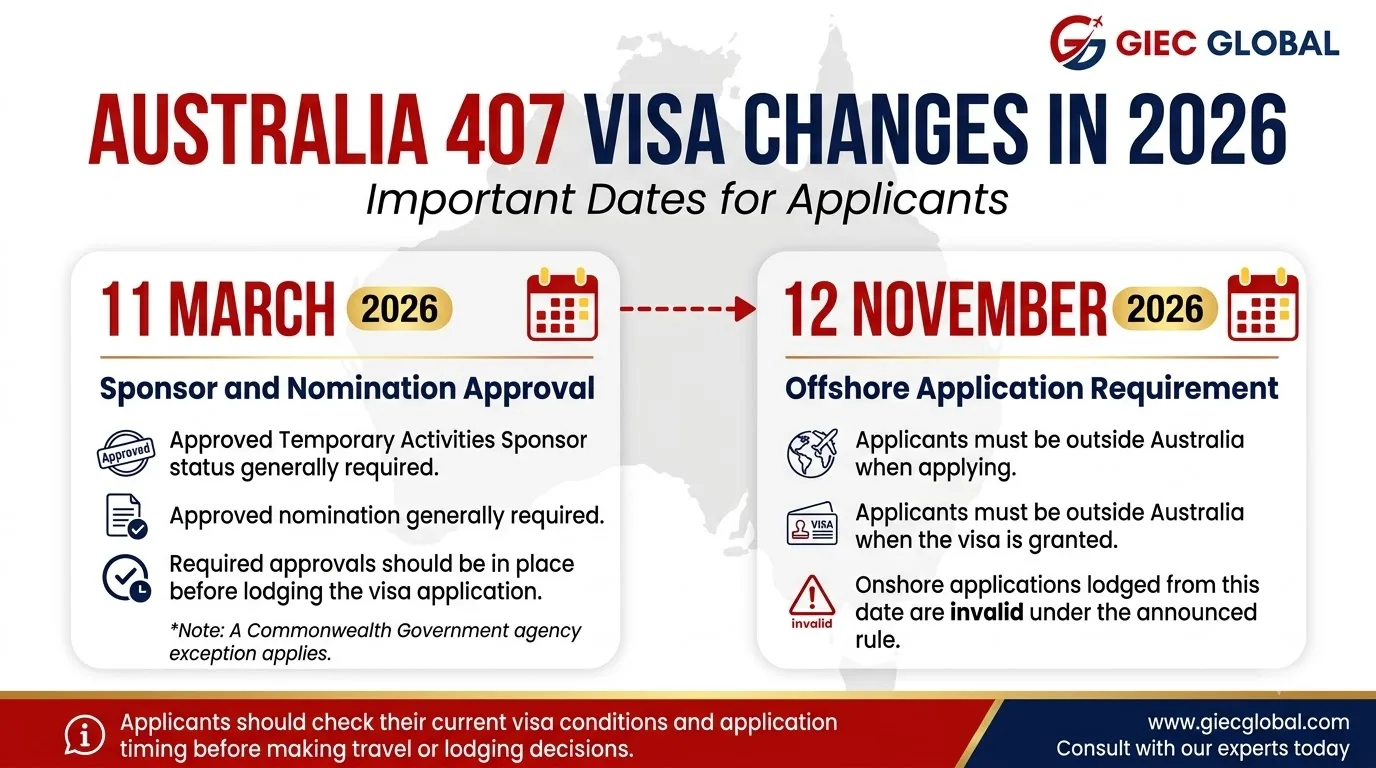
There are important changes to the 407 visa Australia application process in 2026. Applicants and sponsors should understand the rules that apply on the date of application rather than relying on older guides.
From 11 March 2026, the general process requires the Australian organisation to have approved Temporary Activities Sponsor status and an approved nomination before the applicant lodges the Training visa application. An exception applies where the sponsor is an Australian Commonwealth Government agency, in which case the applicable government agency process must be followed.
This means that applicants should not assume they can submit the visa application while sponsorship or nomination approval is still pending. The host organisation should prepare the sponsorship application, nomination and training plan first.
The Department of Home Affairs has announced a further change starting on 12 November 2026. From that date, applicants must be outside Australia when they apply for a Training visa and when the visa is granted.
An application lodged in Australia from that date will be invalid under the announced rule, even if the online system allows the applicant to submit it. Applicants who are already in Australia should check their current visa expiry date and plan carefully before travelling or lodging another application.
Valid applications lodged before 12 November 2026 will generally continue to be assessed under the rules that applied when they were lodged, including the sponsorship and nomination changes introduced in March 2026.
| Change | Application requirement | What applicants should do |
|---|---|---|
| 11 March 2026 | Sponsor and nomination approval generally required before lodging the visa application. | Wait for the relevant approvals before submitting the visa application. |
| 12 November 2026 | Applicants must be outside Australia when applying and when the visa is granted. | Check application timing, current visa conditions and travel arrangements before lodging. |
These dates are particularly important for people already in Australia on another visa. Read the official 407 visa application rule changes before making plans.
Applicants must meet the relevant subclass 407 visa requirements. The Department of Home Affairs considers the proposed training, sponsor, nomination and the applicant’s personal circumstances.
The main requirements generally include the following:
| Requirement | What it means |
|---|---|
| Approved sponsorship | An eligible Australian organisation must have the required Temporary Activities Sponsor approval, unless a specific government agency arrangement applies. |
| Approved nomination | The sponsor must nominate the applicant for an eligible occupational training programme, unless the Commonwealth Government agency exception applies. |
| Genuine training purpose | The programme must provide structured occupational training rather than ordinary employment. |
| Relevant background | The applicant must meet the relevant experience, qualification or other criteria for the selected training category. |
| English language | The applicant must provide accepted evidence of functional English unless an applicable exemption or alternative evidence arrangement applies. |
| Health requirements | The applicant and relevant accompanying family members must meet Australian health requirements. |
| Character requirements | Police certificates or other character evidence may be required. |
| Health insurance and financial support | The applicant should have adequate arrangements for health insurance and the financial support required during the stay. |
| Age requirement | Applicants are usually required to be at least 18 when the visa decision is made, subject to the applicable rules and exceptions. |
There is no general points test for the subclass 407 visa. It is also not a general occupation-shortage visa. The focus is whether the proposed training meets the relevant requirements and whether the applicant is suitable for that programme.
407 visa sponsorship is a central part of the application. The applicant cannot simply choose an Australian employer and lodge a training visa application without the required sponsorship and nomination arrangements.
The Australian host organisation generally needs approval as a Temporary Activities Sponsor. It must also meet the relevant requirements for the type of training it intends to provide. Home Affairs may consider whether the organisation is suitable to sponsor the applicant and whether it can provide or arrange the proposed training.
Eligible Australian organisations may include businesses, educational institutions and other organisations that meet the relevant sponsorship criteria. Commonwealth Government agencies follow a specific process.
Individuals and sole traders should not assume they can act as sponsors. The proposed sponsor must meet the Department’s requirements and be able to support the nominated training arrangement.
The sponsor should also understand which costs it is legally responsible for. Sponsorship and nomination charges should not simply be transferred to the trainee where the migration rules prohibit this. The organisation should confirm the current cost rules before making payment arrangements.
A well-prepared 407 visa training plan is one of the most important parts of the nomination. It should explain what the applicant will learn, how the training will be delivered and how the sponsor will assess progress.
A basic job description is not a substitute for a training plan. The programme should have genuine learning objectives and demonstrate why the applicant needs the proposed training.
The plan should be specific to the applicant. Copying a generic programme or describing normal job responsibilities without explaining the training element can weaken the nomination.
The 407 visa occupation list is relevant to certain occupational training applications, particularly training intended to improve skills in an eligible occupation.
Applicants should not assume that the subclass 407 uses exactly the same occupation lists as Australia’s permanent skilled migration programmes. The applicable list and requirements depend on the type of training being proposed.
For occupational training to improve skills, relevant recent experience is generally expected. The applicable criteria commonly refer to at least 12 months of full-time equivalent experience in the occupation within the 24 months before the nomination is lodged. Applicants should confirm the exact requirements for their training category before proceeding.
For training connected with registration or capacity building overseas, the occupation-list rules may be different. The sponsor should check the current Department of Home Affairs requirements rather than relying on an old occupation list.
Applicants generally need to demonstrate functional English for the subclass 407 visa unless they qualify for an applicable exemption or another accepted form of evidence.
IELTS is one way to demonstrate functional English. For tests taken on or after 7 August 2025, the Department’s functional-English information lists an average IELTS Academic or General Training band score of at least 4.5. Other approved English tests and accepted evidence may also be available.
| English evidence | Important information |
|---|---|
| IELTS Academic | The Department lists an average band score of at least 4.5 for applicable tests taken on or after 7 August 2025. |
| IELTS General Training | The Department lists an average band score of at least 4.5 for applicable tests taken on or after 7 August 2025. |
| PTE Academic | An approved test with the required functional-English score may be accepted. |
| TOEFL iBT | An approved test and the applicable score may be accepted. Registration and test-delivery rules apply. |
| Other accepted evidence | Some applicants may demonstrate functional English through eligible education or passport evidence, depending on the rules. |
Applicants should not book a test based only on an old online article. The accepted tests, score requirements, test dates and evidence rules can change. Completely online or at-home English tests are not accepted as evidence under the Department’s published functional-English guidance.
For the current requirements, see the official Functional English requirements page.
People searching for the 407 visa age limit should understand that the subclass 407 has an age requirement that differs from many skilled migration programmes.
Under the Department’s published criteria, applicants are usually required to be at least 18 years old when the visa application is decided. The word “usually” is important because specific exceptions may apply under the relevant rules.
There is no reason to assume that the age limits used for a Working Holiday visa or a points-tested skilled visa automatically apply to the 407 training visa. Applicants should check the subclass 407 criteria for their individual circumstances.
Preparing the right documents can help applicants and sponsors organise the nomination and visa application more effectively. The exact evidence depends on the training category, sponsor and applicant’s background.
| Document group | Examples | Who generally prepares it? |
|---|---|---|
| Personal identity | Passport, identity details and family documents. | Applicant |
| Qualifications and experience | Certificates, transcripts, references and employment evidence. | Applicant |
| Sponsorship | Organisation details and sponsorship approval evidence. | Australian sponsor |
| Nomination | Nomination details and supporting evidence. | Australian sponsor |
| Training plan | Objectives, activities, schedule, supervision and outcomes. | Sponsor, with relevant applicant information |
| Health and character | Medical examinations, police certificates and insurance evidence. | Applicant and relevant family members |
Documents should be accurate and consistent. Employment dates, job titles, qualifications and training objectives should match across the application. If a document is not in English, an appropriate translation may be required.
The 407 visa cost includes the visa application charge and other expenses connected with preparing the application. The amount payable depends on the applicant’s circumstances and the number of family members included.
The Department’s published subclass 407 information lists the main applicant visa charge from A$535. Additional applicant charges may apply. The Department’s Visa Pricing Estimator should be used to check the amount payable for the specific application.
| Cost category | What to consider |
|---|---|
| Main applicant visa charge | Published from A$535. Confirm the amount in the official pricing information before lodging. |
| Additional applicants | Extra charges may apply for eligible family members included in the application. |
| Sponsorship application | A separate charge may apply if the organisation needs Temporary Activities Sponsor approval. |
| Nomination | The sponsor should check the applicable nomination charge and payment requirements. |
| English test | Applicants may need to pay for an approved English test if they use test results as evidence. |
| Health examinations | Medical examination costs depend on the applicant and the required checks. |
| Police certificates | Fees may apply when obtaining police or character documents. |
| Other expenses | Translations, health insurance, travel and document preparation may add to the overall cost. |
Visa charges can change. The amount displayed in an older article or previous application should not be treated as the current price. Check the official visa fees and charges information and the Visa Pricing Estimator before making payment.
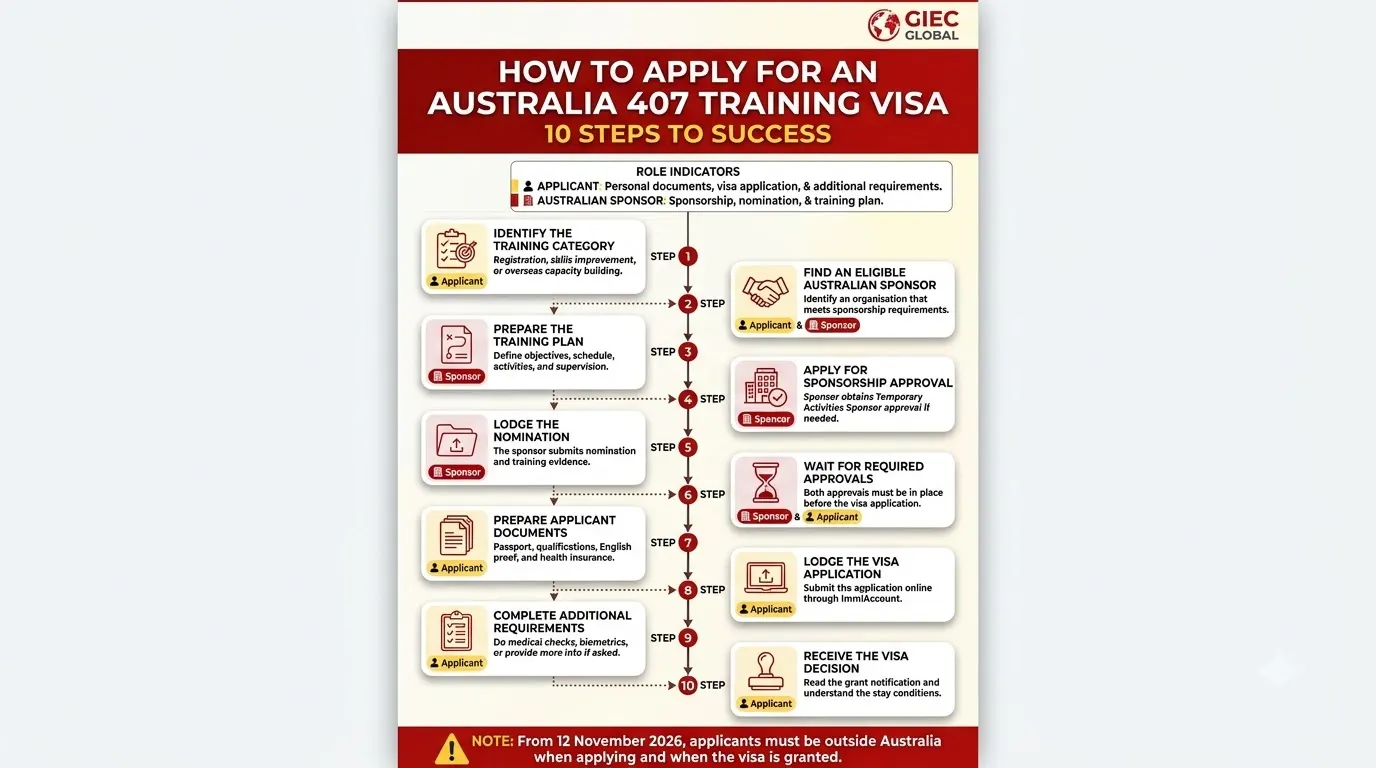
The 407 visa application involves preparation by both the applicant and the Australian sponsor. The sponsor’s approval and nomination are important stages, so applicants should not treat the process as a simple online visa form.
First, identify whether the proposed programme relates to registration, improving occupational skills or capacity building overseas. The selected category determines the relevant nomination requirements and supporting evidence.
The applicant needs an Australian organisation that can meet the Temporary Activities Sponsor requirements. The organisation should understand the responsibilities involved before agreeing to sponsor the applicant.
The sponsor should develop a programme with clear objectives, activities, a schedule, supervision and expected outcomes. It should explain why the programme is genuine occupational training rather than ordinary employment.
If the organisation does not already have the necessary approval, it may need to apply to become a Temporary Activities Sponsor. The relevant government agency arrangements should be checked where applicable.
The sponsor submits the nomination and supporting training information. The nomination should accurately explain the applicant, training category, programme and arrangements.
For the general process, the sponsor and nomination must be approved before the applicant lodges the 407 visa application. Do not rely on older advice that suggests all stages can simply be submitted together.
The applicant should organise identity documents, qualifications, work experience evidence, English evidence, health insurance and any other required supporting documents.
Once the required approvals are in place, the applicant can lodge the visa application in accordance with the rules that apply on that date. From 12 November 2026, applicants must be outside Australia when they apply and when the visa is granted.
The Department may request further information, medical examinations, biometrics or additional evidence. Applicants should monitor their ImmiAccount and respond within the stated timeframe.
Once a decision is made, the applicant should carefully read the visa grant notification and understand the visa conditions, approved period of stay and training arrangements before travelling or commencing the programme.
| Stage | Responsible person | Main activity |
|---|---|---|
| Training assessment | Applicant and sponsor | Identify the correct training category and programme. |
| Sponsor approval | Australian organisation | Obtain required Temporary Activities Sponsor approval. |
| Nomination | Australian organisation | Submit nomination and structured training evidence. |
| Visa application | Applicant | Prepare and lodge the application after required approvals. |
| Assessment | Department of Home Affairs | Assess eligibility and supporting documents. |
| Visa decision | Department of Home Affairs | Grant or refuse the application. |
The 407 visa processing time can vary depending on the circumstances of the application. There is no single processing period that applies to every applicant.
The time required may be affected by:
Applicants should check the Department’s official global visa processing times guide. This tool provides an indication based on recently decided applications. It is not a guarantee that an individual application will be finalised within the displayed period.
It is sensible to prepare documents early and avoid making non-refundable travel arrangements based on an estimated processing date.
The subclass 407 is a training visa, not a general work visa. Its purpose is to allow the applicant to participate in the approved workplace-based training programme.
Work undertaken as part of the programme must follow the applicable Australian workplace and minimum wage requirements. The host organisation should not use the training visa as a way to fill a labour shortage or obtain unpaid workers.
Before accepting a training arrangement, applicants should understand what they will be doing, who will supervise them and how the activities relate to the nominated training objectives.
Eligible family members may be included in or apply with the main applicant, subject to the relevant requirements. Each family member must provide the required identity and supporting documents and may need to satisfy health and character criteria.
Additional visa charges can apply when family members are included. The applicant should also plan for accommodation, living expenses, health insurance and other costs for accompanying family members.
Do not assume that a spouse or partner automatically has unrestricted work rights. Work and study conditions depend on the visa granted and the conditions attached to it. Family members should check their own visa grant details and use the Visa Entitlement Verification Online service where appropriate.
The Training visa may allow an applicant to stay in Australia for up to two years. The actual visa period depends on the approved training programme and the Department’s decision.
For example, a shorter training programme may result in a visa period that reflects the programme’s duration rather than the maximum possible stay. Applicants should not assume that every subclass 407 visa is granted for two full years.
The visa is temporary. It cannot simply be extended by asking for extra time. A further application may be possible in certain circumstances, but continuing sponsorship and the relevant nomination requirements must be considered. The applicant may also need to explain why the original training could not be completed within the initial period.
The visa may allow multiple travel during its validity, subject to the grant conditions. Time spent outside Australia does not extend the visa period.
One of the most common questions is whether the 407 training visa or the 482 Skills in Demand visa is more suitable. The correct option depends on the applicant’s genuine purpose in Australia.
| Feature | Subclass 407 Training visa | Subclass 482 Skills in Demand visa |
|---|---|---|
| Main purpose | Structured occupational training or professional development. | Employer-sponsored employment in an eligible position. |
| Primary focus | Skills development and workplace-based learning. | Employment in a nominated role. |
| Sponsorship | Approved Temporary Activities Sponsor and relevant nomination are generally required. | Eligible employer sponsorship and nomination requirements apply. |
| Training plan | A structured training programme is central to the application. | Not the same training-plan requirement as the 407 visa. |
| Employment purpose | Not intended to fill a workforce shortage. | Designed for eligible sponsored employment. |
| Stay period | Up to two years, depending on the approved programme and visa decision. | Depends on the stream and visa grant. |
| Permanent residency | Does not directly provide permanent residency. | Some applicants may have separate permanent visa options if they meet the relevant criteria. |
If your main objective is to take up a genuine sponsored job in Australia, a work visa may be more appropriate than the subclass 407. If your objective is structured professional training, the 407 may be worth considering.
The 407 visa to permanent residency question is important for people planning to stay in Australia for the long term. The subclass 407 is a temporary visa and does not directly provide permanent residency.
However, completing a training programme may help an individual develop professional skills, gain relevant experience or understand Australian workplace practices. Depending on the person’s occupation, qualifications and circumstances, separate migration options may be available in the future.
Eligibility for another visa is assessed separately. Completing a 407 training programme does not guarantee sponsorship, an invitation or permanent residence.
For further information, read our General Skilled Migration guide, use the Australia PR points calculator or explore our Australian permanent residency guide.
A well-prepared application should explain the training arrangement clearly and provide evidence that supports the applicant’s circumstances. The following mistakes can create problems during the sponsorship, nomination or visa assessment stages.
The subclass 407 is for structured occupational training. Applicants who mainly want to fill a job vacancy should investigate the appropriate employment visa instead.
Under the 2026 process, the required sponsor and nomination approvals generally need to be in place before the visa application is lodged. Applicants should check whether the Commonwealth Government agency exception applies.
A training plan should explain objectives, activities, supervision and expected outcomes. A document that simply lists normal job duties may not demonstrate genuine training.
The sponsor should identify the correct category and prepare evidence that meets its specific requirements. Choosing a category without checking the applicant’s background can create difficulties.
English test rules and accepted evidence can change. Applicants should confirm the current functional-English requirements before booking a test or lodging an application.
From 12 November 2026, applicants must be outside Australia when applying and when the visa is granted. Applicants planning an onshore application should review this change carefully.
The 407 is temporary and does not directly lead to PR. Any future visa application must satisfy its own requirements.
Understanding the Australia 407 training visa involves more than completing an online application. Applicants need to understand the training categories, sponsor requirements, nomination process and supporting documents. Australian host organisations also need to prepare a genuine programme that meets the relevant requirements.
GIEC Global UK can help applicants understand the process, review their circumstances, organise supporting documents and identify questions that should be addressed before an application is lodged. We can also help explain how the 407 training visa differs from other Australian visa options.
Every application is assessed by the Australian Department of Home Affairs. No consultant can guarantee a visa grant, sponsorship approval or future permanent residency outcome.
To discuss your circumstances, visit GIEC Global UK and contact our team.
Disclaimer: This article provides general information about the Australian Training visa (subclass 407) and is not individual immigration or legal advice. Visa criteria, application charges, occupation requirements and processing arrangements can change. Always check the latest Department of Home Affairs information and obtain advice based on your individual circumstances before lodging an application.
Melbourne, Victoria, Australia
Public University
University of Melbourne in Melbourne, Victoria, Australia. QS World University Rankings 2026: 19th in the world. Tuition: AUD $45,000 – AUD $52,000 per year.

Sydney, New South Wales, Australia
Public University
University of New South Wales in Sydney, New South Wales, Australia. QS World University Rankings 2026: 20th in the world. Tuition: AUD $45,000 – AUD $52,000 per year.

Sydney, New South Wales, Australia
Public University
The University of Sydney in Sydney, New South Wales, Australia. QS World University Rankings 2026: 25th in the world. Tuition: AUD $45,000 – AUD $53,000 per year.

Canberra, Australian Capital Territory, Australia
Public University
Australian National University in Canberra, Australian Capital Territory, Australia. QS World University Rankings 2026: 32nd in the world. Tuition: AUD $44,000 – AUD $50,000 per year.

Melbourne, Victoria, Australia
Public University
Monash University in Melbourne, Victoria, Australia. QS World University Rankings 2026: 36th in the world. Tuition: AUD $42,000 – AUD $48,000 per year.

Brisbane, Queensland, Australia
Public University
The University of Queensland in Brisbane, Queensland, Australia. QS World University Rankings 2026: 42nd in the world. Tuition: AUD $42,000 – AUD $48,000 per year.
It is a temporary Australian visa for structured workplace-based training or professional development. It can be granted for up to two years.
People who have an approved sponsor and nomination, a relevant occupation, qualification or field of expertise, functional English, adequate health insurance and a clean health and character record.
Yes. An Australian organisation that is an approved Temporary Activities Sponsor must nominate you. Individuals and sole traders cannot sponsor a 407 applicant.
For applications from 11 March 2026, the sponsor and nomination generally must be approved before you lodge a valid visa application, unless the sponsor is a Commonwealth Government agency.
From 1 July 2026, the main applicant visa charge is A$535. Additional applicants aged 18 or over pay A$535 and children under 18 pay A$135. Confirm current fees on the Home Affairs website.
The sponsor pays them. Home Affairs states that sponsorship and nomination costs, as well as agent fees and training costs, cannot be passed on to the trainee.
Functional English is required. Many applicants show this with an IELTS score of 4.5 overall or an equivalent test, but check Home Affairs for the evidence that applies to you.
It is a structured plan lodged with the nomination. It explains the training objectives, activities, schedule, supervision, assessment and why the training is needed in Australia.
Occupational training, professional development, and registration or capacity building overseas. Your nomination must fit one of them.
Yes, for occupational training the occupation generally has to be on the Home Affairs list. The list may not apply to registration or capacity building programs, so check the current list.
Up to two years, depending on the length of the approved training program. The visa period usually matches the training plan.
Work is allowed only as part of the training program, and all work must be paid at least the minimum wage. The visa is not intended to fill workforce shortages.
Eligible partners and children can usually apply as additional applicants. Their work and study rights depend on their visa conditions, so check the grant letter before assuming they can work.
Yes, if you hold an eligible substantive visa. Holders of certain visas, such as subclass 403, subclass 771 or special purpose visas, cannot apply onshore.
It varies and has at times been long. Home Affairs publishes processing times, so check the current figures and apply early. Sponsor and nomination approval also take time.
No. It is a temporary visa. You would need another pathway such as skilled migration, a graduate visa after study, or employer sponsorship.
The 482 is an employer-sponsored work visa for filling a role. The 407 is a training visa for structured learning. If your main aim is employment, the 407 is the wrong visa.
No. The 457 visa was closed in 2018 and replaced by other employer-sponsored visas. The 407 is a separate training visa.
You cannot simply extend it. You may need a new or updated nomination and a further visa application, so plan the program length carefully at the start.
Our team checks whether the 407 is the right visa, helps you prepare evidence and plan your next step, and explains the rules in plain language. Book a consultation to review your case.
Free consultation
A registered agent can review your profile and explain which pathway may suit you.
Thank you! Your enquiry has been received. A GIEC adviser will contact you shortly.
Book your free consultation
Thank you! Your enquiry has been received. A GIEC adviser will contact you shortly.
Book your free consultation
Thank you! Your enquiry has been received. A GIEC adviser will contact you shortly.