
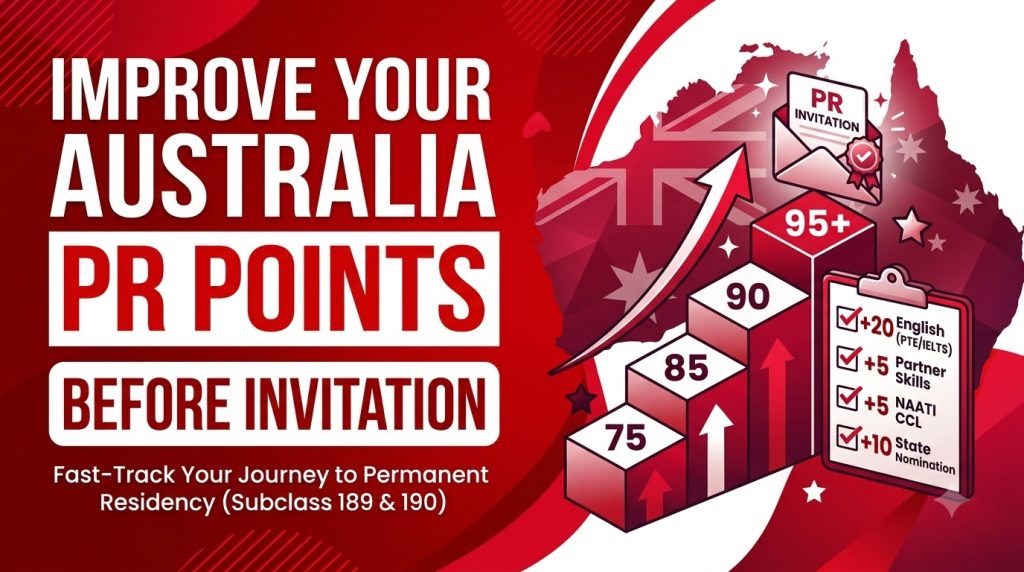
Reaching 65 points makes you eligible to submit an Expression of Interest for Australian permanent residency. It does not get you invited. Invitations go to the highest-ranked candidates in each occupation, and in recent rounds many occupations have needed scores well above the minimum. If your EOI is sitting in SkillSelect without an invitation, the most effective thing you can do is improve your Australia PR points before the next round.
This guide explains which points you can still influence, how much each one is worth, how long each improvement realistically takes and which mistakes quietly cost applicants their place in the queue. It is written for applicants preparing from the UK, but the rules apply to everyone using the Australia PR points system for the 189, 190 and 491 visas.
How Australia PR Points Work Before an Invitation
Three things decide whether you are invited:
- Your points score: SkillSelect ranks EOIs within each occupation from highest to lowest score.
- Your date of effect: When candidates have the same score, the one who reached that score earlier is invited first.
- Occupation demand: The number of invitations available for your occupation in each round limits how far down the ranking the Department reaches.
One rule shapes every strategy in this guide: you must actually hold every point you claim at the moment you are invited. Points you expect to earn next month do not count. If you claim points you cannot prove at the invitation date, your visa application can be refused, so every improvement must be completed and documented before you update your EOI.
Australia PR Points Table: What You Can and Cannot Change
Before you plan improvements, separate the factors you control from the ones you do not. The table below shows the current points test and how realistic it is to improve each factor.
| Factor | Points available | Can you improve it? |
|---|---|---|
| Age | 25 (18–24), 30 (25–32), 25 (33–39), 15 (40–44) | No, but timing matters |
| English | 0 (Competent), 10 (Proficient), 20 (Superior) | Yes, often the fastest gain |
| Skilled employment outside Australia (last 10 years) | 5 (3–4 yrs), 10 (5–7 yrs), 15 (8–10 yrs) | Yes, over time |
| Skilled employment in Australia (last 10 years) | 5 (1–2 yrs), 10 (3–4 yrs), 15 (5–7 yrs), 20 (8–10 yrs) | Only if working in Australia |
| Qualification | 20 (Doctorate), 15 (Bachelor’s or Master’s), 10 (Diploma or trade) | Rarely, and slowly |
| Partner | 10 (single, or partner is an Australian citizen or PR), 10 (partner with skills assessment and Competent English), 5 (partner with Competent English only) | Yes, if partnered |
| Credentialled community language | 5 | Yes, if bilingual |
| Australian study, regional study, specialist education, Professional Year | 5, 5, 10, 5 | Only through study in Australia |
| Nomination | 5 (190), 15 (491) | Yes, through state or regional nomination |
Combined employment points are capped at 20. Use our Australia PR points calculator to see your current score before deciding where to focus.
Proven Ways to Improve Your Australia PR Points
1. Move up to Proficient or Superior English (up to 20 points)
For most applicants, English is the single biggest lever. Competent English is the minimum requirement and earns nothing. Proficient adds 10 points and Superior adds 20, and you can often achieve the jump within a few months of focused preparation.
The required scores changed for tests taken on or after 7 August 2025. Many older guides still quote the previous PTE scores of 65 and 79 in each component, which now apply only to older tests.
| Level (tests from 7 August 2025) | IELTS (each band) | PTE Academic (Listening / Reading / Writing / Speaking) | Points |
|---|---|---|---|
| Competent | 6.0 | 47 / 48 / 51 / 54 | 0 |
| Proficient | 7.0 | 58 / 59 / 69 / 76 | 10 |
| Superior | 8.0 | 69 / 70 / 85 / 88 | 20 |
Only PTE Academic is accepted for skilled migration. PTE Core is not. Results from tests taken on or before 6 August 2025 can generally still be used until 6 August 2028, depending on the visa. Our guide to the PTE score for Australia PR explains the scoring in more depth.
British, Irish, American, Canadian and New Zealand passport holders automatically meet Competent English. That earns zero points, though, so a test is still worth taking if you want the 10 or 20. If you have already missed your target score, our advice on overcoming failed English tests for Australia PR covers practical ways to close the gap. These include switching test formats and targeting the specific component holding you back.
2. Reach the next work experience threshold (5 to 20 points)
Employment points are awarded in bands, so crossing a threshold can add 5 points overnight. Moving from two years and eleven months of overseas experience to three years takes you from 0 to 5 points. Moving from four years and eleven months to five years takes you from 5 to 10.
Only skilled employment counts. It generally needs to be paid work of at least 20 hours a week in your nominated or a closely related occupation. It must also fall after the date your assessing authority considers you skilled, which is often called the skill-met date. Experience before that date earns no points, even if it is listed on your CV. Read more about how UK work experience counts for Australia PR.
Two practical points matter here. First, check whether your skills assessment needs updating to show the extra experience, since some assessing authorities assess employment as well as qualifications. Second, experience only counts within the last 10 years, so older roles eventually drop out of the calculation. Our skills assessment guide for Australia PR explains how each authority treats employment.
3. Claim partner points (5 or 10 points)
If you have a spouse or de facto partner who is not an Australian citizen or permanent resident, the partner category is one of the most underused sources of points:
- 5 points: Your partner has at least Competent English. If your partner holds a British or Irish passport, this can be met through their passport without a test.
- 10 points: Your partner is under 45, has Competent English and holds a suitable skills assessment in an occupation on the same skilled occupation list as yours.
Single applicants, and applicants whose partner is an Australian citizen or permanent resident, automatically receive 10 points. A partner skills assessment takes effort and fees, but for couples where both have degree-level careers it often costs less than a second English retake that may not succeed.
4. Pass the NAATI CCL test (5 points)
The Credentialed Community Language (CCL) test from NAATI assesses your ability to interpret between English and another language at a community level. A pass adds 5 points. The test is delivered online only, so applicants based in the UK can sit it without travelling to Australia. The NAATI fee for 2026–27 is AUD 814. Languages and test dates vary, so check NAATI’s current list before preparing.
The CCL test suits applicants who are genuinely bilingual and comfortable switching quickly between languages. It is not a shortcut for people who speak a second language only casually, because the marking is detailed and deductions add up quickly.
5. Secure state or regional nomination (5 or 15 points)
If your score is not high enough for a 189 invitation, nomination can close the gap. A Skilled Nominated 190 visa adds 5 points. A Skilled Work Regional 491 visa adds 15 points, through state nomination or sponsorship by an eligible relative living in a designated regional area.
Nomination comes with conditions. Each state publishes its own occupation priorities and criteria, and some favour people already living there. The regional 491 visa requires you to live and work in regional Australia. The regional allocation for 2026–27 has also been cut significantly, so competition for 491 places is likely to be stronger. Many states also run their own registration systems on top of SkillSelect, as shown by Victoria’s skilled nomination programme for 2026–27.
6. Check your qualification points are correct
Gaining a higher qualification is rarely a quick fix. A master’s degree earns the same 15 points as a bachelor’s degree, and only a doctorate earns 20. It is worth confirming, though, that you are receiving the qualification points you are entitled to. Your assessing authority must recognise your degree as comparable to an Australian bachelor’s degree for you to claim 15 points. If it has assessed your qualification at a lower level, you may only be able to claim 10. Understand exactly what your skills assessment outcome letter says before you claim points in your EOI.
7. Australian study points: useful, but not a shortcut
Several categories reward study in Australia. These include the Australian study requirement (5 points), study in regional Australia (5 points), a specialist education qualification in a STEM field (10 points) and the Professional Year (5 points). They are only available to people who study in Australia, and the cost and time involved are significant. They make sense if you were already planning to study in Australia. Our guide on getting PR in Australia after a study visa explains this route, but it should not be treated as a quick way to add points.
Want a clear plan for your score? GIEC Global UK can review your current points, skills assessment outcome and EOI. We will identify which improvements are realistic for you before you spend money on retakes, assessments or courses.
Protect the Points You Already Have
Improving your score is only half the strategy. Many applicants lose points without noticing:
- Age brackets: Your age points fall from 30 to 25 when you turn 33, and from 25 to 15 when you turn 40. Applicants are not eligible once they turn 45. If a birthday is approaching, time your other improvements carefully. Our guide on the maximum age for Australia PR from the UK explains the age rules in detail.
- English test validity: For skilled visas, your test must generally have been taken within the three years before the relevant date. An expired result means losing your English points until you retest.
- Skills assessment validity: A skills assessment is usually valid for three years unless the assessing authority specifies a shorter period. An expired assessment makes your EOI unusable.
- Experience dropping out: Employment points only count work within the last 10 years, so older experience gradually stops counting.
- EOI expiry: An EOI remains in SkillSelect for two years. If it expires, you must submit a new one with a new date of effect.
Date of Effect: Why Timing Matters as Much as Points
When many applicants share the same score in a popular occupation, the date of effect decides who is invited first. This is the date and time your EOI reached its current score. When your points change, whether because you entered a new English result or because SkillSelect recalculated your age or experience, your date of effect changes too.
This has three practical consequences:
- Update quickly once a gain is final: If you have passed a higher English level or crossed an experience threshold, update your EOI promptly. Every day you delay, other applicants can reach the same score ahead of you.
- Do not wait for a perfect score before lodging: An EOI at a lower score still holds a place in the ranking, and some states search the pool for candidates at different score levels.
- Watch for automatic decreases: When an age milestone reduces your score, you may move behind applicants you were previously ahead of.
Our guide on getting an Australia PR invitation from the UK explains how rounds are run and how state selection works alongside the federal ranking.
Which Improvement Should You Focus On First?
| Strategy | Points gained | Typical time needed | Best suited to |
|---|---|---|---|
| English retake (Proficient to Superior) | +10 | Weeks to a few months | Applicants close to Superior in most components |
| English upgrade (Competent to Proficient) | +10 | Weeks to a few months | Most applicants without Proficient yet |
| Partner English | +5 | Immediate to a few months | Couples, especially with a UK or Irish passport-holding partner |
| Partner skills assessment | +10 | Several months | Couples where both work in listed occupations |
| NAATI CCL | +5 | One to three months of preparation | Genuinely bilingual applicants |
| Next experience threshold | +5 | Depends on how close you are | Applicants within months of 3, 5 or 8 years |
| State nomination (190) | +5 | Depends on state rounds | Occupations prioritised by a state |
| Regional nomination (491) | +15 | Depends on state rounds | Applicants willing to live regionally |
Example: from 60 to 80 points
Consider a 31-year-old software engineer in London. She has a bachelor’s degree, four years of skilled experience after her skill-met date and Proficient English, and her partner holds a British passport:
- Age 30 + English 10 + overseas experience 5 + degree 15 = 60 points, below the minimum.
- Claiming Competent English for her partner through his British passport: 65 points.
- Achieving Superior English: 75 points.
- Reaching five years of skilled experience: 80 points for the 189, or 85 with state nomination.
The order matters. Her 33rd birthday will cost her 5 age points, so her English retake and EOI update should happen well before then.
2026 Changes That Affect Your Points Strategy
- Points test reform is coming, but not yet in force: The May 2026 Federal Budget confirmed that the points test will be redesigned to favour younger, more highly skilled and better-educated migrants. No start date or new point values have been legislated, so the current test still applies. Securing your strongest English result now is sensible under either system.
- More 189 places, fewer regional places: The 2026–27 Migration Program increased Skilled Independent places while sharply reducing the regional allocation. Strong independent scores may matter more than before.
- Occupation demand shapes invitations: Your required score depends heavily on your occupation. In the June 2026 round, minimum invited scores ranged from 65 to 100 depending on the occupation.
- Higher fees: Visa application charges rose by around 25% from 1 July 2026, which makes getting your points right before you apply even more important.
Mistakes That Cost Applicants Points
- Overclaiming in the EOI: Claiming experience before your skill-met date, or an English level you cannot prove, can lead to refusal after invitation.
- Booking the wrong test: PTE Core is not accepted for skilled migration, so book PTE Academic.
- Relying on outdated score