
Australia continues to attract international students who want to gain internationally recognised qualifications, develop professional skills and explore long-term opportunities overseas. For many students, studying in Australia is not only an educational decision but also an opportunity to understand whether they may qualify for permanent residency (PR) in the future.
However, permanent residency after studying australia is not automatic. Completing a bachelor’s degree, master’s qualification or PhD does not guarantee an invitation for skilled migration or approval of a permanent visa. Graduates must meet the specific immigration requirements applicable to their chosen pathway.
If you are considering how to get PR in Australia after study, it is important to understand the relationship between your qualification, nominated occupation, skills assessment, English-language ability, age and potential points score.
Can You Get Permanent Residency in Australia After Studying?
Yes. International students may be eligible to apply for Australian permanent residency after completing their studies if they satisfy the requirements of an available migration pathway.
However, an Australian qualification by itself does not provide permanent residency. Your eligibility depends on the occupation you intend to nominate, the relevant skilled occupation list, your skills assessment, age, English-language results and other visa-specific requirements.
Is Studying in Australia a Direct Pathway to PR?
Studying in Australia can help you develop the qualifications required for certain occupations. It may also help you meet the Australian study requirement for points-tested skilled migration, provided the relevant conditions are satisfied.
Depending on your circumstances, you may investigate:
- Skilled Independent visa (subclass 189).
- Skilled Nominated visa (subclass 190).
- Skilled Work Regional (Provisional) visa (subclass 491).
- Permanent Residence (Skilled Regional) visa (subclass 191).
- Temporary Graduate visa (subclass 485), as a temporary post-study option.
The best pathway will depend on your qualifications, occupation, personal circumstances and the immigration requirements in force when you apply.
Understanding the Australia Study-to-PR Pathway
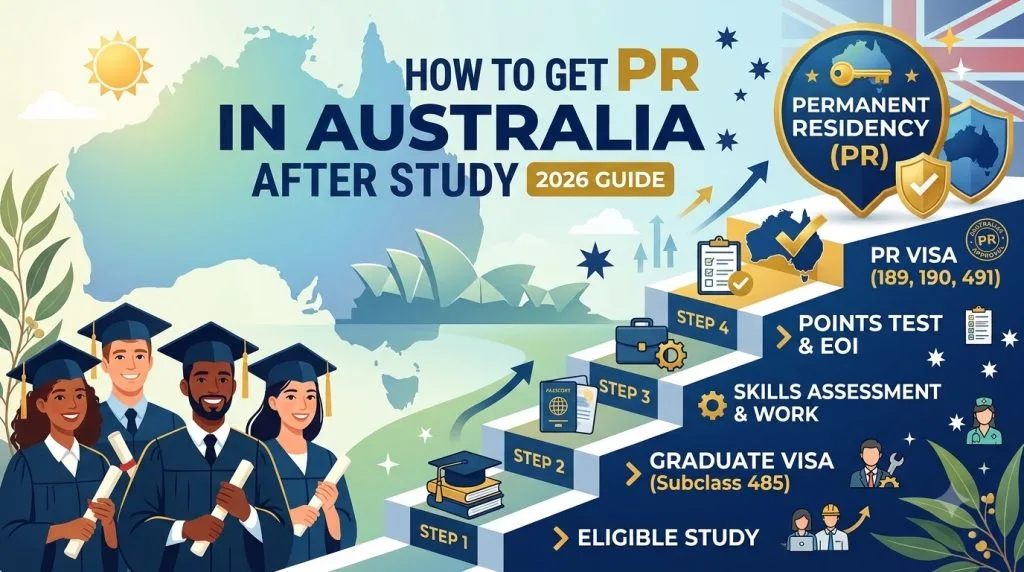
A study-to-PR pathway generally involves several stages. It is not a single visa or an automatic process that begins when you graduate.
How Does the Study-to-PR Process Work?
- Select an Australian course that supports your academic and career objectives.
- Complete the qualification and satisfy the relevant Australian study requirements.
- Identify an occupation that matches your qualifications and professional background.
- Check whether the occupation is eligible for your intended skilled visa.
- Review the relevant skills assessment requirements.
- Check your English-language ability and potential PR points.
- Explore an appropriate skilled migration pathway.
- Submit an Expression of Interest (EOI), if required.
- Receive an invitation or nomination where applicable.
- Apply for the relevant visa and provide supporting documents.
This sequence is a planning framework, not a guarantee of eligibility. Some applicants may need additional qualifications, professional registration or work experience.
Main Permanent Residency Pathways After Studying in Australia
International graduates may explore different skilled migration options depending on their qualifications, occupation and eligibility.
1. Skilled Independent Visa (Subclass 189)
The Skilled Independent visa (subclass 189) is a points-tested permanent visa for eligible skilled workers. It allows successful applicants to live and work permanently in Australia without requiring state or territory nomination.
Subclass 189 Visa Eligibility Requirements
- Your nominated occupation must be eligible for the relevant visa stream.
- You must obtain a suitable skills assessment.
- You must satisfy the age requirement.
- You must demonstrate at least competent English.
- You must score at least 65 points under the applicable points test.
- You must submit an Expression of Interest through SkillSelect.
- You must receive an invitation to apply.
Applicants must generally be under 45 years old when invited to apply.
Is 65 Points Enough to Get Australian PR?
Not necessarily. Sixty-five points is the minimum threshold for the points-tested subclass 189 visa, not a guaranteed invitation score.
The Department of Home Affairs may consider points rankings, occupation availability and the number of invitations in relevant rounds. Some occupations may require a considerably stronger points profile to receive an invitation.
Official information: Skilled Independent Visa Subclass 189.
2. Skilled Nominated Visa (Subclass 190)
The Skilled Nominated visa (subclass 190) is a permanent skilled migration visa that requires nomination from an Australian state or territory government.
This option may be worth investigating for graduates whose nominated occupation, qualifications and circumstances match the nomination priorities of a particular state or territory.
Subclass 190 Visa Requirements
- Nominated occupation.
- Qualifications and suitable skills assessment.
- Relevant employment experience, where required.
- English-language ability.
- State or territory-specific eligibility criteria.
- Invitation to apply.
Each state and territory has its own nomination arrangements. Studying in a particular state does not automatically make you eligible for its nomination programme.
Successful nomination provides an additional 5 points under the applicable points test.
Official information: Skilled Nominated Visa Subclass 190.
3. Skilled Work Regional (Provisional) Visa (Subclass 491)
The Skilled Work Regional (Provisional) visa (subclass 491) is designed for eligible skilled workers who want to live and work in designated regional areas of Australia.
Applicants may qualify through nomination by a state or territory government agency or sponsorship by an eligible relative, subject to the relevant requirements.
Subclass 491 Visa Requirements
- An occupation on the relevant skilled occupation list.
- A suitable skills assessment.
- An invitation to apply.
- Meeting the applicable points test.
- State or territory nomination or eligible relative sponsorship.
The visa generally allows eligible holders to stay in Australia for five years and live, work and study in designated regional areas.
Can Regional Study Improve Your PR Opportunities?
Regional study may be worth considering for students who are comfortable living outside Australia’s major metropolitan areas.
Eligible regional study can provide 5 additional points under the relevant points test. However, the study must satisfy the Australian study requirement, and the applicant must meet the applicable residence and campus requirements.
Studying in regional Australia does not automatically provide a 491 nomination or guarantee permanent residency.
Official information: Skilled Work Regional Visa Subclass 491.
4. Permanent Residence (Skilled Regional) Visa (Subclass 191)
The subclass 191 visa is a permanent residency pathway for eligible holders of certain regional provisional visas, including subclass 491.
Subclass 191 Visa Requirements
- Hold an eligible subclass 491 or subclass 494 visa for at least three years.
- Comply with the conditions of the eligible visa.
- Provide Australian Taxation Office notices of assessment for three income years out of the five years of the eligible visa.
- Satisfy the applicable health and character requirements.
The current subclass 191 regional provisional stream does not impose a minimum income threshold, although the required tax assessment notices must be provided.
Official information: Permanent Residence Skilled Regional Visa Subclass 191.
What Is the Role of the Temporary Graduate Visa (Subclass 485)?
The Temporary Graduate visa (subclass 485) is an important consideration for international students who have recently completed eligible Australian qualifications.
It allows eligible graduates to live, work and study in Australia temporarily after completing their studies.
Although the subclass 485 visa is not a permanent visa, it may provide additional time to develop professional experience, understand the Australian employment market and investigate possible skilled migration options.
How Long Can You Stay in Australia After Studying?
Under the Post-Higher Education Work stream, the general stay periods depend on the qualification answer with ” which masters degrees lead to pr in australia international “ .
| Australian Qualification | General Stay Period |
|---|---|
| Bachelor degree, including honours | 2 years |
| Master’s by coursework | 2 years |
| Master’s by research | 3 years |
| Doctoral degree (PhD) | 3 years |
These are general periods and should not be assumed to apply identically to every passport holder.
Special 485 Arrangements for Indian Graduates
Under the Australia–India Economic Cooperation and Trade Agreement (AI-ECTA), eligible Indian graduates may receive different post-study stay periods.
| Qualification for Eligible Indian Nationals | Stay Period |
|---|---|
| Bachelor degree, including honours | 2 years |
| Bachelor degree with first-class honours in STEM, including ICT | 3 years |
| Master’s by coursework | 3 years |
| Master’s by extended study | 3 years |
| Master’s by research | 3 years |
| Doctoral degree (PhD) | 4 years |
These arrangements are particularly important when comparing postgraduate study options. Eligible Indian graduates should check the current Department of Home Affairs requirements and their passport-based eligibility before relying on a particular stay period.
What Are the Main Eligibility Requirements for the 485 Visa?
- Being aged 35 or under when applying, subject to applicable exceptions.
- Being in Australia when applying.
- Holding an eligible visa.
- Having held a Student visa within the previous six months.
- Completing an eligible degree-level qualification from a CRICOS-registered course.
- Meeting the English-language requirements.
- Providing evidence of adequate health insurance.
- Satisfying the applicable health and character requirements.
Some applicants using a Master’s by research or doctoral qualification to meet the study requirement may qualify for the higher age limit of under 50.
Important: The subclass 485 visa does not guarantee Australian PR. It is a temporary visa, and applicants must independently qualify for a suitable permanent residency pathway.
Official information: Temporary Graduate Visa Subclass 485.
Which Master’s Degrees Can Help With PR in Australia?
One of the most frequently asked questions among international students is: which master’s degrees lead to PR in Australia?
There is no official universal list of Master’s degrees that guarantees permanent residency.
The relevant question is whether a qualification supports a realistic professional occupation that is eligible under the intended migration pathway and whether the graduate can meet the associated skills assessment and other requirements.
1. Master’s in Information Technology and Computer Science
Information technology is a broad academic and professional field.
Popular IT and Computer Science Courses
- Master of Information Technology.
- Master of Computer Science.
- Master of Software Engineering.
- Master of Cybersecurity.
- Master of Data Science.
- Master of Information Systems.
These qualifications may support careers in software development, information systems, cybersecurity, data analysis and other technology-related fields.
However, not every IT qualification is suitable for every nominated occupation. The Australian Computer Society (ACS) has its own assessment requirements, which may consider the applicant’s qualification, major, subjects and professional experience.
2. Master’s in Engineering
Engineering qualifications may support careers across infrastructure, construction, manufacturing, energy and technology-related industries.
Popular Engineering Master’s Courses
- Master of Civil Engineering.
- Master of Mechanical Engineering.
- Master of Electrical Engineering.
- Master of Engineering Management.
- Master of Structural Engineering.
- Master of Environmental Engineering.
Engineering qualifications should be evaluated against the relevant occupational classification and Engineers Australia’s assessment requirements.
3. Master’s in Nursing and Healthcare
Nursing and selected healthcare qualifications are frequently researched by students interested in professional opportunities in Australia.
Popular Healthcare Courses
- Master of Nursing.
- Master of Public Health.
- Master of Clinical Nursing.
- Master of Health Administration.
- Selected allied health qualifications.
Academic qualification and professional registration are separate matters. For regulated professions, applicants may need to satisfy registration requirements, professional standards, English-language criteria and relevant skills assessment conditions.
For example, completing a healthcare-related Master’s degree does not automatically qualify someone to practise as a registered nurse in Australia.
4. Master’s in Teaching and Education
Education is another area that attracts international students.
Popular Education Courses
- Master of Teaching (Primary).
- Master of Teaching (Secondary).
- Master of Education.
- Master of Educational Leadership.
- Master of Special Education.
Is Master of Education on Australia’s PR List?
There is no general PR entitlement attached to the course title Master of Education. The relevant question is whether the applicant’s qualifications and professional background meet the criteria for a particular eligible occupation.
A Master of Education may develop knowledge in educational policy, leadership, curriculum or research. It does not automatically provide the professional teaching qualification or registration required for a particular teaching occupation.
5. Master’s in Research and PhD Programmes
Research-based postgraduate qualifications may support academic, scientific and research careers.
Popular Research Qualifications
- Master of Research.
- Master of Philosophy.
- Doctor of Philosophy (PhD).
- Research degrees in science, technology, engineering and mathematics.
Certain Australian postgraduate research qualifications in specified STEM and ICT fields may also be relevant to the specialist education qualification points category, subject to the detailed requirements.
How Should You Choose the Right Master’s Degree?
- Identify the professional occupation you want to pursue.
- Check whether the occupation is eligible for your intended migration pathway.
- Review the relevant skills assessment authority’s requirements.
- Compare the course curriculum with the occupation’s requirements.
- Check whether professional registration is required.
- Investigate employment opportunities in the relevant industry.
- Compare tuition fees, course duration and living expenses.
- Check whether the qualification satisfies the Australian study requirement.
The best course is one that supports your academic, professional and long-term objectives, rather than one selected solely because it is advertised as a PR course.
Australia PR Requirements for International Students
The Australia PR requirements for international students depend on the visa subclass. For points-tested skilled migration, applicants commonly need to consider the following factors.
Age Requirements
Age is an important component of the skilled migration points test. For the points-tested subclass 189 visa, applicants must generally be under 45 when invited to apply.
Eligible Skilled Occupation
Your nominated occupation must be eligible for the particular visa pathway.
Australia’s skilled occupation information includes occupation codes, relevant assessing authorities and other eligibility details.
Students should not assume that every occupation appears on every skilled migration list.
Official information: Australian Skilled Occupation List.
Skills Assessment
A skills assessment is an important requirement for many skilled migration applications. The relevant assessing authority examines whether your qualifications and, where required, employment experience meet the standards for your nominated occupation.
Examples of Skills Assessment Authorities
- Engineers Australia assesses relevant engineering occupations.
- The Australian Computer Society assesses relevant ICT occupations.
- The Australian Nursing and Midwifery Accreditation Council assesses relevant nursing occupations.
- VETASSESS assesses a range of professional and other occupations.
English-Language Requirements
English-language ability can affect both visa eligibility and points. Applicants may need to demonstrate competent, proficient or superior English, depending on their visa and circumstances.
Health and Character Requirements
Applicants must satisfy the applicable health and character requirements. Depending on individual circumstances, this may involve medical examinations, police certificates and supporting information for family members included in the application.
Supporting Documentation
- Valid passport and identity documents.
- Academic certificates and transcripts.
- English-language test results.
- Skills assessment outcome.
- Employment references, where applicable.
- Evidence of skilled employment.
- Relationship documents, where applicable.
- Health and character documents.
- Evidence supporting all claims in the Expression of Interest.
Australia PR Points System for International Students
The skilled migration points system is an important consideration for graduates who intend to apply through points-tested visa pathways.
The points test considers several factors, including age, English-language ability, qualifications, skilled employment, Australian study, regional study and partner skills.
Which Factors Can Increase Your PR Points?
| Factor | Potential Points |
|---|---|
| Age 25 to under 33 | 30 |
| Age 18 to under 25 | 25 |
| Age 33 to under 40 | 25 |
| Proficient English | 10 |
| Superior English | 20 |
| Australian study requirement | 5 |
| Eligible regional Australian study | 5 |
| Eligible specialist educational qualification | 10 |
| Eligible Professional Year | 5 |
| Eligible credentialled community language | 5 |
| Subclass 190 state nomination | 5 |
| Subclass 491 state or eligible family nomination/sponsorship | 15 |
The table highlights selected categories, not a complete points calculation. Eligibility conditions apply to each category, and applicants should use the current official points table.
Does Studying in Australia Give You PR Points?
Meeting the Australian study requirement can provide 5 points under the relevant skilled migration points test. However, the qualification must satisfy the applicable Australian study requirement.
Can Regional Study Increase Your PR Points?
Eligible regional study may provide an additional 5 points. To qualify, the applicant generally needs to have lived and studied at an eligible regional campus and completed a qualification that meets the Australian study requirement.
How Can English-Language Results Affect PR Points?
- Competent English: 0 points.
- Proficient English: 10 points.
- Superior English: 20 points.
For an individual estimate, use the official Department of Home Affairs points information and the GIEC Australia PR Points Calculator.
Can I Apply for PR in Australia While Studying?
Many international students ask whether they can apply for permanent residency before completing their Australian degree.
The answer depends on the visa subclass and the applicant’s existing qualifications and circumstances.
Being enrolled at an Australian university does not automatically make someone eligible for PR. Some students may already have qualifications and professional experience from overseas that could make them eligible to investigate skilled migration before graduating.
What Can You Do While Studying?
- Research your intended skilled occupation.
- Check the current occupation list.
- Understand the skills assessment process.
- Review English-language requirements.
- Monitor relevant state nomination programmes.
- Maintain your academic records and qualification documents.
- Research professional registration requirements.
- Understand the conditions of your current Student visa.
It is important to comply with all Student visa conditions throughout your studies. A future intention to apply for PR does not replace your existing visa obligations.
Step-by-Step: How to Apply for PR in Australia After Study
Step 1: Identify Your Nominated Occupation
Start by deciding which professional occupation you intend to nominate. Your occupation should be consistent with your academic qualifications, professional background and the requirements of the relevant assessing authority.
Step 2: Check the Skilled Occupation List
Review the official skilled occupation information for the visa you intend to explore. Check the relevant occupation code, visa eligibility and assessing authority.
Step 3: Review Your Qualification and Skills Assessment Requirements
Compare your academic records and course content with the requirements of the relevant skills assessing authority.
Step 4: Check Your English-Language Ability
Review the English-language standard required for your intended visa. If you intend to claim additional points, investigate the test scores needed for proficient or superior English.
Step 5: Calculate Your Potential PR Points
Review your age, qualification, English results, skilled employment and other eligible factors. You can use the official points information and calculator to estimate your potential score.
Step 6: Explore State Nomination and Regional Options
If subclass 190 or subclass 491 may suit your circumstances, review the relevant state and territory nomination requirements.
Step 7: Consider the Subclass 485 Visa, If Eligible
If you qualify, the Temporary Graduate visa may allow you to remain in Australia temporarily after completing your studies.
Step 8: Submit an Expression of Interest
For relevant points-tested skilled migration pathways, applicants submit an Expression of Interest through SkillSelect. An EOI communicates your interest in applying and provides information about your qualifications, occupation and claimed points.
Step 9: Receive an Invitation or Nomination
Depending on the visa pathway, you may need an invitation and state or territory nomination. Invitation outcomes depend on the applicable requirements, available places and selection processes.
Step 10: Prepare and Submit Your Visa Application
If invited and eligible, prepare the required documentation and submit your application through the official system. Check all details carefully and ensure your claims are supported by evidence.
How Long Does It Take to Get PR in Australia After Studying?
There is no fixed timeframe for permanent residency after studying in Australia.
Factors That Affect Your PR Timeline
- Completing your qualification.
- Preparing a skills assessment.
- Meeting English-language requirements.
- Gaining any necessary professional experience.
- Submitting an Expression of Interest.
- Waiting for a nomination or invitation.
- Preparing and lodging the permanent visa application.
- Waiting for a decision.
The subclass 491 to subclass 191 pathway also involves a separate regional provisional period. Eligible applicants must generally hold the qualifying visa for at least three years before applying for subclass 191.
Remember that visa processing time is different from the total time required to become eligible for PR.
Which Australian Courses Give the Longest Post-Study Work Visa?
Course duration and post-study visa duration are two different things. A longer academic programme does not automatically provide a longer post-study stay period.
General Post-Study Work Periods
- Two years after an eligible bachelor’s degree.
- Two years after an eligible Master’s by coursework or extended degree.
- Three years after an eligible Master’s by research.
- Three years after an eligible doctoral degree.
Different arrangements apply to eligible Indian nationals under AI-ECTA, including longer stay periods for certain postgraduate qualifications.
Common Mistakes International Students Should Avoid
1. Choosing a Course Only Because It Is Advertised as a PR Course
No university or education provider can guarantee permanent residency through a particular course.
2. Ignoring the Skills Assessment
A qualification may not satisfy the requirements of the relevant assessing authority.
3. Assuming 65 Points Guarantees an Invitation
The minimum threshold does not guarantee selection.
4. Confusing a Master’s Degree With Professional Registration
A postgraduate academic qualification does not automatically provide professional registration in regulated occupations.
5. Ignoring the Age Requirement
Age can affect both eligibility and the points available under the skilled migration system.
6. Waiting Until Graduation to Research Migration Options
It is better to understand your intended occupation and assessment requirements before enrolling.
7. Relying on Outdated Occupation Lists
Occupation eligibility and state nomination priorities may change. Always check current official information.
8. Assuming a Regional University Guarantees PR
Regional study may provide certain benefits under the relevant points test, but it does not guarantee nomination or permanent residency.
How to Plan Your Study-to-PR Journey Before Choosing a University
A successful education decision should consider more than university rankings and course fees.
Academic Planning
- Identify your preferred area of study.
- Compare relevant universities and courses.
- Review course entry requirements.
- Confirm the course and provider’s CRICOS registration.
- Understand the duration and tuition fees.
Career Planning
- Identify your intended occupation.
- Research professional accreditation requirements.
- Check the relevant skills assessment authority.
- Investigate realistic employment opportunities.
- Consider whether additional professional registration is necessary.
Migration Planning
- Review the current occupation list.
- Understand the 189, 190 and 491 requirements.
- Check your potential PR points.
- Review the subclass 485 eligibility rules.
- Investigate state nomination requirements.
- Understand the conditions of your current visa.
Financial Planning
- Compare tuition fees and living expenses.
- Prepare a realistic study budget.
- Understand the additional costs of English tests, assessments and visa applications.
- Consider the financial implications if migration rules change.
How GIEC Global Can Help With Your Australia Study Plans
Choosing an Australian university and understanding possible future migration options require careful planning.
GIEC Global helps students explore international education opportunities and understand the important considerations involved in selecting a suitable course and institution.
Our Education Support Includes
- Australian university and course options.
- Course entry requirements.
- Tuition fees and available intakes.
- Academic eligibility.
- Study application procedures.
- Relevant education and migration information.
- Questions to discuss with an appropriately authorised Australian migration professional.
If your long-term objective includes permanent residency, it is important to understand the distinction between education advice and formal immigration advice.
Visa eligibility should always be assessed against current Australian immigration legislation and your individual circumstances.
Planning to study in Australia? Visit GIEC Global to explore Australian study opportunities.
You can also learn more about Australian Permanent Residency and use the Australia PR Points Calculator to explore the points system.
Final Thoughts: Is Permanent Residency After Studying in Australia Possible?
Permanent residency after studying in Australia may be possible for international students who meet the requirements of an eligible migration pathway.
However, completing a degree does not automatically provide PR, and no particular Master’s course guarantees a successful migration outcome.
The most practical approach is to identify your intended occupation before selecting a course, understand the relevant skills assessment requirements, review the Australian PR points system and compare the available skilled migration pathways.
The subclass 485 visa may provide eligible graduates with temporary post-study options, while subclasses 189, 190 and 491 may offer different routes to skilled migration depending on individual eligibility.
If you are considering studying in Australia in 2026, start by researching your academic and career options together. A well-informed decision can help you build a stronger educational foundation while keeping realistic future migration possibilities in view.
Always verify the latest requirements through the Australian Department of Home Affairs before making an education or migration decision.
Frequently Asked Questions
How to get PR in Australia after study?
First identify an eligible occupation and migration pathway, then check the skills assessment, English, age, points and other requirements. Depending on your circumstances, options may include skilled, state-nominated, regional or employer-sponsored pathways.
Can I get PR in Australia after completing my Master's degree?
Yes, it may be possible if you meet the requirements of an eligible visa pathway. A Master's degree alone does not guarantee permanent residency.
Which Master's degrees lead to PR in Australia for international students?
No Master's degree guarantees PR. Compare course content, eligible occupations, skills assessment requirements, professional registration and employment opportunities before enrolling.
What is the easiest way to get PR in Australia for international students?
There is no universally easiest route. The most suitable pathway depends on your occupation, qualifications, age, English ability, work experience, points and whether you can obtain nomination or employer sponsorship.
Can I apply for PR in Australia while studying?
You can research pathways and prepare where possible while studying, but eligibility depends on the visa. Some pathways require a completed qualification, skills assessment, invitation or other conditions.
Does studying in Australia guarantee permanent residency?
No. Completing an Australian qualification does not automatically provide PR eligibility or guarantee a visa invitation or approval.
What is the 485 visa after studying in Australia?
The Temporary Graduate visa subclass 485 allows eligible graduates to live, work and study temporarily after completing an eligible qualification. It is not a permanent visa.
How long can I stay in Australia after my Master's degree?
The stay period depends on your qualification, visa stream and circumstances. Under the general Post-Higher Education Work stream settings, a Master's by coursework or extended degree usually allows two years, while specific arrangements may differ for eligible applicants.
Can I get PR in Australia after a PhD?
A PhD may support your career and some migration options, but it does not guarantee PR. You must meet the requirements of the visa pathway you choose.
Is a Master of Education on the Australian PR list?
The course title alone does not determine eligibility. Check whether your intended teaching or education occupation is eligible and whether your qualification meets the relevant skills assessment and registration requirements.
How many points do I need for Australian PR after studying?
The points-tested subclass 189 pathway has a minimum threshold of 65 points, but meeting that threshold does not guarantee an invitation. Other pathways have their own requirements.
How much time does it take to get PR in Australia for international students?
There is no fixed timeframe. The total period depends on eligibility, skills assessment, work experience, invitation or nomination, visa processing and individual circumstances.
Can I get Australian PR without work experience after a Master's degree?
It depends on the visa pathway and occupation. Some pathways may not require the same employment evidence as others, but you must satisfy all applicable criteria and the skills assessment requirements.
Can international students apply for the subclass 189 visa?
Eligible graduates may apply if they meet the subclass 189 requirements and receive an invitation. They generally need an eligible occupation, a suitable skills assessment, the required points and competent English.
What is the difference between subclass 189 and subclass 190?
Subclass 189 is a points-tested permanent skilled visa that does not require state nomination. Subclass 190 is a permanent skilled visa that requires nomination by an Australian state or territory.
Can regional study help with Australian PR?
Regional study may be relevant to some migration strategies, but it does not guarantee nomination or PR. Check the current regional definitions and the requirements of the specific visa.
Can I get PR in Australia after studying in the UK?
A UK qualification does not automatically qualify you for Australian PR. You may be eligible for a skilled or other migration pathway if your qualifications, occupation, assessment and other circumstances meet the relevant requirements.
Do I need a skills assessment for Australian PR?
Many skilled migration pathways require a suitable skills assessment from the relevant authority. Requirements vary by visa and occupation.
Can I apply for Australian PR after my student visa expires?
You must hold a visa status that allows you to remain lawfully in Australia and meet the application requirements for the pathway. An Expression of Interest alone does not provide a bridging visa.
Where can I check the official Australian PR requirements?
Check the Australian Department of Home Affairs website at https://immi.homeaffairs.gov.au/ for current visa criteria, occupation information, fees and application procedures.