
Moving from the UK to Australia is a goal for many skilled professionals who want to develop their careers and build a long-term future overseas. If you have relevant qualifications and work experience, the Australian Skilled Nominated Visa (Subclass 190) may be one pathway to explore.
The Subclass 190 visa is a points-tested permanent visa for skilled workers nominated by an Australian state or territory government. It can allow successful applicants to live and work permanently in Australia. However, meeting the basic requirements does not guarantee an invitation or visa grant. Your occupation, skills assessment, points score and the nomination rules of your chosen state or territory all matter.
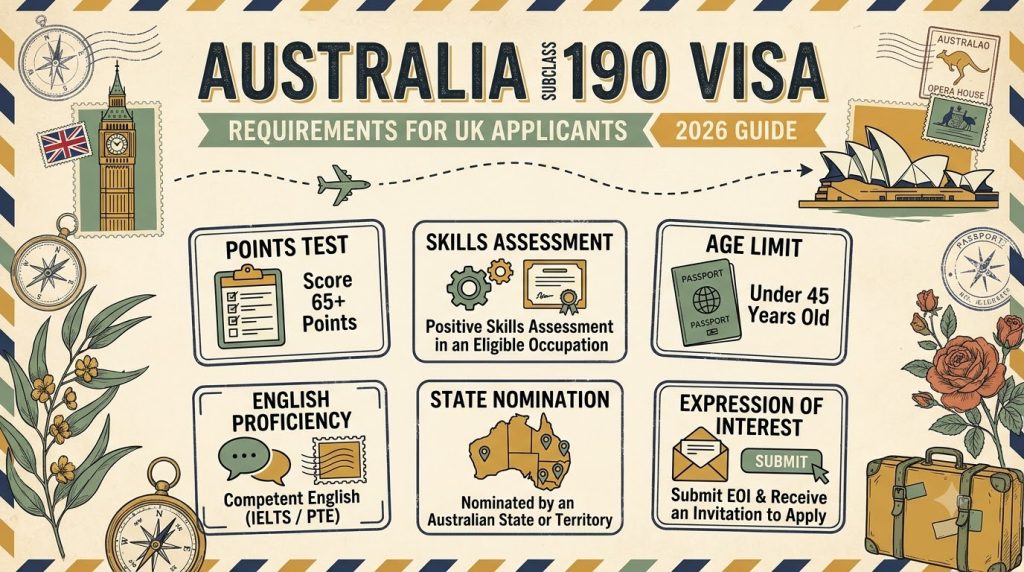
This guide explains the Australia 190 visa requirements for UK applicants in 2026, including age, English language, points, skills assessment, state nomination, application steps, costs and processing times. It also explains the difference between a skilled migration visa and a visitor visa for British citizens.
What Is the Australian Subclass 190 Visa?
The Skilled Nominated Visa (Subclass 190) is an Australian permanent residence visa for eligible skilled workers who receive nomination from an Australian state or territory government.
Unlike a visitor visa, it is designed for people seeking to live and work in Australia permanently. Once granted, the visa generally allows you to work and study anywhere in Australia, access Medicare if eligible, sponsor eligible relatives for permanent residence and travel to and from Australia for five years under the initial travel facility.
For UK applicants, the main point is that living in the UK or holding a British passport does not automatically qualify you for the Subclass 190 visa. You must meet the Australian skilled migration criteria and the nomination requirements of the state or territory you are applying through.
Official source: Department of Home Affairs — Skilled Nominated Visa Subclass 190.
Australia 190 Visa Requirements for UK Applicants
The main visa requirements generally include the following.
1. Age requirement
You must be under 45 years old when you receive the invitation to apply for the Subclass 190 visa. If you submit an Expression of Interest (EOI) before turning 45 but receive your invitation after your 45th birthday, you generally will not meet this age requirement.
Applicants living in the UK should consider their age early in the process because skills assessments, English tests and state nomination steps may take time. An EOI is not an invitation and does not guarantee that you will be invited before reaching the age limit.
2. Eligible skilled occupation
Your nominated occupation must be eligible under the relevant skilled occupation rules for Subclass 190. Having a job in the UK does not automatically mean that the same role qualifies for Australian skilled migration.
Check the occupation list and identify the assessing authority responsible for assessing your qualifications and work experience. Some occupations have specific requirements relating to qualifications, employment history, registration or professional licensing.
Before paying for a skills assessment, confirm that the occupation and assessing authority are appropriate for your intended visa pathway.
3. Suitable skills assessment
Most applicants need a suitable skills assessment for their nominated occupation. The assessment checks whether your qualifications and experience meet the standards set by the relevant Australian assessing authority.
UK qualifications and work experience may be useful, but recognition is not automatic. The assessing authority may request academic transcripts, certificates, employment references, payslips, contracts, detailed job descriptions or other supporting records.
The Department generally requires a suitable skills assessment at the relevant invitation stage. Check the current rules and validity period for your occupation before relying on an older assessment.
4. Points-test requirement
Subclass 190 is a points-tested visa. You generally need at least 65 points to meet the minimum points threshold, but the points required for an invitation may be higher depending on the occupation, state nomination program and invitation round.
Points may be available for factors such as:
- Age.
- English language ability.
- Skilled employment outside Australia.
- Skilled employment in Australia.
- Educational qualifications.
- Australian study or other eligible qualifications.
- Partner skills and other eligible factors.
- State or territory nomination.
Subclass 190 nomination generally contributes five points under the points test. You should calculate your score using the official points table and claim only points that you can substantiate with evidence.
Reaching 65 points does not guarantee an invitation. States and territories have their own priorities and may select applicants according to their specific workforce needs and nomination criteria.
Official source: Subclass 190 points table.
5. English language requirement
Applicants generally need at least competent English at the relevant stage. Higher English results may increase your points score.
If you are applying from the UK, do not assume that living in the UK automatically satisfies every English requirement. Your passport, citizenship and the current evidence rules may be relevant, and applicants should check what proof is accepted for their particular circumstances.
Depending on the rules in force and your circumstances, accepted evidence may include an eligible passport or an approved English test result. If you intend to use a test, confirm the accepted test types, minimum scores and validity requirements before booking.
A stronger English result can improve your points score, but it does not guarantee state nomination or an invitation.
6. State or territory nomination
The Subclass 190 visa requires nomination by an Australian state or territory government agency. Each jurisdiction sets its own nomination requirements, which may change between program years.
Depending on the state or territory, nomination criteria may consider:
- Whether your occupation is in demand.
- Your qualifications and skills assessment.
- Relevant employment experience.
- Your current employment and job offer, if required by that program.
- Your links to the state or territory.
- Whether you are living or working in that jurisdiction.
- Any specific commitment to live and work in the nominating jurisdiction.
Some programs accept applicants who are living overseas, while others may apply different criteria or priorities to offshore applicants. You should check the current requirements for each state rather than assuming that one state’s rules apply across Australia.
Official source: State and territory nomination allocations and information.
7. Health and character requirements
You and relevant family members included in the application must meet the applicable health and character requirements. The Department may request medical examinations, police certificates and additional information.
Applicants should disclose information accurately and follow the Department’s instructions. Previous visa refusals, immigration history or other personal circumstances may require careful review.
How to Apply for an Australian 190 Visa from the UK
The process generally involves several stages. The order and timing of state nomination steps can differ by jurisdiction, so always follow the current instructions for your chosen state or territory.
Step 1: Check your occupation
Identify the occupation you intend to nominate and confirm whether it is eligible for the Subclass 190 pathway. Review the relevant occupation list and assessing authority requirements.
Step 2: Review your eligibility and points
Check your age, qualifications, skilled employment history, English evidence and other points-test factors. Calculate your points conservatively and make sure you can prove every claim.
Step 3: Complete your skills assessment
Prepare the documents required by your occupation’s assessing authority. This may include qualifications, transcripts, employment references and evidence of your work duties.
Step 4: Research state nomination options
Compare the current requirements of Australian states and territories. Look for programs that accept applicants in your circumstances and check whether your occupation, employment background and location meet their criteria.
Step 5: Submit an Expression of Interest
Submit an EOI through SkillSelect when you have reviewed the applicable requirements and can support the claims you make. An EOI is not a visa application, and submitting one does not guarantee nomination or an invitation.
Some states and territories may require an additional registration of interest or a separate nomination application. Follow the current instructions for the relevant program.
Step 6: Receive nomination and an invitation
If a state or territory nominates you and the relevant process progresses, you may receive an invitation to apply for the visa. Nomination and invitation are separate from the final visa decision.
Step 7: Lodge the visa application
If invited, lodge the visa application within the deadline stated in your invitation. The Department’s current instructions generally give invited applicants 60 calendar days to apply. Submit supporting documents and pay the required application charge.
Step 8: Complete further checks
Respond to requests from the Department and complete any required health, character or additional document checks. Keep your contact details current and monitor your application.
Documents UK Applicants May Need
Your document checklist depends on your nominated occupation, assessing authority, state nomination pathway and personal circumstances. Common documents may include:
- Valid passport and identity records.
- Birth certificate and any relevant name-change records.
- CV or employment history.
- Qualification certificates and academic transcripts.
- Skills assessment outcome.
- Employment references describing job duties, dates and working hours.
- Supporting evidence of employment, such as payslips, tax records or contracts, where relevant.
- English test results or other accepted English evidence.
- Expression of Interest and invitation details.
- State or territory nomination information.
- Police certificates and health examination records, as required.
- Partner and dependent family member documents, if included.
- Certified translations for documents not in English, where required.
Employment references should accurately describe the work performed. A job title alone may not demonstrate that your duties match the nominated occupation. Requirements vary by assessing authority, so use the official checklist rather than relying on a generic list.
Australia 190 Visa Cost in 2026
The visa application charge can change, and the total cost depends on the date the application is received and the people included in it. Check the official Visa Pricing Estimator before lodging an application rather than relying on an old fee figure.
Your budget may include more than the visa charge. Depending on your case, you may also need to pay for:
- Skills assessment.
- English language testing, if required.
- Qualification documents and certified translations.
- Police certificates.
- Medical examinations.
- State nomination-related expenses, where applicable.
- Travel and relocation.
- Professional assistance, if you choose to use it.
The Expression of Interest itself is not a visa application, and submitting an EOI through SkillSelect does not carry a visa application charge. However, other steps in the process may have separate costs.
Official source: Department of Home Affairs — Visa fees and charges.
190 Visa Processing Time in 2026
There is no single processing time that applies to every Subclass 190 applicant. The overall journey may include time for a skills assessment, state nomination, an invitation and the final visa assessment. These stages are separate, and the length of each can vary.
The Department’s processing-time guide provides an indication based on recently decided applications. It is not a guarantee of how long an individual application will take. State nomination availability and eligibility requirements may also change during the process.
To plan more realistically:
- Check the processing information published by your assessing authority.
- Review the current nomination information for your chosen state or territory.
- Make sure your documents are complete and consistent.
- Respond to official requests within the stated deadlines.
- Check the Department’s processing-time guide before making relocation plans.
Avoid relying on old processing-time estimates or past invitation rounds as a promise of future results.
Which Australian State Should UK Applicants Choose?
There is no single state that is best for every applicant. The right option depends on your occupation, experience, qualifications and the current nomination criteria.
Before choosing a state or territory, check:
Occupation eligibility: Is your occupation accepted under the current nomination program?
Offshore eligibility: Does the program accept applicants who are living in the UK?
Employment requirements: Does the state require current employment, a job offer or a particular work history?
Residence or commitment: Does the program require you to live, work or commit to living in that state?
Program status: Is the relevant nomination pathway open and accepting applications under its current rules?
State and territory programs can change their criteria and nomination allocations. A state that accepted an occupation in an earlier program year may not have the same criteria in 2026. Check the official state migration website before making a decision.
Is the Subclass 190 Visa Permanent Residency?
Yes. The Skilled Nominated Visa (Subclass 190) is a permanent visa. If granted, it allows the holder to stay in Australia permanently, subject to Australian law and the visa’s conditions.
Visa holders can generally work and study in Australia, enrol in Medicare if eligible, and sponsor eligible relatives for permanent residence. The visa also has an initial travel facility that generally lasts five years from the date of grant. After that, a Resident Return Visa or another suitable travel arrangement may be needed to return to Australia as a permanent resident, depending on the person’s circumstances.
The Subclass 190 visa is different from a temporary work visa, visitor visa or the Skilled Work Regional (Provisional) Visa Subclass 491. Compare each pathway against your goals and eligibility before deciding which one to pursue.
Do British Citizens Need a Visa to Move to Australia?
British citizens need an appropriate visa to enter Australia. An eVisitor or Electronic Travel Authority may be available for eligible short visits, but a visitor visa is not the same as a permanent skilled migration visa.
If your goal is to relocate permanently and work in Australia, you need to explore a visa pathway that permits that purpose. Subclass 190 is one possible permanent skilled pathway for eligible applicants who meet the nomination and visa requirements.
Your citizenship and current residence are different factors: being a British citizen does not automatically qualify you for a Subclass 190 visa, and living in the UK does not mean you must apply for a visitor visa if your intention is skilled migration.
For visitor entry information, see the UK Government’s Australia entry requirements. For skilled migration, use the Australian Department of Home Affairs’ official visa information.
Common Mistakes to Avoid
UK applicants should avoid these common mistakes when planning a Subclass 190 application:
- Assuming that 65 points guarantees an invitation.
- Selecting an occupation without checking the relevant skilled occupation rules.
- Assuming UK qualifications or work experience automatically meet Australian assessment standards.
- Using employment references that do not clearly explain job duties.
- Choosing a state without checking its current nomination criteria.
- Assuming that every state accepts applicants who live overseas.
- Relying on outdated visa fees or processing-time estimates.
- Confusing a visitor visa with a permanent skilled migration visa.
- Claiming points that cannot be supported with evidence.
- Making relocation plans before receiving the appropriate visa decision.
A careful review of your occupation, skills assessment, points and state nomination options can help you understand which steps to take next. No points score or nomination strategy can guarantee a visa outcome.
How GIEC Global Can Help
Understanding the Australian skilled migration system can be challenging, particularly when you are applying from overseas and need to coordinate a skills assessment, English evidence, state nomination and visa documents.
GIEC Global can help you understand the general process, organise information and identify questions to review before proceeding. Your eligibility and available options depend on your own qualifications, occupation, work history, age and other circumstances.
If you need professional immigration assistance, check that the person providing it is authorised under the applicable Australian rules. No adviser can guarantee a state nomination, invitation or visa grant.
To discuss your Australian migration plans, visit the GIEC Global contact page.
Frequently asked questions
What are the Australia 190 visa requirements for UK applicants in 2026?
Applicants generally need to be under 45 when invited, have an eligible occupation and suitable skills assessment, meet the points and English requirements, obtain state or territory nomination, receive an invitation and meet health and character requirements.
What is the Australian Subclass 190 visa?
The Skilled Nominated Visa Subclass 190 is a permanent visa for eligible skilled workers nominated by an Australian state or territory government.
Can I apply for an Australian 190 visa from the UK?
Yes, eligible applicants can submit an Expression of Interest from outside Australia. However, they must meet the visa requirements and the current nomination criteria of the state or territory involved.
How many points do I need for a 190 visa in Australia?
The minimum points threshold is generally 65. Meeting it does not guarantee an invitation, as invitation outcomes depend on relevant selection and nomination processes.
What is the age limit for the Australian 190 visa?
Applicants generally must be under 45 years old when invited to apply for the visa.
Do UK citizens need an English test for an Australian 190 visa?
Applicants need to meet the applicable English requirement. Certain passports may be accepted as evidence of competent English under current rules, so check the Department's requirements for your circumstances before booking a test.
Does UK work experience count towards Australian 190 visa points?
Eligible overseas skilled employment may contribute points if it meets the points-test rules and is supported by suitable evidence. The work must meet the relevant requirements for the nominated occupation or closely related occupation.
Do UK qualifications count for an Australian 190 visa?
UK qualifications may be relevant, but they are not automatically accepted for every occupation. The relevant Australian assessing authority determines whether your qualifications and experience meet its assessment requirements.
Do I need a skills assessment for the Subclass 190 visa?
A suitable skills assessment for the nominated occupation is generally required. Check the relevant occupation list and assessing authority instructions.
Do I need state nomination for the 190 visa?
Yes. Subclass 190 requires nomination by an Australian state or territory government agency. Each jurisdiction sets its own nomination criteria.
Can I get a 190 visa without a job offer?
A job offer is not a universal requirement for every Subclass 190 pathway, but some state or territory nomination programs may have employment-related requirements. Check the current rules for your chosen jurisdiction.
How long does the 190 visa take to process in 2026?
Processing times vary. Check the Department of Home Affairs processing-time guide for a current indication, and remember that skills assessment and state nomination may add time before the visa application stage.
How much does an Australian 190 visa cost?
The application charge can change and depends on the circumstances of the application. Use the official Visa Pricing Estimator to confirm the current amount and account for additional assessment, testing and document costs.
Is the Subclass 190 visa permanent residency?
Yes. If granted, Subclass 190 is a permanent visa that allows the holder to live in Australia permanently, subject to Australian law and the visa's conditions.
Can I work anywhere in Australia on a 190 visa?
Subclass 190 generally allows permanent residents to work and study anywhere in Australia. Applicants should also understand any commitments associated with the state nomination pathway they used.
Which Australian state is best for a 190 visa applicant from the UK?
There is no single best state for every applicant. Compare current occupation eligibility, offshore applicant rules, employment criteria and other nomination requirements across the states and territories.
Can I include my family in a Subclass 190 application?
Eligible family members may be included in the application, subject to the Department's requirements. Family members may need to meet health and character requirements and provide supporting documents.
Is an Expression of Interest the same as a visa application?
No. An Expression of Interest submitted through SkillSelect indicates interest in skilled migration. It does not guarantee nomination or an invitation and is not itself a visa application.
Can I apply for an Australian visitor visa instead of a 190 visa?
A visitor visa is intended for eligible temporary visits and is not a substitute for a permanent skilled migration visa. Choose a visa that matches your purpose and eligibility.
Where can I check the official Subclass 190 requirements?
Visit the Department of Home Affairs at https://immi.homeaffairs.gov.au/visas/getting-a-visa/visa-listing/skilled-nominated-190 for current eligibility, application and document guidance.