
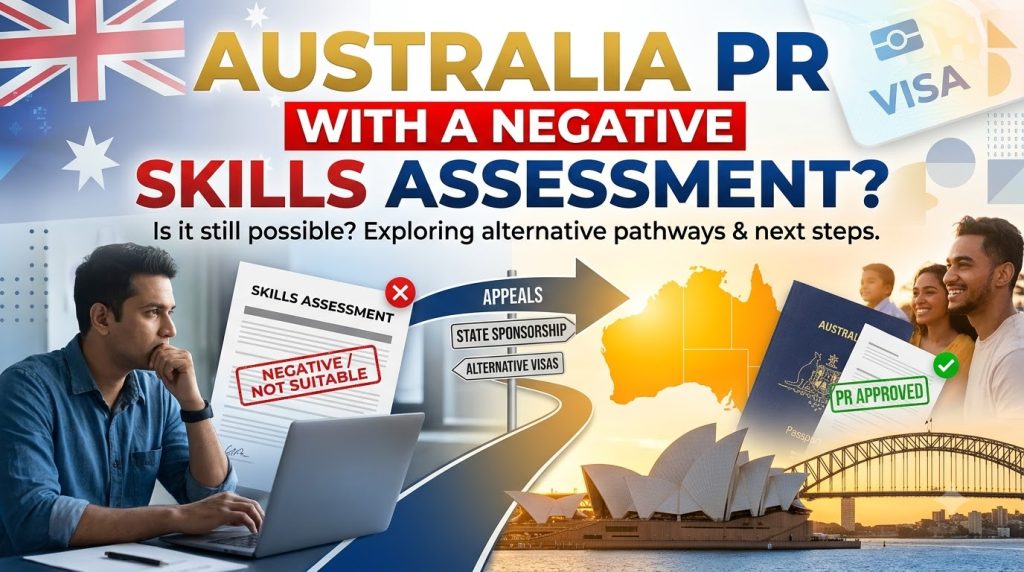
Receiving a negative skills assessment can feel like the end of your plans to move to Australia. You may have spent months gathering employment references, translating documents and paying assessment fees, only to receive a letter saying your skills are “not suitable” for your nominated occupation. The good news is that a negative outcome is rarely the final word. Whether you can still get Australia PR with a negative skills assessment depends on why the assessment failed, which visa you are aiming for, and how quickly you act.
This 2026 guide explains what a negative skills assessment means for permanent residency, the review and appeal options offered by the main assessing authorities, how to reapply with stronger evidence, and the PR pathways that do not depend on a points-tested skills assessment. If you are new to the process, start with our skills assessment guide for Australia PR in 2026 for background on how assessments work.
The Short Answer: Can You Get Australia PR With a Negative Skills Assessment?
You cannot use a negative skills assessment to apply for the main points-tested skilled visas: the Skilled Independent visa (Subclass 189), the Skilled Nominated visa (Subclass 190) and the Skilled Work Regional visa (Subclass 491). These visas require a suitable skills assessment for your nominated occupation.
However, a negative outcome does not permanently close the door. Most applicants still have realistic options:
- ask the assessing authority to review or appeal the decision
- reapply with stronger evidence once the gaps are fixed
- apply under a different occupation that genuinely matches your qualifications and duties
- gain the missing experience or qualifications, including through Australian study
- use a visa pathway that does not require a points-tested skills assessment, such as some employer-sponsored, partner or talent-based routes
The right option depends on the reason for the refusal, so the first step is always to read your outcome letter carefully.
Why a Positive Skills Assessment Matters for Australian PR
For points-tested skilled visas, Home Affairs requires you to hold a suitable skills assessment at the time you are invited to apply. Without one, you cannot validly claim your occupation in SkillSelect, and an invitation would be of no use. If the assessment letter does not state its own validity period, it is generally treated as valid for three years from the issue date. If the letter states a shorter period, that shorter period applies.
Two other rules often catch applicants out:
- A provisional skills assessment issued for a Temporary Graduate visa (Subclass 485) is not a suitable skills assessment for points-tested PR visas.
- Home Affairs has said it will accept a suitable assessment obtained within the 60-day invitation period, following the Thapa Federal Court decision. Even so, it is far safer to hold a positive outcome before you lodge your Expression of Interest (EOI).
Which Visas Require a Skills Assessment?
| Visa | Skills assessment required? |
|---|---|
| Skilled Independent (Subclass 189) | Yes, suitable at the time of invitation |
| Skilled Nominated (Subclass 190) | Yes, suitable at the time of invitation |
| Skilled Work Regional (Subclass 491) | Yes, suitable at the time of invitation |
| Employer Nomination Scheme (Subclass 186) – Direct Entry | Generally yes, unless an exemption applies |
| Employer Nomination Scheme (Subclass 186) – Temporary Residence Transition | Generally no |
| Skills in Demand (Subclass 482) | Depends on the occupation and passport; exemptions exist |
| Partner visas | No |
| National Innovation visa (Subclass 858) | No standard skills assessment; based on exceptional achievement |
You can compare these pathways in more detail on our Australian permanent residency services page.
What Does a Negative Skills Assessment Actually Mean?
A negative or “unsuccessful” skills assessment means the assessing authority was not satisfied, based on the evidence you submitted, that you meet its standards for that specific occupation. It is not a judgement on your overall ability or career, and it is not a visa refusal by Home Affairs.
Common reasons include:
- Qualification not comparable: your degree or diploma was not assessed as equivalent to the Australian level required for the occupation.
- Qualification not closely related: your field of study does not match the nominated occupation closely enough.
- Insufficient relevant employment: you have too little post-qualification experience, or some years were deducted under the authority’s rules.
- Duties do not match the occupation: your reference letters describe tasks that fit a different occupation.
- Weak or incomplete evidence: references lack detail, dates, hours or signatures, or there is no supporting payroll or tax evidence.
- Wrong pathway or occupation: you applied under an occupation that did not reflect your real role.
Many UK applicants are refused because their references describe job titles rather than detailed duties. Our article on how UK work experience counts for Australia PR explains how to present British employment evidence effectively.
Option 1: Request a Review or Appeal
If you believe the assessor made an error, or that they overlooked evidence you supplied, a review or appeal may be the fastest route. Each assessing authority has its own process and strict deadlines.
| Assessing authority | Typical occupations | Review and appeal process |
|---|---|---|
| Australian Computer Society (ACS) | ICT professionals | Level 1 appeal within 60 days of the outcome letter. Level 2 appeal within 30 days of the Level 1 outcome. The Level 2 decision is final. |
| Engineers Australia | Engineers, technologists, associates | Request a review first. An appeal can follow only after an unsuccessful review and must be lodged within six months of the original outcome letter. The appeal outcome is final. |
| VETASSESS (professional occupations) | Many general professional occupations | Review within 90 days of the outcome. Appeal within 90 days of the review decision. |
| Trades Recognition Australia (TRA) and its providers | Trade occupations | Review options and deadlines vary by programme and provider, and some windows are very short. Check your outcome letter immediately. |
Fees and processing times change regularly. For example, VETASSESS updated its professional assessment fees from 9 September 2026, with an appeal costing AUD 1,132 and a reassessment within 12 months costing AUD 779, both excluding GST. Always confirm current fees on the authority’s website before lodging.
When Does a Review or Appeal Make Sense?
A review or appeal is usually worthwhile when:
- the outcome letter misreads your qualification, dates or duties
- evidence you submitted was not considered
- the decision is inconsistent with the authority’s published criteria
- you can supply clarifying evidence, where the process allows it
It is usually not the best route when the gap is real, for example if you simply do not yet have enough years of relevant experience. In that case, reapplying later or changing strategy is often more effective than paying for an appeal that cannot succeed.
Option 2: Reapply With Stronger Evidence
Many negative outcomes come down to documentation rather than ability. If the problem was weak reference letters, missing payslips or unclear duties, a fresh application or reassessment with better evidence can lead to a positive result. Strong evidence usually includes:
- detailed reference letters on company letterhead, listing duties, dates, hours per week and salary
- supporting evidence such as payslips, P60s, HMRC records or employment contracts
- certified copies of qualifications and full academic transcripts
- evidence that each role was paid and full-time, or clearly stated part-time hours
- a CV that matches your reference letters exactly
Our guide to avoiding rejection due to missing or incorrect documents covers the most common evidence errors in more detail.
Received a negative outcome and not sure what to do next? GIEC Global UK can review your outcome letter, identify why it failed and recommend whether to appeal, reapply or change strategy. Book a skills assessment consultation before your review deadline passes.
Option 3: Apply Under a Different Occupation
Sometimes the assessment fails because the occupation chosen does not reflect your actual work. A software tester who applied as a software engineer, or a project coordinator who applied as a project manager, may be better suited to another occupation code.
Changing occupation can work well, but it must be genuine. Your qualifications and the duties described in your references need to match the new occupation’s tasks. Before switching, check:
- whether the new occupation is on the relevant skilled occupation lists for 189, 190 or 491 visas
- which authority assesses the new occupation and what it requires
- whether states and territories are currently nominating that occupation
- how invitation levels for the occupation have looked in recent rounds
For engineers, the four Engineers Australia categories (professional engineer, engineering technologist, engineering associate and engineering manager) can make a big difference. Our guide to Australia PR for engineers explains how occupation choice affects your chances. Reading how to get an Australia PR invitation from the UK will also help you judge whether a new occupation is likely to be invited.
Option 4: Build the Missing Skills or Experience
If the refusal reflects a genuine gap, such as too few years of relevant experience or a qualification that is not closely related, the long-term fix is to close that gap. Possible routes include:
- gaining more relevant, paid employment in your nominated occupation and reapplying once you meet the minimum
- completing a bridging course or further qualification that is closely related to the occupation
- obtaining professional registration or licensing where it supports your assessment
- studying in Australia, then building local experience through the Temporary Graduate visa
Australian study can reset your pathway completely, because Australian qualifications are often assessed more straightforwardly. Our guide on how to get PR in Australia after a study visa explains how this route works. Note that study should only be chosen if you genuinely intend to study, because the Student visa has its own Genuine Student requirement.
Option 5: PR Pathways That Don’t Rely on a Points-Tested Skills Assessment
If a skills assessment for your occupation is unlikely to succeed in the near future, some alternative pathways are worth considering.
Employer-Sponsored Pathways
An Australian employer can sponsor you under the Skills in Demand visa (Subclass 482). Depending on your occupation and passport, a skills assessment may not be mandatory, and exemptions exist. After working for your sponsor for the required period, the Temporary Residence Transition stream of the Subclass 186 visa can lead to PR, generally without a new skills assessment. Regional employers may also be able to use Designated Area Migration Agreements. You can learn more about these in our article on regional migration pathways and DAMAs.
Partner and Family Pathways
If you are in a genuine relationship with an Australian citizen, permanent resident or eligible New Zealand citizen, a partner visa for Australia does not require a skills assessment. Eligibility depends entirely on the relationship, not your occupation.
National Innovation Visa
For people with an internationally recognised record of exceptional achievement, the National Innovation visa (Subclass 858) assesses talent and achievement rather than a standard occupation-based skills assessment. It is highly selective and suits only a small number of applicants.
How a Negative Outcome Affects Your Points and EOI
A negative skills assessment also affects your points planning. You cannot lodge a valid EOI for an occupation you have not been positively assessed in. Some authorities also deduct years of experience before they treat your employment as “skilled”, which reduces the experience points you can claim.
Never claim points in SkillSelect that your assessment does not support. Overclaiming can lead to a visa refusal. Once you have a positive outcome, use our Australia PR points calculator to recalculate your score. Our guide on how to improve your Australia PR points before invitation covers practical ways to make up any shortfall, such as a higher English score or state nomination.
Common Mistakes After a Negative Skills Assessment
| Mistake | Why it causes problems |
|---|---|
| Missing the review or appeal deadline | You may lose the cheaper review route and have to pay for a full new application |
| Appealing when the gap is genuine | The appeal fails and you lose both time and fees |
| Resubmitting the same reference letters | The same evidence usually produces the same result |
| Switching to an occupation that does not match your duties | Leads to a second negative outcome and credibility concerns |
| Lodging an EOI without a positive assessment | Any invitation cannot be used, and points claims may be inaccurate |
| Ignoring alternative visa pathways | You may miss a faster route, such as employer sponsorship |
Which Option Fits Your Situation?
| Your situation | Most suitable next step |
|---|---|
| Assessor misread or overlooked your evidence | Review or appeal within the deadline |
| Evidence was weak or incomplete | Reassessment or new application with stronger documents |
| Your duties fit a different occupation | Reapply under the correct occupation |
| Too little relevant experience | Gain experience, then reapply |
| Qualification not closely related | Further study, a different occupation or an employer-sponsored route |
| Australian job offer or partner | Employer-sponsored or partner visa pathway |
How GIEC Global UK Can Help
Getting Australia PR with a negative skills assessment on your record is often still possible, but it requires the right strategy at the right time. Deadlines for reviews and appeals are short, and a second unsuccessful application can make your next attempt harder. GIEC Global UK helps UK-based professionals understand why an assessment failed, rebuild their evidence, choose the right occupation and explore alternative Subclass 189, Subclass 190 and Subclass 491 strategies. Contact our team for a tailored assessment of your options.
Disclaimer: This article provides general information based on Department of Home Affairs and assessing authority guidance available in October 2026. It is not legal or migration advice. Assessment criteria, deadlines, fees and visa rules change regularly, so always check official sources or speak to a qualified adviser before acting. No skills assessment or visa outcome can be guaranteed.
Frequently asked questions
Can you get Australia PR with a negative skills assessment?
Not through the points-tested 189, 190 or 491 visas, which need a suitable skills assessment at invitation. You may still succeed after a review, appeal or reassessment, or through pathways such as employer sponsorship or a partner visa.
What should I do after an unsuccessful skills assessment?
Read the outcome letter to find the exact reason, check the review or appeal deadline, and then decide whether to appeal, reapply with stronger evidence, change occupation or explore another visa pathway.
How long do I have to appeal a negative ACS skills assessment?
ACS allows a Level 1 appeal within 60 days of the outcome letter and a Level 2 appeal within 30 days of the Level 1 outcome. The Level 2 decision is final.
Can I appeal a negative Engineers Australia assessment?
Yes. You must request a review first, and an appeal can follow only after an unsuccessful review. The appeal must be lodged within six months of the original outcome letter, and its result is final.
How long do I have to request a VETASSESS review?
For professional occupations, VETASSESS accepts a review within 90 days of the outcome, and an appeal within 90 days of the review decision.
Can I change my nominated occupation after a negative skills assessment?
Yes, if your qualifications and duties genuinely match the new occupation. Check that it is on the relevant skilled occupation list and is assessed by an authority whose criteria you can meet.
Can I lodge an EOI without a positive skills assessment?
You should not. Points-tested visas require a suitable assessment at the time of invitation, and claiming an occupation or points you cannot support may lead to visa refusal.
Which Australian PR pathways do not need a skills assessment?
Partner visas do not require one. The 186 Temporary Residence Transition stream generally does not, and the National Innovation visa is based on exceptional achievement rather than an occupational skills assessment.
How long is a positive skills assessment valid for Australian PR?
If the letter shows no validity period, Home Affairs generally treats it as valid for three years from issue. If the letter states a shorter period, that shorter period applies.
Does a 485 skills assessment count for Australia PR?
No. A provisional skills assessment issued for the Temporary Graduate visa is not a suitable skills assessment for points-tested permanent visas.
Will a negative skills assessment affect my future visa applications?
A negative assessment is not a visa refusal, so it does not create a Home Affairs refusal record. You must still be truthful in future applications, and repeated unsuccessful assessments can make the next one harder.
Can a migration consultant help with a negative skills assessment?
Yes. An experienced adviser can identify why the assessment failed, help you rebuild your evidence, assess whether an appeal is worthwhile and suggest suitable alternative pathways.