
Migration · Australia
Australia Subclass 189 Skilled Independent Visa
Understand the Australia 189 visa requirements, points test, skills assessment, fees and invitation process. Explore whether the Skilled Independent visa may suit your Australian permanent residency plans.
Pathway at a glance
Eligibility and documents
- ligible occupation for the subclass 189 points-tested stream
- Suitable skills assessment from the relevant assessing authority
- Under 45 years of age at the time of invitation
- At least Competent English at the relevant time
- Minimum 65 points under the applicable points test
- Invitation to apply through SkillSelect
- Valid passport and identity documents
- Academic qualifications and transcripts
- English-language evidence
- Employment evidence supporting claimed points
- Documents supporting partner points, if claimed
- Family relationship and dependent documents, if applicable
- Health and character documents when required
Application process
- 1
Check occupation eligibility
Confirm that your nominated occupation is eligible for the subclass 189 points-tested stream.
- 2
Obtain a skills assessment
Apply to the relevant assessing authority and review its qualification and employment requirements.
- 3
Check English requirements
Confirm accepted evidence and assess whether higher English proficiency may improve your points score.
- 4
Calculate your points
Review age, qualifications, skilled employment, English and other eligible factors.
- 5
Submit your EOI
Complete an accurate Expression of Interest through SkillSelect.
- 6
Wait for an invitation
Monitor official invitation rounds and keep your EOI details current.
- 7
Lodge the visa application
If invited, submit the application and supporting evidence through ImmiAccount within the stated deadline.
- 8
Complete checks
Respond to document requests and meet applicable health and character requirements.
Costs and fees
| Main applicant visa charge | From AUD 6,135; verify the current official charge |
|---|---|
| Additional applicants | Extra visa charges apply to eligible family members |
| Skills assessment | Varies by assessing authority and occupation |
| English test | Depends on the test and provider |
| Medical examinations | Depends on the applicant and required checks |
| Police certificates | Depends on the countries and certificates required |
| Document preparation | Translation, certification or other costs may apply |
| Professional assistance | Depends on the provider and scope of services |
Fees change. Check the official source before you pay.
The Australia 189 visa, officially known as the Skilled Independent visa (subclass 189), is a permanent residency pathway for eligible skilled workers who want to live and work in Australia without employer sponsorship or state or territory nomination. Under the points-tested stream, applicants must meet the relevant eligibility requirements, submit an Expression of Interest (EOI) through SkillSelect and receive an invitation before lodging a visa application.
For skilled professionals considering Australian permanent residency, understanding the subclass 189 visa requirements is an important first step. Your age, nominated occupation, skills assessment, English language ability, qualifications, skilled employment history and other eligible factors can affect your points score and invitation prospects.
However, meeting the minimum points threshold does not guarantee an invitation. SkillSelect invitations are competitive and depend on the Department of Home Affairs’ selection arrangements, occupation requirements, invitation rounds and the scores and ranking of other candidates. A points score should therefore be treated as an eligibility calculation, not a promise of an invitation.
This guide explains the 189 visa Australia requirements, eligible occupations, points test, English requirements, skills assessment, application process, fees, processing times and invitation rounds. It also compares the subclass 189 with the subclass 190 visa and explains how to consider other Australian migration pathways if the independent visa is not suitable.
What Is the Australia 189 Visa?
The Skilled Independent visa (subclass 189) is a permanent visa for eligible skilled migrants. The points-tested stream is designed for invited workers whose qualifications and experience match occupations required in Australia. It does not require an employer to sponsor the applicant or a state or territory government to nominate them.
Applicants for the points-tested stream generally begin by checking their occupation and obtaining a suitable skills assessment. They then calculate their points and submit an Expression of Interest through SkillSelect. If the Department invites them, they can lodge a subclass 189 visa application within the deadline stated in the invitation.
The subclass 189 visa is different from a temporary work visa. If the visa is granted, the holder becomes an Australian permanent resident and can live, work and study in Australia indefinitely, subject to Australian laws and any applicable conditions. The visa also provides a five-year travel facility from the date of grant.
It is important to understand that the subclass 189 visa has different streams. This article focuses mainly on the points-tested stream because it is the pathway relevant to skilled workers who apply through an occupation, points test and SkillSelect invitation. The New Zealand and Hong Kong streams have separate eligibility requirements.
Key facts about subclass 189
| Feature | Details |
|---|---|
| Official name | Skilled Independent visa (subclass 189) |
| Visa type | Permanent residence |
| Employer sponsorship | Not required for the points-tested stream |
| State nomination | Not required for the points-tested stream |
| Invitation | Required before applying under the points-tested stream |
| Minimum points threshold | 65 points to meet the basic points threshold; this does not guarantee an invitation |
| Age | Under 45 at the time of invitation |
| Skills assessment | Suitable assessment for the nominated occupation required |
| English | At least Competent English at the relevant time |
| Application location | Can be in or outside Australia, subject to visa-status rules |
| Published base visa charge | From AUD 6,135 for the main applicant; check the official pricing estimator for the current amount |
These details relate to the points-tested stream. Other subclass 189 streams have separate eligibility rules. Always check the official subclass 189 visa page before making a decision.
Australia 189 Visa Requirements
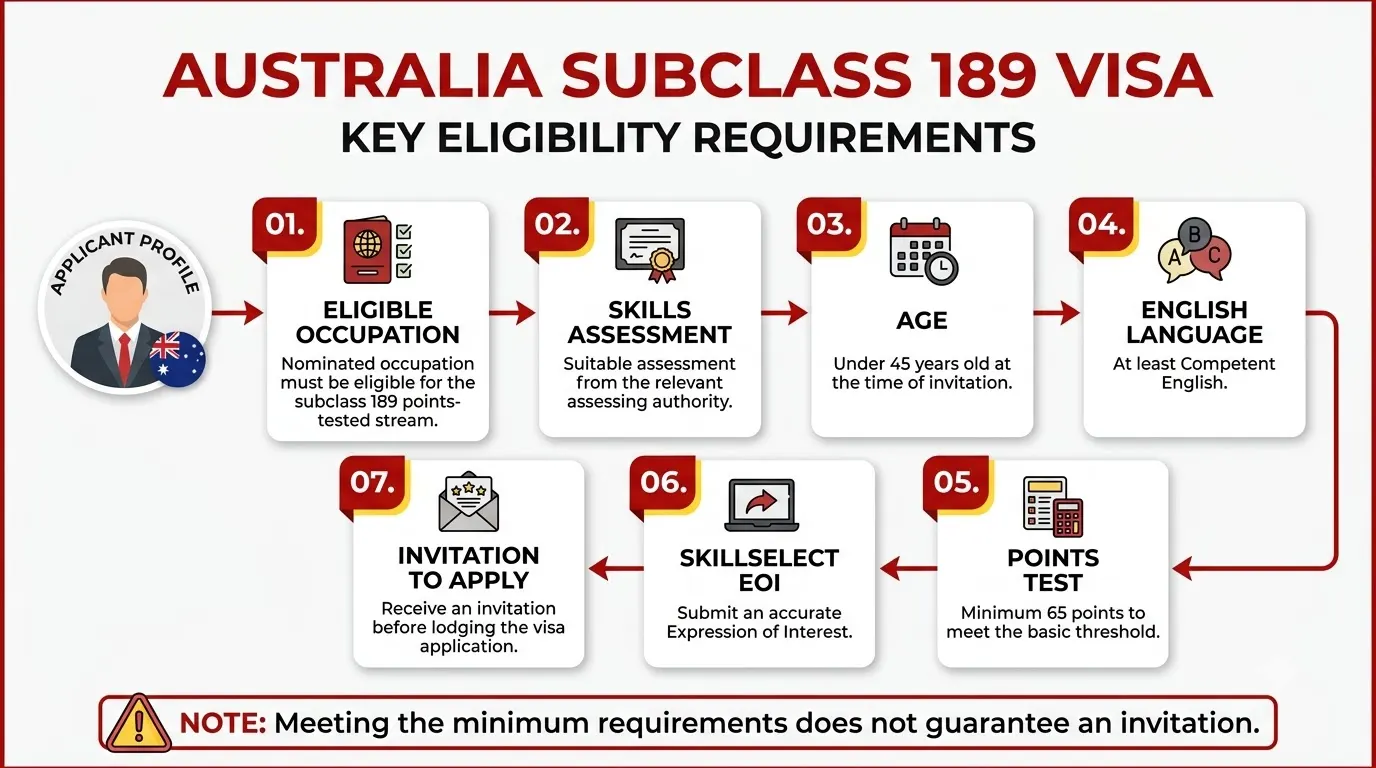
Applicants must satisfy the visa criteria that apply to their stream. For the points-tested subclass 189 visa, this includes having an eligible nominated occupation, a suitable skills assessment, the required English ability, the relevant age and points score, and an invitation to apply. Meeting only one or two requirements is not enough to qualify.
It is also important to distinguish between the requirements for submitting an EOI and the requirements for receiving an invitation and lodging the visa application. Some eligibility criteria must be satisfied at the time of invitation, and supporting evidence must be provided when the visa application is lodged.
1. Eligible skilled occupation
Your nominated occupation must be eligible for the relevant subclass 189 points-tested stream. Start by checking the current skilled occupation information published by the Department of Home Affairs. The occupation list and the assessing authority assigned to an occupation determine which assessment pathway applies.
Do not assume that an occupation is eligible simply because it is in demand in Australia, appears in a job advertisement or is available under another visa subclass. Skilled occupation requirements can differ between visa pathways. An occupation that may be considered for a state-nominated or regional visa is not automatically eligible for the independent subclass 189 stream.
When reviewing an occupation, check its official title, occupation code, assessing authority and any special requirements. The duties you perform in your current or previous employment should also be consistent with the nominated occupation. A similar job title alone may not establish that your work experience is relevant.
Applicants should review the occupation requirements before paying for a skills assessment. This can help avoid spending time and money on an assessment that does not support the intended visa pathway.
2. Suitable skills assessment
A suitable skills assessment is a key part of the subclass 189 visa requirements. You need an assessment from the relevant assessing authority for your nominated occupation. The authority evaluates your qualifications, employment history and other evidence against the standards for that occupation.
The assessing authority depends on your profession. Different occupations may be assessed by different organisations, and each authority can have its own application process, evidence rules, qualification standards and assessment fees.
Documents commonly requested for a skills assessment may include:
- Degree certificates, diplomas or trade qualifications.
- Academic transcripts and course details.
- Employment reference letters describing duties and dates.
- Evidence of salary payments or employment, where required.
- Professional registration or licence documents, where relevant.
- Identity documents and any additional forms requested by the assessing authority.
A suitable assessment must be obtained by the time you are invited to apply for a points-tested visa and must be valid at the relevant time. The Department’s rules also address assessment validity periods, including cases where an assessment has a shorter validity period. Check the current requirements for your occupation rather than assuming that an old assessment can still be used.
For a detailed overview of Australia’s skilled migration pathways, see the General Skilled Migration (GSM) guide.
3. Age under 45
For the points-tested subclass 189 visa, you must be under 45 years old when you receive the invitation to apply. This is an important requirement because submitting an EOI before your 45th birthday does not protect your eligibility if you turn 45 before an invitation is issued.
Age also affects the points test. Applicants in the 25 to under 33 age group receive the highest age score under the current points table. Applicants in other eligible age groups receive fewer points, and people aged 45 or older do not meet the standard age requirement for an invitation under this stream.
If you are approaching the age limit, review your occupation, assessment status, English results and likely points position as early as possible. Do not assume that an invitation will arrive before a particular birthday. Invitation timing is controlled by the Department and cannot be guaranteed by an applicant or adviser.
4. Competent English
Applicants must have at least Competent English at the relevant time. The Department accepts specified forms of English-language evidence, subject to current test rules, minimum scores and validity requirements. The accepted tests and score settings can change, so check the official requirements before booking a test or relying on an earlier result.
Competent English is the minimum level for the standard points-tested subclass 189 pathway, but it does not provide additional points under the English points category. Proficient English can attract 10 points, while Superior English can attract 20 points.
Improving your English score may increase your total points, but it does not automatically result in an invitation. The test must be accepted under the rules in force at the relevant time, and you must provide the correct evidence when requested.
5. Minimum points threshold
The points-tested subclass 189 stream has a minimum threshold of 65 points. This is the basic score required to be eligible for consideration, not a guaranteed invitation score. Invitation outcomes can vary by occupation and round, and some occupations may require a substantially higher score.
Your EOI should contain accurate information about your age, English, employment, qualifications and other eligible factors. You must be able to support every points claim with evidence. If a claim cannot be substantiated, it may affect the outcome of your application.
6. Invitation to apply
An invitation is required before you can lodge a points-tested subclass 189 visa application. Submitting an EOI is not the same as applying for a visa. It does not guarantee that the Department will invite you, and it does not grant permission to live or work in Australia.
The Department conducts SkillSelect invitation rounds periodically. It may rank EOIs using the points claimed, the date and time the relevant score was reached, occupation settings and other applicable selection arrangements. A high score can improve your competitive position, but it is not a promise of selection.
Australia 189 Visa Points Test
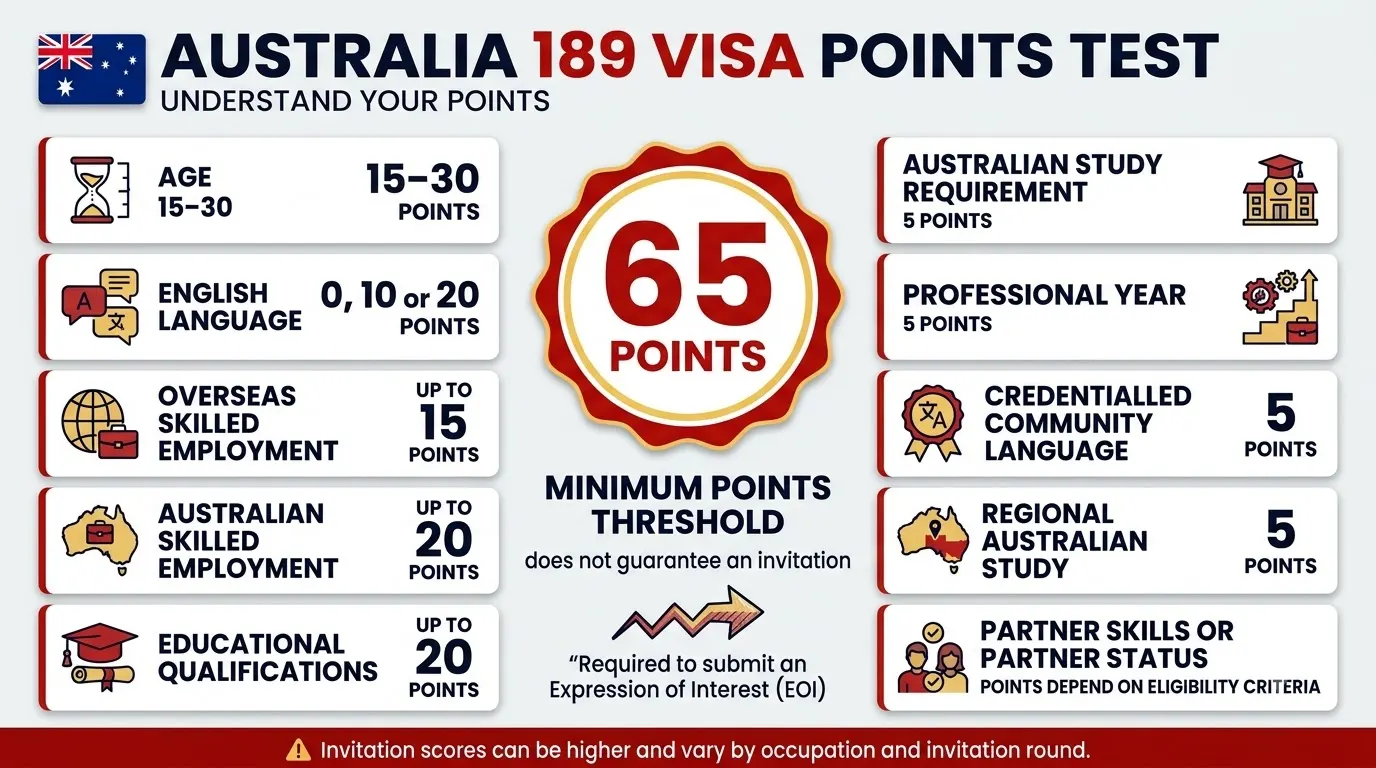
The Australia 189 visa points test measures several factors that may contribute to your eligibility. Points can be awarded for age, English language ability, skilled employment, educational qualifications, Australian study, a Professional Year, credentialled community language, regional study and partner circumstances.
The points you can claim depend on your individual circumstances and the rules in force at the time of invitation. The Department assesses the claims in your EOI, and you must provide evidence to support them when you lodge your application.
Main points categories
| Factor | Examples of points available |
|---|---|
| Age | 15–30 points across eligible age bands |
| English language ability | 0, 10 or 20 points for Competent, Proficient or Superior English |
| Overseas skilled employment | Up to 15 points |
| Australian skilled employment | Up to 20 points |
| Educational qualifications | Up to 20 points, depending on the qualification |
| Australian study requirement | 5 points if the rules are met |
| Professional Year | 5 points where eligible |
| Credentialled community language | 5 points where eligible |
| Study in regional Australia | 5 points where eligible |
| Partner skills or partner status | Points depend on the applicable criteria |
The table provides an overview of the main categories. It is not a substitute for the official points table, because each category has detailed eligibility rules and evidence requirements.
Age points
Age is one of the most important factors in the Australia 189 visa points test. Under the current points table, applicants aged at least 25 but under 33 can receive 30 points. Those aged at least 18 but under 25 can receive 25 points. Applicants aged at least 33 but under 40 can also receive 25 points, while those aged at least 40 but under 45 can receive 15 points.
Age points are assessed under the rules applicable at the time of invitation. If your age changes while your EOI is active, review your points score and update your EOI where necessary. Your age must also remain within the visa’s invitation eligibility limit.
English language points
English can make a significant difference to your total points. Competent English meets the minimum language requirement but attracts zero points. Proficient English attracts 10 points, and Superior English attracts 20 points under the points table.
Before taking a test, review the Department’s accepted tests and score requirements. Different tests may use different scoring systems, and an old conversion chart may not reflect current settings. Make sure the result will be valid when you need to rely on it.
Skilled employment points
Points may be available for qualifying skilled employment in Australia and overseas. The work generally needs to be in your nominated skilled occupation or a closely related skilled occupation and must meet the relevant time, remuneration and evidence rules.
For overseas skilled employment, the points table provides 5 points for at least three but less than five years, 10 points for at least five but less than eight years, and 15 points for at least eight years of qualifying experience. Less than three years does not attract employment points in this category.
For Australian skilled employment, the points table provides 5 points for at least one but less than three years, 10 points for at least three but less than five years, 15 points for at least five but less than eight years, and 20 points for at least eight years of qualifying experience.
There is a combined cap on employment points. Even if your Australian and overseas employment calculations would add up to more than 20 points, the maximum employment score is 20. The Department also applies detailed rules to what counts as skilled employment, including the hours worked and the relationship between the job and nominated occupation.
Education and qualification points
Your highest eligible qualification may contribute points. A recognised doctorate can attract 20 points, while a recognised bachelor’s degree or higher qualification below doctorate level can attract 15 points. Certain Australian diplomas, trade qualifications or qualifications recognised by the relevant assessing authority may attract 10 points.
Points are not simply awarded based on the name of a qualification. The level, recognition, institution and assessment outcome can matter. The relevant assessing authority may determine whether your qualification is suitable for your nominated occupation. Keep your award certificates, transcripts and any assessment outcome available.
Additional points and partner factors
Additional points may be available for meeting the Australian study requirement, completing an eligible Professional Year, holding a recognised credential in a community language or completing qualifying study in regional Australia. Each category has specific conditions. For example, regional study points require the relevant qualification and study to meet the regional and Australian study requirements.
Partner points depend on your partner’s circumstances. In some cases, points may be available where a partner applying for the same visa meets age, English and skills assessment criteria. A separate points category may apply where the partner has Competent English. Applicants who are single, or whose partner is an Australian citizen or permanent resident, may also qualify for points under the relevant rules.
Do not assume that having a partner automatically adds points. The partner category must be selected correctly, and evidence must support the claim at the relevant time.
How many points do you need for a 189 visa?
You need at least 65 points to meet the basic points threshold for the points-tested subclass 189 visa. However, the score needed to receive an invitation can be higher. There is no single score that guarantees an invitation across all occupations and all invitation rounds.
For example, a candidate with 65 points may meet the minimum threshold but may not be competitive in an occupation where recent invitations have been issued at higher scores. Another occupation may have different invitation outcomes. This is why it is important to review the official invitation-round information rather than relying on a general points target shared online.
Use the Australia PR points calculator as an initial planning tool to estimate your score. Then compare each claimed category against the official points rules and make sure you can provide evidence for every claim.
How to Apply for the 189 Visa Australia
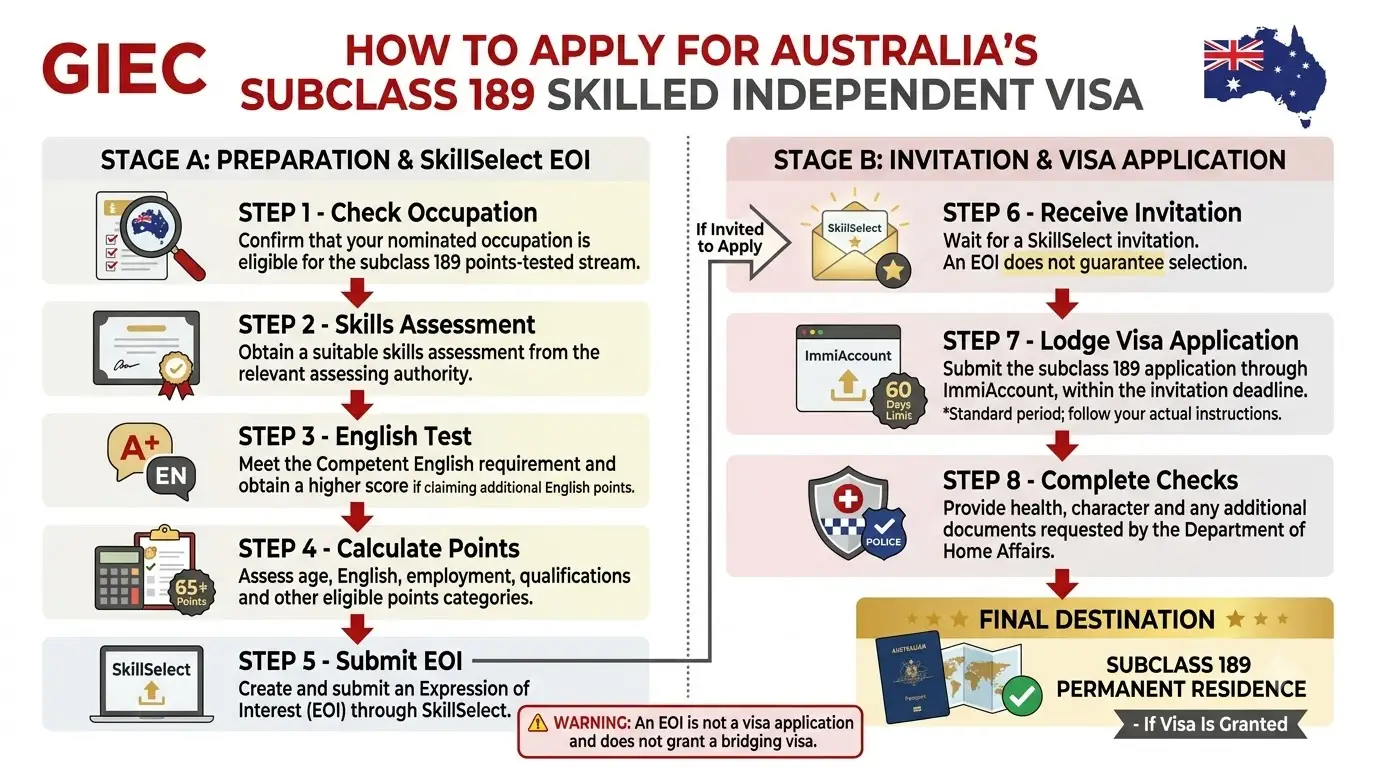
The subclass 189 application process has two main stages: first, submitting an Expression of Interest through SkillSelect; second, lodging a visa application if the Department issues an invitation. Applicants should prepare carefully because information entered in the EOI can affect invitation ranking and must be supported by evidence later.
Step 1: Check your occupation
Confirm that your nominated occupation is eligible for the subclass 189 points-tested stream. Check the relevant occupation list, occupation code and assessing authority. Read the assessment requirements before deciding which documents to collect.
Where your job title differs from the occupation title, compare your actual duties and responsibilities with the official occupation description. The substance of your work is important. A similar job title does not automatically establish that your employment is suitable for the nominated occupation.
Step 2: Obtain a skills assessment
Prepare the documents required by the relevant assessing authority and lodge the assessment application. This may include qualifications, transcripts, employment references, evidence of duties, professional registration and other occupation-specific material.
Allow enough time for the assessment process. Some occupations require detailed employment evidence, practical assessments, registration or additional checks. A skills assessment is not simply a confirmation that you hold a degree; the authority must determine whether your qualifications and experience meet the applicable occupational standard.
Step 3: Complete your English-language requirements
Check which English tests and forms of evidence are accepted under the current Department rules. If you want to claim Proficient or Superior English points, confirm the relevant score requirements before booking your test.
Make sure your English evidence will be valid when required. If you take a test early, check its validity period and whether it will still be accepted at the time of invitation.
Step 4: Calculate your points
Review your age, English proficiency, skilled employment, qualifications and any additional points factors. Calculate the score carefully and keep documents for every claim.
Do not claim employment points for all work automatically. Check whether the employment is in your nominated occupation or a closely related occupation, whether it meets the required hours and dates, and whether you can provide suitable evidence. Similarly, do not claim partner or qualification points unless the applicable criteria are satisfied.
Step 5: Submit an Expression of Interest
Create and submit your EOI through SkillSelect. An EOI is not a visa application, and submitting one does not guarantee an invitation. You can submit an EOI from inside or outside Australia, subject to the relevant requirements.
Enter your personal details, nominated occupation, skills assessment information, English results, employment history, qualifications and points claims accurately. Keep your SkillSelect details up to date if your circumstances change. An EOI may remain active while you wait for an invitation, but it is your responsibility to check its status and update relevant information.
Step 6: Wait for an invitation
The Department issues invitations through SkillSelect rounds. Your EOI may be considered against other candidates, and invitation outcomes depend on the relevant selection rules, occupation settings and available places.
Check the official invitation-round updates and avoid relying on unofficial predictions. An EOI can remain uninvited, even where the applicant meets the minimum 65-point threshold. There is no guaranteed waiting period for an invitation.
Step 7: Lodge your visa application
If you receive an invitation, follow the instructions in the invitation letter and lodge the visa application through ImmiAccount within the stated deadline. The standard invitation period for this points-tested pathway is 60 days, but you should always follow the date and instructions in your own invitation.
Provide the required identity, skills, English, employment, qualification and family documents. Your evidence should support the claims made in your EOI. If your circumstances or points claims have changed, do not assume you can simply carry forward the earlier score without checking the rules.
Step 8: Complete health and character checks
You and relevant family members must meet the applicable health and character requirements. The Department may request medical examinations, police certificates, biometrics or further information depending on your circumstances.
Check ImmiAccount and your email regularly so you can respond to requests within the specified time. Keep copies of submitted documents and make sure information is consistent across forms, employment records and identity documents.
Official process guidance is available through the Department’s Expression of Interest and SkillSelect information.
Can I Apply for a 189 Visa Onshore?
Yes. An applicant may be in Australia when applying for the subclass 189 points-tested visa, provided the applicable visa-status and other requirements are met. Applicants can also apply from outside Australia.
If you apply while in Australia, you must meet the Department’s requirements relating to your current visa status. The rules generally require an applicant to hold a substantive visa or an eligible Bridging visa A, B or C at the time of application. Additional restrictions can apply to applicants who currently hold, or last held, specified regional provisional visas.
Submitting an EOI does not itself give you a bridging visa or permission to remain in Australia. A bridging visa is not automatically granted simply because you have registered interest in SkillSelect. If your current visa is approaching its expiry date, you must independently make sure that you maintain lawful status and understand your available options.
Applicants who have complex visa histories, previous refusals, cancellations or bridging visa conditions should check their circumstances before lodging. An incorrect assumption about onshore eligibility can create serious problems for an application.
For information about a specific bridging travel situation, read the GIEC guide to the Bridging Visa B. This is a separate visa topic and should not be confused with the eligibility rules for a subclass 189 application.
189 Visa Cost and Fees
The published base visa application charge for the main applicant is from AUD 6,135, subject to applicable concessions and changes. Additional charges apply for family members included in the application. The final amount depends on the applicants included and the rules in force when the application is lodged.
The visa application charge is only one part of the total cost of applying for the Australia 189 visa. Applicants may also need to budget for:
- Skills assessment fees charged by the relevant assessing authority.
- English-language test fees.
- Medical examinations for the applicant and relevant family members.
- Police certificates from countries where required.
- Document translation and certification.
- Professional assistance, if the applicant chooses to use an authorised provider.
- Other charges or checks requested during the application process.
The total budget will depend on your occupation, assessment pathway, family composition and the documents required. Applicants with partners or dependent children should check the additional applicant charges before lodging.
For the most accurate amount, use the official Department of Home Affairs Visa Pricing Estimator. The Department notes that the estimator does not include every possible additional cost. Avoid relying on old third-party fee tables because government charges can change.
189 Visa Processing Time
There is no single processing time that applies to every subclass 189 application. The Department’s processing-time guide is based on recently decided cases and provides an indication rather than a guarantee. Actual processing time can be shorter or longer depending on the application and the Department’s priorities.
Processing can depend on several factors, including:
- Whether the application is complete and includes all required documents.
- Whether the information and supporting evidence are clear and consistent.
- How quickly the applicant responds to requests for additional information.
- The time needed for health, character and security checks.
- Whether the Department needs to verify qualifications or employment details.
- The migration programme settings and applicable processing priorities.
It is important to separate the time spent waiting for a SkillSelect invitation from the time taken to process a lodged visa application. An EOI may remain in SkillSelect without receiving an invitation. The visa processing clock does not simply begin when you submit an EOI.
The Department also publishes processing priorities and indicative allocation dates for different groups of applications. These settings can change. For the latest information, use the official subclass 189 visa processing-time information and review the current priority arrangements.
Applicants should avoid making non-refundable travel or relocation commitments based on an estimated processing time. Wait for the visa decision and follow the instructions in the grant notification before making arrangements that depend on permanent residence.
Australia 189 Visa Invitation Rounds
The Department publishes SkillSelect invitation-round information, including the number of invitations issued and, where available, occupation-specific minimum scores and tie-break details. These figures help applicants understand how invitations have been issued, but they do not predict the outcome of the next round.
For example, the Department’s published invitation round on 15 October 2026 issued 20,000 invitations for the subclass 189 visa. The minimum points score and tie-break date varied by occupation. This is a historical result for that round, not a guaranteed score or invitation number for future rounds.
Earlier rounds can show how invitation patterns change. The Department’s 4 June 2026 round issued 10,000 subclass 189 invitations. The October round later issued a different number of invitations, demonstrating why applicants should check the latest official information rather than relying on older articles or social media posts.
Invitation outcomes can be influenced by the occupation nominated, points score, tie-break date, available places and the Department’s selection settings. A minimum score shown for one occupation should not be applied to a different occupation.
To check the latest results, visit the Department’s SkillSelect invitation rounds page. The Department may update this page when new rounds are conducted. Always check the date of the published round before using its figures in your planning.
Documents for a 189 Visa Application
The exact document checklist depends on your circumstances, nominated occupation, skills assessment and the points claims in your EOI. Applicants should prepare their documents early where practical, but must check the invitation and ImmiAccount instructions for the final requirements.
Common documents may include:
- Current passport and identity documents.
- Skills assessment outcome for the nominated occupation.
- English-language test results or other accepted evidence.
- Academic qualification certificates and transcripts.
- Employment reference letters and supporting work records.
- Evidence supporting any additional points claimed.
- Partner identity, relationship and eligibility evidence, where applicable.
- Birth certificates and identity documents for dependent children.
- Police certificates and health information when required.
- Any forms or additional information requested by the Department.
Employment references should clearly identify the employer, job title, employment dates, hours, salary and duties, where those details are required. A short letter that only confirms a job title may not provide enough information to establish that the work qualifies for skilled employment points.
Make sure that dates, job duties and personal details are consistent across your EOI, skills assessment and visa application. If a document is not in English, check the Department’s translation requirements and provide the required translation details.
189 Visa vs 190 Visa: What Is the Difference?
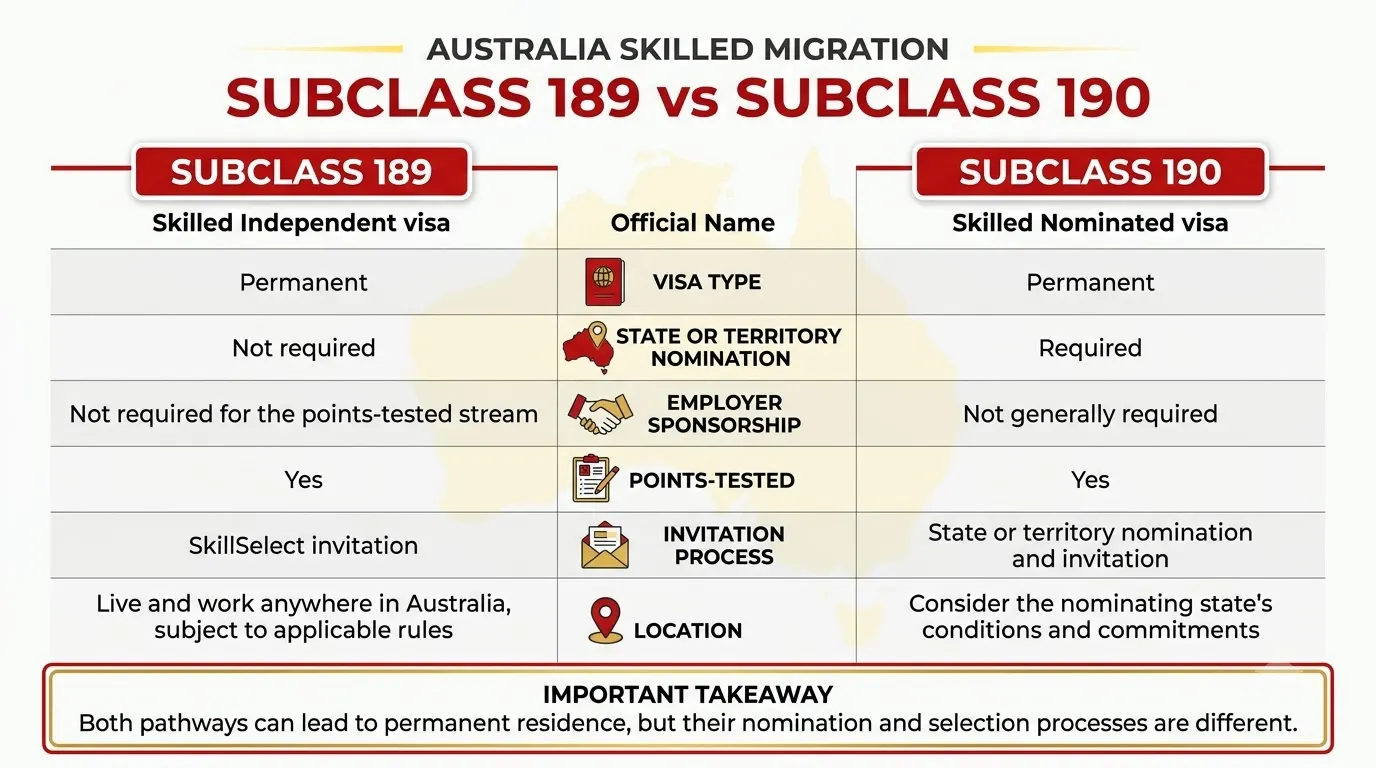
Both the subclass 189 and subclass 190 are skilled migration pathways that can lead to Australian permanent residence. The main difference is the nomination requirement. The subclass 189 points-tested stream does not require state or territory nomination, while the subclass 190 visa requires nomination by an Australian state or territory government.
The subclass 190 pathway may suit applicants whose occupation and circumstances align with a state’s nomination criteria. Each state or territory can set its own selection priorities, eligibility conditions and commitments. These can change during a programme year, so applicants should review the relevant state requirements before deciding which pathway to pursue.
| Feature | Subclass 189 | Subclass 190 |
|---|---|---|
| Visa type | Permanent | Permanent |
| State or territory nomination | Not required | Required |
| Employer sponsorship | Not required for the points-tested stream | Not generally required as the state nomination pathway is separate from employer sponsorship |
| Points-tested | Yes | Yes |
| Invitation or nomination process | SkillSelect invitation | State or territory nomination and invitation process |
| Location | Live and work anywhere in Australia, subject to applicable rules | Applicants should consider the nominating state’s conditions and commitments |
The right pathway depends on your occupation, points score, eligibility and willingness to meet a state’s nomination requirements. A subclass 190 visa is not automatically easier to obtain, and a subclass 189 visa is not automatically the better option for every applicant.
Some applicants may be eligible to consider both pathways. Others may find that their occupation is available for state nomination but not for the independent stream. Compare the relevant occupation lists, points requirements, nomination criteria and current invitation outcomes before choosing a strategy.
Benefits of the Australia 189 Permanent Residency Visa
If granted, the subclass 189 visa provides permanent residence and several important rights. It is designed for skilled workers who meet the points-tested criteria and receive an invitation without needing an employer or state government to sponsor or nominate them.
Key benefits may include:
- Permanent residence: You can remain in Australia indefinitely as a permanent resident.
- Work rights: You can work in Australia, subject to Australian laws and professional licensing requirements.
- Study rights: You can study in Australia under the rules applicable to permanent residents.
- Freedom to live across Australia: The subclass 189 points-tested stream does not impose a state nomination commitment.
- Medicare access: Permanent residents can generally enrol in Australia’s public health care scheme, subject to eligibility rules.
- Family options: You may be able to sponsor eligible relatives for permanent residence under the relevant family visa rules.
- Citizenship pathway: You may become eligible to apply for Australian citizenship if you meet the residence and other legal requirements.
- Travel facility: The visa generally allows travel to and from Australia for five years from the date of grant.
Permanent residence does not mean that every government payment or service is immediately available. Waiting periods and eligibility requirements can apply to certain benefits. Similarly, citizenship is not automatic. Applicants must satisfy the separate citizenship requirements, including residence and character criteria.
After the five-year travel facility expires, a permanent resident who wants to return to Australia as a permanent resident generally needs a Resident Return visa or another appropriate travel entitlement. The permanent residence status and the travel facility are separate matters.
What If You Do Not Meet the 189 Visa Requirements?
Not every skilled worker will qualify for the subclass 189 visa. You may be outside the age limit, have an occupation that is not eligible for this stream, lack a suitable skills assessment or have a points score that is not competitive for an invitation. This does not necessarily mean that every Australian migration option is closed.
The next step is to review your circumstances against other visa pathways rather than assuming that one visa subclass is the only route. Different visas have different requirements, and the most appropriate option depends on your occupation, work experience, qualifications, age, English ability, location and long-term plans.
Consider the Skilled Nominated visa (subclass 190)
If you meet the skilled migration requirements but need a different invitation pathway, check whether a state or territory may nominate you for the subclass 190 visa. State nomination is not automatic. Each state or territory has its own occupation priorities, eligibility settings and application process.
Review the state requirements carefully, including any work experience, employment, residence or commitment conditions. A state nomination pathway may be worth investigating where your occupation and profile match a current state programme.
Review regional skilled migration options
Some applicants may be eligible to consider a regional skilled migration pathway, such as the Skilled Work Regional (Provisional) visa (subclass 491). This is a provisional visa with its own nomination or sponsorship and regional residence requirements. It is not the same as the permanent subclass 189 visa.
Regional pathways may suit people who are willing to live and work in an eligible regional area and meet the relevant requirements. Check the current visa rules and the conditions that apply before choosing this option.
Explore employer-sponsored pathways
Applicants with relevant work experience and an Australian employer opportunity may wish to review employer-sponsored visa options. These pathways have different requirements relating to the occupation, employer, salary, work experience and sponsorship arrangements.
Employer sponsorship should not be treated as a guaranteed alternative. You need to meet the visa criteria, and the employer must also satisfy the applicable sponsorship and nomination obligations.
Consider the Training visa (subclass 407)
The Training visa (subclass 407) is designed for eligible workplace-based occupational training or professional development activities. It is not a direct substitute for permanent skilled migration and does not automatically lead to permanent residence.
Applicants should review the purpose of the training, sponsor requirements and other visa criteria before considering this pathway. It may be relevant for a specific professional development plan, but it should not be selected simply because a subclass 189 invitation has not arrived.
Review the Temporary Graduate visa (subclass 485)
Eligible international graduates may be able to consider the Temporary Graduate visa (subclass 485), depending on their qualification, study history, age and the stream requirements. This visa is designed for eligible graduates and has separate rules from the subclass 189 points-tested pathway.
A temporary graduate visa does not guarantee permanent residence. However, eligible graduates may use the period of temporary stay to gain relevant experience or assess future migration options, provided they comply with all visa conditions.
Review your wider Australian migration options
Applicants who are unsure which pathway is suitable can start by reviewing the main Australia migration options and the requirements for each visa category. The purpose is to identify a pathway that genuinely matches your circumstances, not to select a visa based only on its name or a points estimate.
Common Mistakes to Avoid When Applying for a 189 Visa
Even applicants with strong qualifications can encounter problems if they misunderstand the points test or submit incomplete information. Reviewing common mistakes before lodging an EOI or visa application can help you prepare more carefully.
1. Treating 65 points as an invitation guarantee
The 65-point threshold is the minimum requirement for the points-tested stream. It does not mean that every applicant with 65 points will receive an invitation. Invitation outcomes can vary by occupation and round. Review recent official results, but do not treat historical scores as a guarantee of future selection.
2. Choosing an occupation based only on job demand
An occupation may be advertised by Australian employers without being eligible for the subclass 189 points-tested stream. Check the relevant occupation list and assessing authority before beginning the process. The occupation must also match your qualifications and employment background under the applicable assessment rules.
3. Claiming employment points without enough evidence
Employment points have detailed requirements. The work must meet the relevant occupation, time and other criteria. Keep reference letters and supporting records that show your actual duties and employment history. Do not assume that every year of work experience will automatically count.
4. Using an expired or unsuitable skills assessment
A skills assessment must be suitable for the nominated occupation and valid at the relevant time. Check the assessment outcome and expiry details before relying on it in your EOI. If your occupation or circumstances have changed, you may need to review the assessment requirements again.
5. Using outdated English test information
English test rules and accepted score settings can change. Check the Department’s current requirements before booking a test and before claiming English points. Make sure your evidence meets the relevant standard and remains valid when required.
6. Forgetting to update the EOI
Your age, English results, employment history, qualifications and family circumstances may change while your EOI is active. Review your details and update them where required. The information in your EOI should remain accurate and consistent with the evidence you will provide if invited.
7. Assuming that an EOI gives you a bridging visa
An EOI is not a visa application and does not grant a bridging visa or permission to remain in Australia. Applicants who are already in Australia must separately monitor their current visa expiry date and conditions. Do not rely on an uninvited EOI to maintain lawful status.
8. Relying on unofficial invitation predictions
Online forums and third-party websites may discuss possible invitation scores, but only official Department information confirms published rounds and results. Use unofficial discussion as background only. Make decisions using current government requirements and your own circumstances.
How GIEC Global Can Help With Australian Skilled Migration
Planning an Australia 189 visa application involves more than calculating a points score. Applicants need to understand occupation eligibility, skills assessment requirements, English evidence, employment records, EOI information and the documents required after an invitation.
GIEC Global provides information and assistance to people exploring Australian migration pathways. The first step is to review your profile and identify which visa options may be relevant. This can include checking your nominated occupation, qualifications, work experience, English results and estimated points position.
A careful review should also identify issues that may need attention before an EOI is submitted. For example, an applicant may need to obtain a suitable skills assessment, improve English results, collect more detailed employment references or consider whether another skilled migration pathway is more appropriate.
Migration advice and assistance for Australian visa matters must be provided in accordance with Australian law. Before paying for immigration assistance, check that the person providing the service is authorised to do so as a registered migration agent, Australian legal practitioner or other exempt person, as applicable. You can verify relevant professional details through the appropriate official register.
To discuss your circumstances and explore the available options, visit GIEC Global’s contact page.
Conclusion: Is the Australia 189 Visa Right for You?
The Australia 189 visa is a permanent residency option for skilled workers who meet the occupation, skills assessment, age, English and points requirements and receive an invitation through SkillSelect. Its main attraction is that the points-tested stream does not require employer sponsorship or state or territory nomination, and successful applicants can live and work anywhere in Australia.
Before starting the process, confirm that your occupation is eligible, identify the correct assessing authority and obtain a suitable skills assessment. Calculate your points carefully, check your English evidence and prepare documents for every claim. Then submit an accurate EOI and monitor official invitation updates.
The minimum 65-point threshold is only the starting requirement, not a guarantee of an invitation. Recent invitation rounds can help you understand the selection pattern, but future results may differ. Check the Department of Home Affairs website for current occupation rules, fees, invitation results and processing information.
If the subclass 189 pathway is not suitable, review other skilled migration options such as state nomination, regional migration or an eligible employer-sponsored pathway. The best route depends on your individual circumstances and the requirements in force when you apply.
Explore your Australian skilled migration options: Contact GIEC Global.
Official Australian Government Sources
- Department of Home Affairs – Skilled Independent visa (subclass 189)
- Department of Home Affairs – Subclass 189 points table
- Department of Home Affairs – Expression of Interest and SkillSelect
- Department of Home Affairs – SkillSelect invitation rounds
- Department of Home Affairs – Visa Pricing Estimator
- Department of Home Affairs – Global visa processing times
Disclaimer: This article is for general information only and is not a guarantee of visa eligibility, invitation or visa grant. Australian immigration rules, occupation settings, fees and processing priorities can change. Always check the latest Department of Home Affairs requirements and obtain advice from an appropriately authorised professional where required.
Free consultation
Check your eligibility
A registered agent can review your profile and explain which pathway may suit you.
Book your free consultation
Thank you! Your enquiry has been received. A GIEC adviser will contact you shortly.