
Migration · Australia
Care for Family or Build a Care Career in Australia
The 116 and 836 Carer visas let you move to Australia to care for a relative with a serious long-term condition. Care workers can also be sponsored by Australian aged care providers. Our consultants help you choose the right path.
Pathway at a glance
Eligibility and documents
- Family carer visa: sponsorship by an eligible relative (or their partner) aged 18+ who is an Australian citizen, PR or eligible NZ citizen
- Family carer visa: the relative, or a member of their household, has a long-term or permanent medical condition needing care for at least 2 years
- Family carer visa: Bupa Medical Visa Services assessment confirming a severe impairment
- Family carer visa: evidence the care cannot reasonably be provided by other relatives in Australia or by health, welfare or community services
- Family carer visa: evidence you are willing and able to provide the care
- Family carer visa: sponsor's undertaking to provide accommodation and financial support for 2 years
- Care worker visa: job offer and nomination from an approved Australian employer
- Care worker visa: Certificate III in individual support (or equivalent) or relevant work experience
- Care worker visa: English test results (from IELTS 5.0 overall under the aged care labour agreement)
- Passport, birth certificates and relationship documents
- Police certificates from each country lived in for 12 months or more in the last 10 years since age 16 (ACRO certificate for the UK)
- Health examinations when requested
Application process
- 1
Choose your pathway
Decide whether you are caring for a relative (116/836) or seeking care work with an employer (labour agreement, 482 or 494).
- 2
Family carer – medical assessment
Your relative is assessed by Bupa Medical Visa Services to confirm a severe long-term impairment.
- 3
Family carer – gather evidence
Show why other relatives and local services cannot reasonably provide the care.
- 4
Family carer – lodge your visa
Apply for the 116 from outside Australia or the 836 in Australia and pay AUD 2,720.
- 5
Family carer – wait in the queue
Applications are capped and queued; pay the AUD 2,065 second instalment at final processing.
- 6
Care worker – find a sponsor
Secure a job offer from an aged care or disability provider that can sponsor overseas workers.
- 7
Care worker – meet the criteria
Hold a Certificate III or relevant experience and meet the English requirement.
- 8
Care worker – lodge your visa
Your employer nominates you and you apply for the 482 or 494, with a pathway to PR.
Costs and fees
| Carer visa (116/836) – first instalment, main applicant | AUD 2,720 |
|---|---|
| Carer visa – first instalment, each additional applicant 18+ | AUD 1,365 |
| Carer visa – first instalment, each additional applicant under 18 | AUD 680 |
| Carer visa – second instalment, per applicant | AUD 2,065 (paid before grant) |
| Carer visa – total for one applicant | From AUD 4,785 |
| Care worker visas (482 / 494) | Visa and employer charges vary – the 494 starts from AUD 6,140 |
| Medical assessment, police certificates, translations | Paid separately to providers |
Fees change. Check the official source before you pay.
This guide explains Carer visa 116 and 836 requirements, eligibility, medical assessments, processing times, costs and the application process. It also covers the Aged Care Industry Labour Agreement, care worker sponsorship, English language requirements and possible permanent residence pathways for eligible care workers.
What Is the Carer Visa in Australia?
The Australian Carer visa is a permanent family migration visa that allows an eligible person to move to Australia to provide substantial and ongoing care to a relative who has a long-term medical condition.
The person who needs care must be an Australian citizen, Australian permanent resident or eligible New Zealand citizen, or a qualifying member of their family who lives with them. They must have a medical condition that creates a genuine need for care, and they must not have reasonable access to the required care options in Australia.
The Department of Home Affairs requires a medical assessment through Bupa Medical Visa Services. Applicants must also provide evidence explaining why other relatives in Australia or available health, welfare and community services cannot reasonably provide the required care.
There are two main Carer visa subclasses:
- Carer visa subclass 116: For applicants who apply from outside Australia and remain outside Australia until the visa decision.
- Carer visa subclass 836: For eligible applicants who apply while in Australia and remain in Australia until the visa decision.
Both visas are permanent. Once granted, successful applicants can live, work and study in Australia indefinitely, subject to the applicable visa conditions and Australian laws.
Carer Visa 116 vs Carer Visa 836
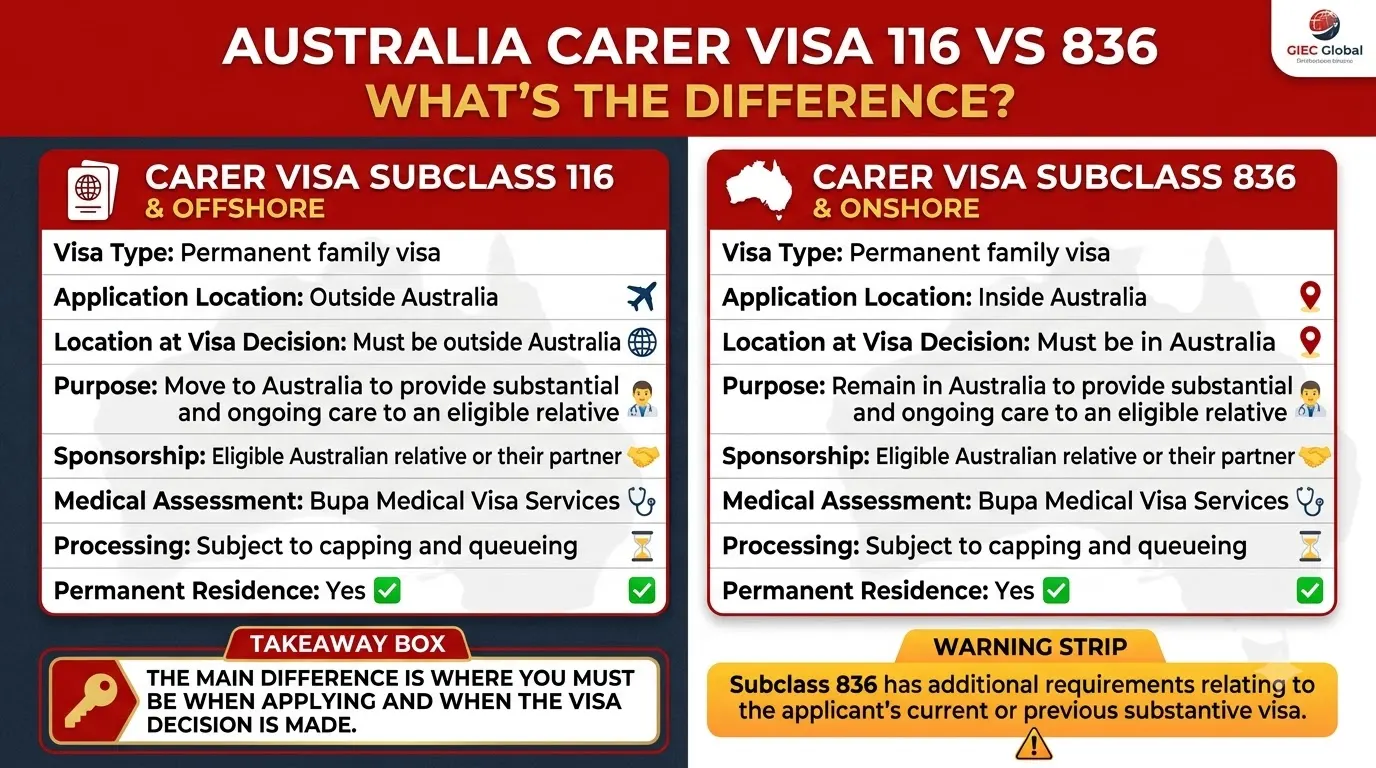
| Feature | Carer Visa 116 | Carer Visa 836 |
|---|---|---|
| Visa type | Permanent family visa | Permanent family visa |
| Application location | Outside Australia | Inside Australia |
| Location at visa decision | Must be outside Australia | Must be in Australia |
| Main purpose | Move to Australia to provide care to an eligible relative | Remain in Australia to provide care to an eligible relative |
| Sponsorship | Eligible Australian relative or their partner | Eligible Australian relative or their partner |
| Medical assessment | Bupa Medical Visa Services | Bupa Medical Visa Services |
| Processing system | Capping and queueing | Capping and queueing |
| Permanent residence | Yes | Yes |
The main difference is where you must be when applying and when Home Affairs makes its decision. The medical, care and sponsorship requirements are broadly similar, but the onshore subclass 836 has additional rules relating to your current or previous substantive visa.
Carer Visa vs Care Worker Visa: Which Do You Need?
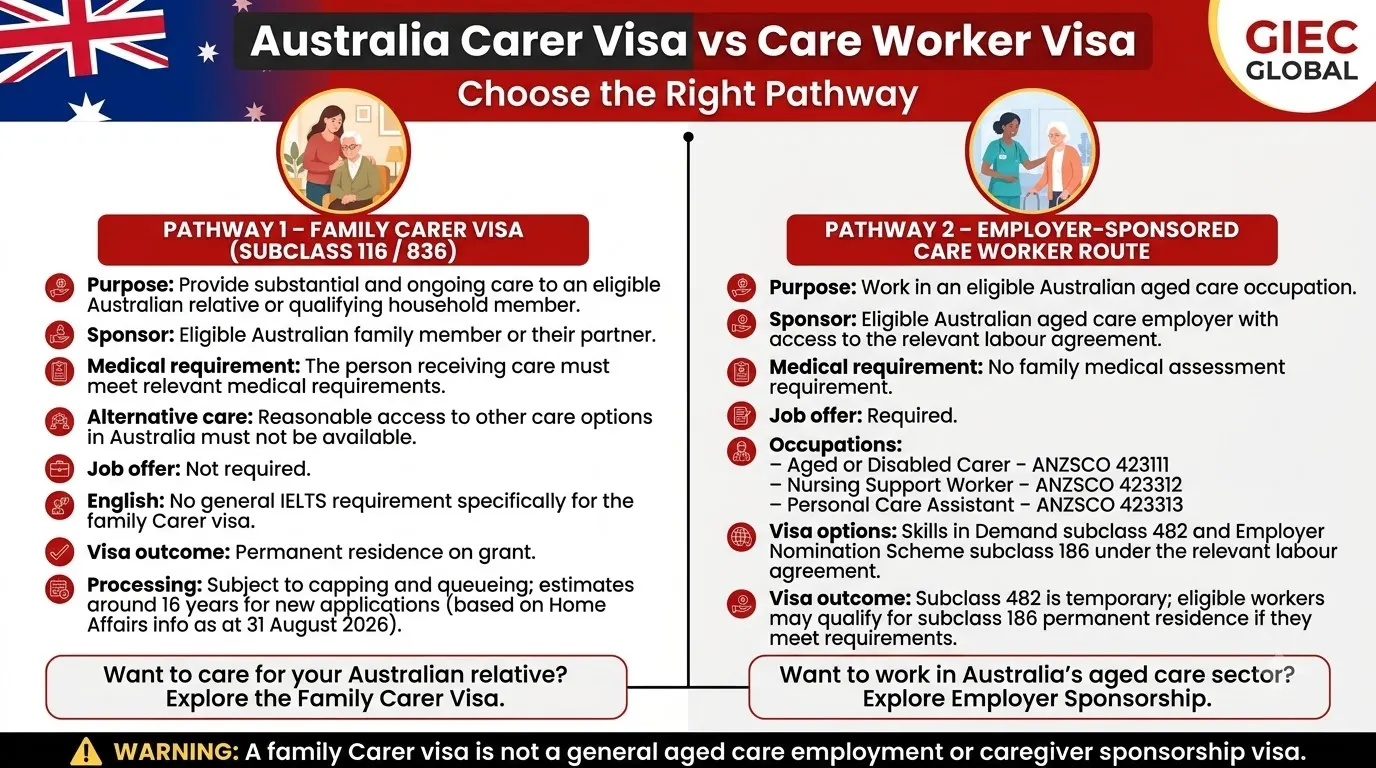
One of the most common sources of confusion is the difference between a family Carer visa and an Australian care worker visa. Both involve providing care, but they serve different immigration purposes.
If an Australian relative has a serious medical condition and needs ongoing assistance, the family Carer visa may be relevant. If you want to work in an aged care facility, nursing support role, disability care service or as a personal care assistant, an employer-sponsored visa may be more appropriate.
| Feature | Family Carer Visa 116/836 | Employer-Sponsored Care Worker Route |
|---|---|---|
| Purpose | Provide substantial care to an eligible Australian relative or qualifying household member | Work in an eligible aged care occupation for an Australian employer |
| Sponsor | Eligible Australian family member or their partner | Eligible Australian aged care employer |
| Visa type | Permanent family visa | Skills in Demand 482 or Employer Nomination Scheme 186 under the relevant labour agreement |
| Medical requirement | The person receiving care must meet the relevant medical requirements | No family medical assessment requirement |
| Job offer | Not required | Required for the employer-sponsored pathway |
| English language | No general IELTS requirement specifically for the family Carer visa | Applicable English requirements depend on the visa and labour agreement |
| Processing | Subject to Other Family visa capping and queueing | Depends on employer approval, nomination and visa processing |
| Permanent residence | Permanent visa on grant | Subclass 482 is temporary; eligible workers may later qualify for subclass 186 |
If your main goal is to find care jobs in Australia with visa sponsorship, applying for a family Carer visa is generally not the correct route. You should investigate employer sponsorship and confirm whether your occupation, experience and qualifications meet the relevant requirements.
Carer Visa Australia Requirements
VsFF
To qualify for an Australian Carer visa, applicants must satisfy the relevant requirements relating to the person receiving care, the family relationship, sponsorship, medical assessment and availability of alternative care in Australia.
The Department assesses each application individually. Having an Australian relative who is unwell does not automatically make a family member eligible for this visa.
1. Who Can You Provide Care For?
You must be willing and able to provide ongoing, substantial care and support to an eligible Australian relative who needs care, or to a qualifying member of that relative’s family who lives with them and needs care.
The person receiving care must have the required Australian immigration status. They generally need to be an Australian citizen, Australian permanent resident or eligible New Zealand citizen.
The sponsoring relationship must meet the Department’s definition of an eligible relative. Depending on the circumstances, this can include family relationships such as:
- Spouse or de facto partner.
- Parent or child.
- Brother or sister.
- Grandparent or grandchild.
- Aunt or uncle.
- Niece or nephew.
- Relevant step-relations and other qualifying family relationships.
The exact relationship and sponsorship requirements must be checked against the current Home Affairs rules. The person who needs care and the person who sponsors the applicant are not necessarily the same individual in every situation.
2. The Medical Requirement
The person who needs care must have a long-term medical condition that creates a genuine need for substantial care and assistance. The Department requires a medical assessment through Bupa Medical Visa Services.
The assessment helps establish the person’s medical condition and the amount and type of care they require.
Applicants should understand the following points:
- The medical condition must be supported by the required medical assessment.
- The condition must create a need for ongoing care and assistance.
- The applicant must understand the person’s medical condition and care requirements.
- The applicant must be willing and able to provide the required care.
- Medical evidence alone does not prove that alternative care is unavailable.
Emotional support, loneliness or a general preference for having a family member nearby is not, by itself, enough to establish the medical and care requirements.
3. No Reasonable Access to Other Care in Australia
This is one of the most important parts of the Australian Carer visa requirements. The applicant must show that the person who needs care does not have reasonable access to the care they require from other relatives in Australia or from available health, welfare and community services.
Home Affairs considers whether other people or services can reasonably provide the required care. Applicants should not assume that a family member’s work commitments, personal responsibilities or preference for a particular carer automatically establish that alternative care is unavailable.
Depending on the circumstances, relevant care options may include:
- Other relatives who live in Australia and may be able to provide care.
- Community health and support services.
- Government-funded disability support services, including relevant NDIS services.
- Aged care services and home support arrangements.
- Other appropriate medical, welfare or community care providers.
Applicants should explain what care is required, which services or relatives have been considered and why those options cannot reasonably meet the person’s needs.
4. You Must Be Willing and Able to Provide Care
The Carer visa is intended for a person who will genuinely provide ongoing care, not simply someone who wants to migrate to Australia through a family relationship.
You should understand the medical condition, daily care requirements and practical responsibilities involved. Your application should explain how you will provide the required assistance after arriving in Australia.
Evidence may include a care plan, medical information, details of your relationship with the person receiving care and a clear explanation of the support you intend to provide.
5. Sponsorship Requirement
You must have an eligible sponsor whose sponsorship is approved by the Department of Home Affairs.
The sponsor is generally the Australian relative who needs care or their eligible partner, depending on the circumstances. Sponsorship involves specific obligations, including support arrangements for the applicant during the required initial period after arrival.
Applicants should check that the proposed sponsor meets the age, relationship and immigration-status requirements before lodging the application.
Carer Visa 116 Requirements: Applying from Outside Australia
The Carer visa subclass 116 is designed for applicants who are outside Australia and want to move to Australia to provide care to an eligible relative.
To apply for subclass 116:
- You must be outside Australia when you lodge the application.
- You must remain outside Australia when Home Affairs makes its decision.
- You must have an eligible sponsor.
- You must meet the relevant relationship and care requirements.
- The person receiving care must meet the medical requirements.
- You must demonstrate that reasonable alternative care is not available in Australia.
- You and any included family members must meet applicable health and character requirements.
The offshore Carer visa is a permanent visa. If it is granted, you can move to Australia and provide the required care. You should not arrange travel to Australia for the purpose of entering on the Carer visa until Home Affairs confirms the grant in writing.
Can I Apply for Carer Visa 116 from the UK?
Yes. A person living in the UK may be able to apply for the Australian Carer visa subclass 116 if they meet the eligibility requirements and are outside Australia when applying and when the visa is decided.
Living in the UK does not automatically make an applicant eligible. The Australian relative must meet the sponsorship and medical requirements, and the applicant must demonstrate that other care options in Australia are not reasonably available.
Applicants should also consider the long queue before deciding whether this route is suitable for their family circumstances.
Carer Visa 836 Requirements: Applying in Australia
The Carer visa subclass 836 is the onshore version of the family Carer visa. It may be suitable for a person who is already in Australia and wants to apply to provide care to an eligible Australian relative.
Generally, an applicant must:
- Be physically in Australia when applying.
- Remain in Australia when Home Affairs makes the decision.
- Have an eligible sponsor.
- Meet the relevant care and medical requirements.
- Show that reasonable alternative care is not available.
- Meet the applicable substantive visa and immigration-history requirements.
- Satisfy the health and character requirements.
Can I Apply for Carer Visa 836 While Holding a Bridging Visa?
Some applicants may be eligible to apply for subclass 836 after their previous substantive visa has ceased, provided they meet the specific rules concerning their current or previous visa and the timing of their application.
However, holding a Bridging Visa does not automatically make a person eligible for the Carer visa 836. The Department has specific requirements concerning the substantive visa held or previously held and the validity and timing of the application.
If you are currently holding a Bridging Visa A or another bridging visa, review your immigration history before applying. You can read more about Bridging Visa A and the wider Australian migration options.
Can I Apply for Carer Visa 836 with a No Further Stay Condition?
A No Further Stay condition can restrict a person from making certain onshore visa applications. If your current visa includes condition 8503, 8534 or another relevant restriction, you should check whether the condition applies to the subclass 836 application and whether any waiver provisions are available.
Do not assume that a Carer visa application can be lodged simply because you are in Australia. The current visa conditions and applicable exceptions must be reviewed first.
Carer Visa Australia Processing Time
The Carer visa is part of Australia’s Other Family visa category. This category also includes the Remaining Relative visa and the Aged Dependent Relative visa.
Unlike some other Australian family visas, Other Family applications are subject to capping and queueing. This means the Department can grant only a limited number of visas during each migration program year. Eligible applications are placed in a queue and released for final processing as places become available.
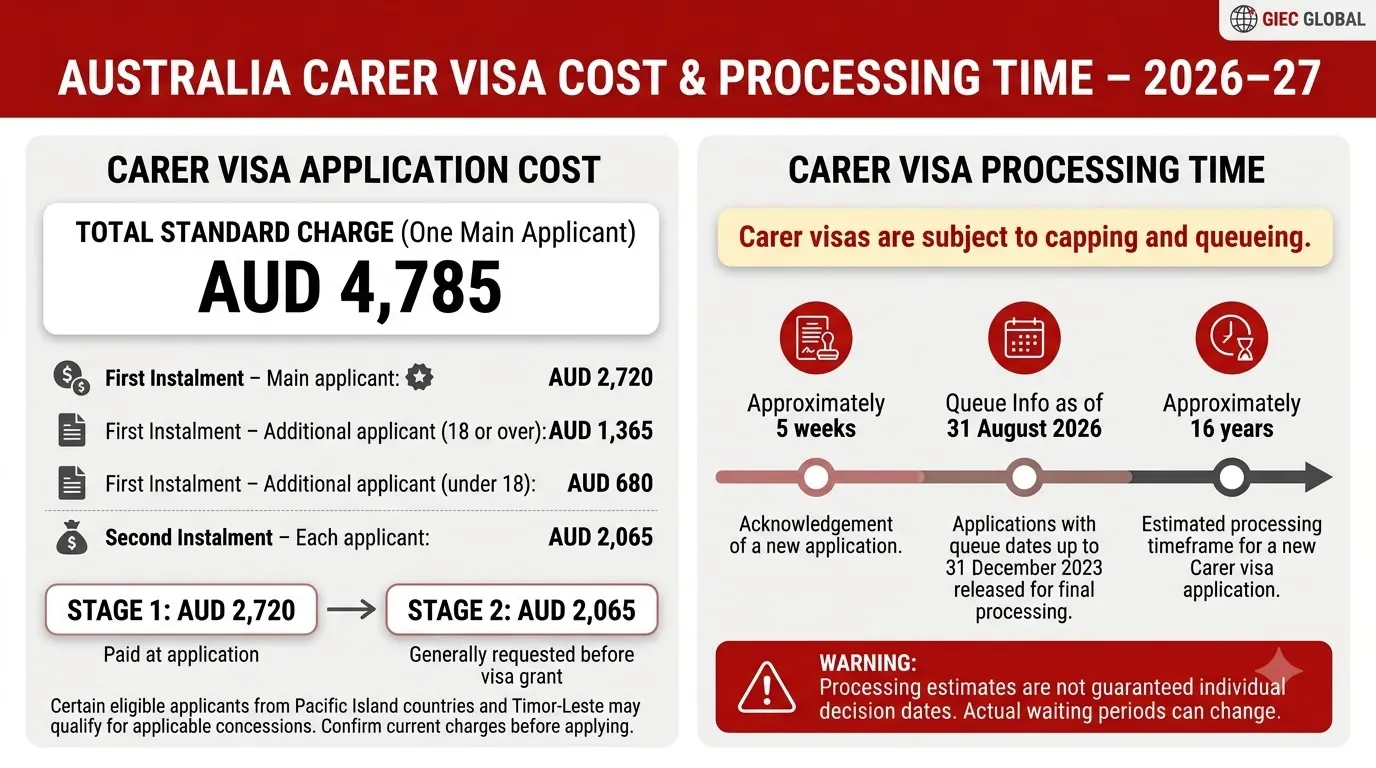
According to Home Affairs information published as at 31 August 2026:
| Processing Detail | Home Affairs Information |
|---|---|
| Acknowledgement of a new application | Approximately 5 weeks |
| Carer visa queue dates released for final processing | Applications with a queue date up to 31 December 2023 |
| Estimated processing timeframe for a new Carer visa application | Approximately 16 years |
| Visa category | Other Family visas |
| Queue system | Capping and queueing |
These figures are based on the Department’s published queue information as at 31 August 2026. They are not a guaranteed decision date for an individual application.
Why Is the Carer Visa Processing Time So Long?
The main reason is that demand for Other Family visas is greater than the number of places available in the migration program. Once the available places for a program year are reached, remaining applications stay in the queue until places become available in a future year.
Home Affairs assesses applications against the core visa requirements and assigns a queue date to eligible applications. Applications are then released for final processing in queue-date order, subject to the applicable processing priorities and rules.
The estimated 16-year timeframe may change as a result of:
- The number of new applications received.
- The number of available visa places in future migration program years.
- Changes to migration program planning levels.
- Withdrawals and refusals of other applications.
- Changes to processing directions and priorities.
- Individual health, character and document verification requirements.
Is There an Urgent Carer Visa Australia Option?
The Carer visa is generally not suitable for families who need an immediate solution to a care requirement because of its long queue. Home Affairs may consider certain family visa applications for priority processing where special compassionate circumstances and compelling reasons justify departing from the normal processing order.
However, priority processing is not automatic. It is assessed on a case-by-case basis and should not be treated as a guaranteed way to bypass the queue.
If your family needs immediate care arrangements, you may need to investigate available Australian health, welfare and community services while considering the longer-term immigration options.
Carer Visa Australia Cost (2026–27)
The Carer visa application charge is paid in two instalments. The first instalment is payable when the application is lodged. The second instalment is generally payable when the Department requests it, before the visa can be granted.
The standard published charge for subclass 116 and subclass 836 starts at AUD 2,720 for the main applicant, with additional applicant charges depending on age.
| Application Charge | Amount |
|---|---|
| First instalment – main applicant | AUD 2,720 |
| First instalment – additional applicant aged 18 or over | AUD 1,365 |
| First instalment – additional applicant under 18 | AUD 680 |
| Second instalment – each applicant | AUD 2,065 |
| Total standard charge – one main applicant | AUD 4,785 |
These are standard published charges. Eligible applicants from certain Pacific Island countries and Timor-Leste may qualify for a lower first instalment under the applicable concessions introduced from 1 July 2026. Always check the Department’s current visa pricing information before applying.
Is the Carer Visa Second Instalment Always Payable?
The second instalment is generally payable when Home Affairs requests it after the applicant has met the other visa requirements. However, the Department may consider reducing the second instalment to nil in certain circumstances if the applicant can demonstrate that payment would cause severe financial hardship to the applicant or the person receiving care.
This is not an automatic exemption. The applicant must make a request and provide supporting evidence. The Department decides whether the relevant hardship provisions apply.
Other Costs to Consider
The visa application charge is not necessarily the only expense involved. Applicants may also need to budget for:
- Bupa Medical Visa Services assessment and related medical expenses.
- Health examinations for visa applicants and relevant family members.
- Police certificates and character documents.
- Biometrics, if requested.
- Document certification and English translations.
- Postage or courier costs for paper-based applications.
- Professional immigration assistance, if used.
Does the Carer Visa Require an Assurance of Support?
The Carer visa should not be confused with family visa subclasses that require a bonded Assurance of Support. The sponsor has separate sponsorship obligations, including providing accommodation and financial support to the applicant during the required initial period.
Applicants should understand the sponsor’s responsibilities before lodging the application. The sponsor may need to demonstrate that they can meet the relevant obligations and support arrangements.
Benefits of the Australian Carer Visa
The Carer visa is a permanent visa. Once granted, it provides an eligible applicant with the ability to live in Australia indefinitely and provide the required care to their relative.
Key benefits include:
- Permanent residence: You can stay in Australia indefinitely after the visa is granted.
- Work rights: You can work in Australia, subject to Australian employment laws.
- Study rights: You can study in Australia.
- Medicare: You can enrol in Australia’s public healthcare scheme, subject to the applicable eligibility rules.
- Family sponsorship: You may be able to sponsor eligible relatives for Australian visas in the future.
- Travel facility: The visa generally includes a five-year travel facility from the grant date.
- Citizenship pathway: You may apply for Australian citizenship if you meet the relevant residence and other requirements.
Can I Travel Outside Australia on a Carer Visa?
Yes. The Carer visa generally provides a five-year travel facility from the date of grant. During this period, you can travel to and from Australia while the travel facility remains valid.
After the initial five-year travel facility expires, you may need a Resident Return visa (subclass 155 or 157) to return to Australia as a permanent resident, unless you have become an Australian citizen.
Australia Care Worker Visa: Working in Aged Care
If you are searching for an Australia care worker visa, aged care visa sponsorship or caregiver jobs in Australia, you should understand the employer-sponsored migration system.
Australia has an Aged Care Industry Labour Agreement that allows approved aged care employers to sponsor eligible overseas workers for specific direct care occupations. It provides an employer-sponsored pathway for certain roles where the employer meets the relevant labour agreement requirements.
The agreement is different from the family Carer visa. It is intended for people who want to work in the Australian aged care sector rather than move to Australia to care for a particular relative.
Aged Care Industry Labour Agreement
The Aged Care Industry Labour Agreement supports approved employers who need to recruit overseas workers for eligible direct care occupations.
The main occupations covered include:
- Aged or Disabled Carer – ANZSCO 423111: Provides care, household assistance, support and companionship to older people or people with disabilities.
- Nursing Support Worker – ANZSCO 423312: Provides support and limited patient care under the direction of nursing staff.
- Personal Care Assistant – ANZSCO 423313: Provides personal care and assistance in health facilities or in a person’s home.
The employer must have access to the relevant labour agreement and meet the agreement’s sponsorship and employment requirements. A worker cannot independently apply for an Aged Care Industry Labour Agreement without an eligible sponsoring employer.
Care Worker Visa Australia Requirements
The requirements depend on the nominated occupation, the sponsoring employer, the visa subclass and the terms of the labour agreement.
Under the published Aged Care Industry Labour Agreement settings, relevant requirements include:
- A genuine full-time position with an eligible aged care employer.
- Employer sponsorship and nomination under the applicable agreement.
- A relevant AQF Certificate III or equivalent qualification, or the required relevant work experience.
- Any required positive skills assessment for an overseas qualification or work-experience-based claim.
- The applicable English language requirements.
- Compliance with the salary and employment conditions in the agreement.
- Meeting health, character and other visa requirements.
English Language Requirements for Aged Care Workers
English requirements depend on the visa subclass and the type of aged care provider.
For overseas workers sponsored by standard aged care providers under the Skills in Demand visa subclass 482, the published Aged Care Industry Labour Agreement concession includes:
- IELTS overall score of 5.0 or an accepted equivalent.
- Minimum 5.0 in speaking.
- Minimum 5.0 in listening.
- Minimum 4.5 in reading.
- Minimum 4.5 in writing.
For eligible culturally and linguistically diverse aged care providers, a different English concession may apply where the worker is fluent in the target community language. The published concession includes IELTS 4.5 or equivalent with no component minimum, subject to the agreement’s conditions.
For the Employer Nomination Scheme subclass 186 under the agreement, the published English concession is IELTS 5.5 or equivalent with no minimum component scores.
These are labour agreement concessions, not universal English requirements for every Australian care job. Registration, licensing or other visa requirements may require a different level of English.
Qualifications and Work Experience
Under the Aged Care Industry Labour Agreement, workers generally need one of the following:
- A relevant Australian Qualifications Framework Certificate III or equivalent qualification, or a higher qualification; or
- At least 12 months of relevant full-time work experience, or equivalent part-time experience.
If you obtained your qualification overseas or rely on work experience instead of a relevant qualification, a positive skills assessment may be required.
The relevant assessing authority depends on the occupation:
- Community Work Australia: Aged or Disabled Carer (ANZSCO 423111).
- Australian Nursing and Midwifery Accreditation Council: Nursing Support Worker (ANZSCO 423312) and Personal Care Assistant (ANZSCO 423313).
Applicants should confirm the current assessment requirements before paying for a qualification assessment or submitting a visa application.
Care Worker Salary in Australia
Salary requirements for an employer-sponsored care worker depend on the applicable labour agreement and employment conditions. Under the published Aged Care Industry Labour Agreement settings, the employer must pay the worker at least AUD 51,222 in guaranteed annual earnings or the Australian Market Salary Rate for the position, whichever is higher.
This figure is a labour agreement-specific minimum and should not be confused with the general skilled visa income threshold. The employer must also meet applicable employment laws and the relevant market salary requirements.
Actual care worker salaries vary according to:
- The nominated occupation and level of responsibility.
- The employer and type of aged care facility.
- Location and employment agreement.
- Full-time hours, shifts and applicable allowances.
- Relevant qualifications and experience.
Before accepting a job offer, review the employment contract and confirm that the proposed salary and conditions comply with the relevant labour agreement and Australian workplace laws.
Care Worker Visa Sponsorship Australia: 482 and 186 Pathways
Under the Aged Care Industry Labour Agreement, eligible employers may sponsor overseas workers through the Skills in Demand visa subclass 482 and the Employer Nomination Scheme visa subclass 186.
1. Skills in Demand Visa Subclass 482
The Skills in Demand visa subclass 482 is an employer-sponsored temporary visa. It replaced the former Temporary Skill Shortage visa arrangements in December 2024.
For eligible aged care workers, the 482 pathway may be available where an approved employer has access to the Aged Care Industry Labour Agreement and nominates the worker for an eligible occupation.
Applicants generally need:
- An eligible sponsoring employer.
- A genuine nominated position in an occupation covered by the agreement.
- Relevant qualifications or work experience.
- The required English language evidence.
- Any required skills assessment.
- Compliance with the applicable salary and employment terms.
- Health, character and other visa requirements.
A subclass 482 visa is temporary. It does not automatically become permanent residence. However, eligible workers may have a pathway to subclass 186 if they meet the relevant requirements and receive an eligible nomination.
2. Employer Nomination Scheme Visa Subclass 186
The Employer Nomination Scheme visa subclass 186 is a permanent employer-sponsored visa. Under the Aged Care Industry Labour Agreement, eligible workers may be nominated for the subclass 186 Labour Agreement stream.
The published agreement settings include a requirement for at least two years of relevant work experience in Australia in a direct care occupation. The experience is not necessarily required to be with one particular employer or under one particular visa subclass.
Applicants must also satisfy the applicable age, English, skills, nomination and other visa criteria. The standard age limit for the subclass 186 visa is generally 45 years at the time of application, although specific exemptions may apply under the migration rules or relevant agreement.
Can Aged Care Workers Get Permanent Residency in Australia?
Yes, some eligible aged care workers may be able to obtain Australian permanent residence through the subclass 186 Labour Agreement stream.
However, permanent residence is not guaranteed simply because a person works in aged care or holds a subclass 482 visa. The employer must be able to nominate the worker under the relevant agreement, and the applicant must satisfy all applicable requirements.
Before accepting a temporary care worker position, check whether the employer has access to the relevant labour agreement and whether the proposed role may support a future permanent residence nomination.
Other Australian Visa Options for Care Workers
The Aged Care Industry Labour Agreement is not the only possible migration route for people working in healthcare or care-related occupations. Depending on your qualifications, experience, occupation and employer, other visa options may be worth investigating.
494 Skilled Employer Sponsored Regional Visa
The subclass 494 visa is a regional employer-sponsored visa. It may be relevant to eligible occupations and employers in designated regional areas, subject to the occupation list and nomination requirements.
It is a provisional visa that can provide a pathway to permanent residence through the subclass 191 visa if the applicant meets the applicable requirements.
However, applicants should not assume that every aged care or disability support occupation is eligible for subclass 494. The relevant occupation, employer and regional sponsorship arrangements must be checked.
Read more about the Subclass 494 visa Australia.
Skilled Migration for Registered Nurses
Registered nurses may have different migration options from aged care support workers. Depending on their registration, qualifications, work experience and occupation, eligible nurses may consider skilled migration routes such as:
- Skilled Independent visa subclass 189.
- Skilled Nominated visa subclass 190.
- Skilled Work Regional visa subclass 491.
- Employer-sponsored visa options, where eligible.
Registered nurses must check the applicable occupation requirements, skills assessment and registration standards. Working as a personal care assistant or aged care worker does not automatically qualify someone as a registered nurse.
Explore our Australia General Skilled Migration information for further guidance.
Australia Care Worker Visa vs UK Health and Care Worker Visa
Some applicants search for a UK carer visa, Health and Care Worker visa or care worker sponsorship because they are comparing employment opportunities in the UK and Australia.
These are separate immigration systems. Australia’s Aged Care Industry Labour Agreement and the UK’s Health and Care Worker route have different employer, occupation, salary and immigration requirements.
The UK ended new overseas recruitment for care workers and senior care workers from 22 July 2025. Certain transitional arrangements remain available for eligible workers already in the UK, subject to the applicable immigration rules.
Therefore, a person outside the UK should not assume that they can obtain a new UK care worker visa through an overseas care job offer. Applicants considering Australia should assess the Australian employer-sponsored routes separately.
How to Apply for a Carer Visa in Australia
The Carer visa application process involves checking the family relationship, confirming the medical and care requirements, arranging the Bupa assessment, preparing supporting documents and lodging the correct subclass application.
Step 1: Check Your Eligibility
Start by checking whether the person who needs care meets the Australian immigration-status requirement and whether your family relationship qualifies under the Carer visa rules.
You should also consider whether you can provide the substantial ongoing care required and whether reasonable alternative care is available in Australia.
Step 2: Arrange the Bupa Medical Assessment
The relative who needs care, or the qualifying household member, must undergo the required assessment through Bupa Medical Visa Services.
The Department requires evidence that this assessment process has at least begun before it will accept the application. A medical certificate should be provided as required by Home Affairs.
Step 3: Prepare Evidence of Unavailable Alternative Care
Prepare written evidence explaining why other relatives and available health, welfare or community services cannot reasonably provide the required care.
This may involve medical records, care assessments, details of existing support arrangements, information about relatives living in Australia and evidence explaining why those arrangements cannot meet the person’s needs.
Step 4: Choose the Correct Visa Subclass
Select the correct subclass according to your location:
- Subclass 116 if you are outside Australia and will remain outside Australia until the decision.
- Subclass 836 if you are in Australia and meet the onshore application requirements.
Step 5: Prepare the Application and Supporting Documents
Common documents may include:
- Valid passport and identity documents.
- Birth, marriage or other relationship certificates.
- Evidence of the sponsor’s Australian citizenship, permanent residence or eligible New Zealand citizenship.
- Bupa Medical Visa Services documentation.
- Evidence explaining why alternative care is not reasonably available.
- Documents showing the applicant’s ability and willingness to provide care.
- Documents for any included family members.
- Other supporting evidence requested by Home Affairs.
Documents not in English must be translated according to the Department’s requirements. Keep copies of the completed forms and supporting evidence.
Step 6: Lodge the Application
The Carer visa application is generally lodged on paper using the relevant Other Family visa forms and supporting documents. The Department provides instructions on payment and the correct submission address.
Applicants should follow the latest subclass-specific instructions. Do not assume that an online visa application process used for another family visa also applies to subclass 116 or 836.
Step 7: Pay the First Instalment
Pay the applicable first instalment and include the required payment evidence with the application. An application may be considered invalid if the correct application charge is not paid or required documents are missing.
Step 8: Wait for the Queue Date
After receiving a valid application, Home Affairs assesses it against the core visa requirements. If the application meets the requirements to enter the queue, the Department assigns a queue date and notifies the applicant in writing.
Keep your contact details and passport information up to date. You may need to provide additional documents when the Department releases the application for final processing.
Step 9: Complete Final Checks and Pay the Second Instalment
When the application reaches final processing, Home Affairs may request updated health, character or other documents. The Department will also advise when the second instalment is payable.
The visa cannot be granted until the required conditions and payments have been satisfied or an applicable concession has been approved.
How to Apply for an Australia Care Worker Visa with Sponsorship
The employer-sponsored process is different from the family Carer visa process. An overseas worker generally needs an eligible aged care employer that can sponsor the position under the relevant labour agreement.
- Identify an eligible occupation: Check whether your experience matches Aged or Disabled Carer, Nursing Support Worker or Personal Care Assistant.
- Check your qualifications: Review whether you have the relevant Certificate III or equivalent qualification, or the required work experience.
- Check English requirements: Confirm the English language level and accepted test evidence for the intended visa.
- Find an eligible employer: Identify an aged care provider that has access to the relevant labour agreement and can nominate overseas workers.
- Receive a genuine job offer: Confirm the job duties, salary, location, employment conditions and sponsorship arrangements.
- Complete any required skills assessment: Arrange the appropriate assessment if your qualification or work-experience pathway requires it.
- Employer nomination: The employer must complete the relevant sponsorship and nomination steps.
- Submit the visa application: Apply for the relevant subclass 482 or 186 visa and provide the required evidence.
- Wait for the decision: Do not make relocation or employment arrangements that depend on visa approval until the Department has granted the visa.
A job advertisement mentioning visa sponsorship does not prove that the employer can sponsor an overseas worker under the Aged Care Industry Labour Agreement. Always verify the employer’s sponsorship arrangements and the proposed occupation.
Common Mistakes to Avoid When Applying for a Carer Visa
Carer visa applications require detailed evidence. A genuine family relationship or medical condition alone may not be sufficient if the other eligibility requirements are not met.
1. Confusing a Family Carer Visa with a Care Worker Visa
A family Carer visa is not a general work visa for people seeking aged care employment. Applicants looking for care jobs with sponsorship should explore employer-sponsored routes instead.
2. Not Arranging the Bupa Assessment
The required medical assessment is an important part of the application. Applicants should follow the Department’s instructions and ensure that the assessment process has begun before lodging.
3. Providing Insufficient Evidence of Care Needs
A general medical report may not fully explain the level of care required. Ensure that the supporting medical information addresses the person’s condition and actual care needs.
4. Failing to Explain Alternative Care Options
Applicants must explain why care cannot reasonably be provided by other relatives or available services in Australia. Simply stating that a particular family member is busy or unavailable may not be enough.
5. Choosing the Wrong Subclass
Subclass 116 is for offshore applicants, while subclass 836 is for eligible onshore applicants. The applicant’s location at lodgement and decision is important.
6. Ignoring the Long Processing Queue
The estimated processing time for a new Carer visa application is currently around 16 years. Families should understand this before relying on the visa to meet an immediate care requirement.
7. Assuming a Care Worker Job Guarantees Sponsorship
A job offer alone does not guarantee a visa. The employer, occupation, labour agreement, salary and applicant’s qualifications must all meet the relevant requirements.
How GIEC Global’s Australian Immigration Consultants Can Help
Choosing the correct Australian immigration pathway depends on your family circumstances, the type of care required, your current visa status and your long-term migration plans.
GIEC Global supports families and skilled applicants with Australian immigration guidance. Our team can help you understand the difference between a family Carer visa and employer-sponsored care worker options.
Depending on your circumstances, our support may include:
- Reviewing whether your family circumstances may meet the Carer visa requirements.
- Explaining the differences between subclass 116 and subclass 836.
- Helping organise evidence relating to the medical condition and care requirements.
- Identifying the documents needed to explain why other care is not reasonably available.
- Reviewing relevant bridging visa and onshore application considerations.
- Explaining employer-sponsored aged care pathways and labour agreement requirements.
- Reviewing relevant qualification, English language and skills assessment requirements.
- Comparing suitable family, skilled and employer-sponsored migration options.
Immigration eligibility depends on the individual facts of each case. No consultant can guarantee a visa grant, a queue position or a specific processing timeframe. The final decision rests with the Australian Department of Home Affairs.
Explore our Australian Parent Visa information, learn more about General Skilled Migration, or visit our Migrate to Australia page.
Final Thoughts: Is the Carer Visa Australia Right for You?
The Australian Carer visa can provide a permanent migration pathway for someone who genuinely needs to move to Australia to provide substantial and ongoing care to an eligible relative. However, applicants must meet strict medical, sponsorship, relationship and alternative-care requirements.
Subclass 116 is for eligible applicants outside Australia, while subclass 836 is for eligible applicants inside Australia. Both are subject to capping and queueing, and Home Affairs currently estimates that new Carer visa applications may take around 16 years.
If your objective is to work in Australia’s aged care sector rather than care for a family member, an employer-sponsored route under the Aged Care Industry Labour Agreement may be more relevant. Eligible workers may be sponsored through the Skills in Demand visa subclass 482, with a possible permanent residence pathway through subclass 186 if all requirements are met.
Before applying, identify your actual objective: family care, aged care employment or skilled migration. Choosing the correct pathway can help you avoid an unsuitable application and unnecessary costs.
Official information: Always check the latest requirements, charges and processing information on the Australian Department of Home Affairs website before lodging an application.
Reviewed by the GIEC Global Australia immigration team. Carer visa queue information reflects Home Affairs figures published as at 31 August 2026. Visa charges and Aged Care Industry Labour Agreement details should be reconfirmed against the latest official information before applying. Last reviewed: 6 November 2026. This article provides general information and is not individual immigration advice.
Frequently asked questions
What is the carer visa in Australia?
The Carer visa (subclass 116 offshore or 836 onshore) is a permanent visa for someone who moves to Australia to care for a relative with a long-term medical condition.
Who is eligible for the Australian carer visa?
A person sponsored by an Australian relative with a severe long-term condition that other relatives and services cannot reasonably care for.
What is the difference between the 116 and 836 carer visa?
The 116 is applied for and granted outside Australia; the 836 is applied for and granted in Australia.
How much does the carer visa cost?
From AUD 4,785 for one applicant in 2026–27 – AUD 2,720 at lodgement and AUD 2,065 before grant.
What is the carer visa processing time?
Home Affairs estimates about 16 years for a new application because the visa is capped and queued.
Who assesses the medical condition for a carer visa?
Bupa Medical Visa Services assesses whether the relative has a severe long-term impairment.
Can I get a carer visa to look after my parent?
Yes, a parent can be the sponsor if they meet the medical requirement and other care is not reasonably available.
Is the carer visa a care worker visa?
No. The Carer visa is for caring for a relative. Care workers need employer sponsorship.
Do I need IELTS for the carer visa?
The family Carer visa has no specific English test requirement. Care worker visas do.
How do I get a care worker visa in Australia?
Get sponsored by an aged care or disability provider through the Aged Care Industry Labour Agreement, a 482 or a 494.
What English is needed for an aged care worker visa?
Under the aged care labour agreement, generally IELTS 5.0 overall with minimum component scores.
What qualifications do care workers need for Australia?
Usually a Certificate III in individual support or 12 months of relevant work experience.
What salary do sponsored care workers need?
At least AUD 79,423 from 1 July 2026, and no less than the market rate and award.
Can care workers get PR in Australia?
Yes. Labour agreement workers can apply for PR through the 186 after about two years.
Is there a caregiver age limit in Australia?
The family Carer visa has no age limit. Care worker visas may have age limits, with concessions under labour agreements.
Does the carer visa need an Assurance of Support?
No bonded AoS, but the sponsor must provide accommodation and financial support for two years.
Can I work on a carer visa?
Yes. Once granted, the Carer visa is permanent and you can work, study and enrol in Medicare.
Can I apply for the carer visa from the UK?
Yes, the 116 is applied for from outside Australia, including from the UK, with an ACRO police certificate.
Is the UK Health and Care Worker visa the same as an Australian carer visa?
No. It is a separate UK visa. Australia uses employer sponsorship for care workers.
Why use an immigration consultant for a carer visa?
Carer visas need strong medical and care evidence, and care worker visas need the right sponsor. A consultant gets both right.
Free consultation
Check your eligibility
A registered agent can review your profile and explain which pathway may suit you.
Book your free consultation
Thank you! Your enquiry has been received. A GIEC adviser will contact you shortly.