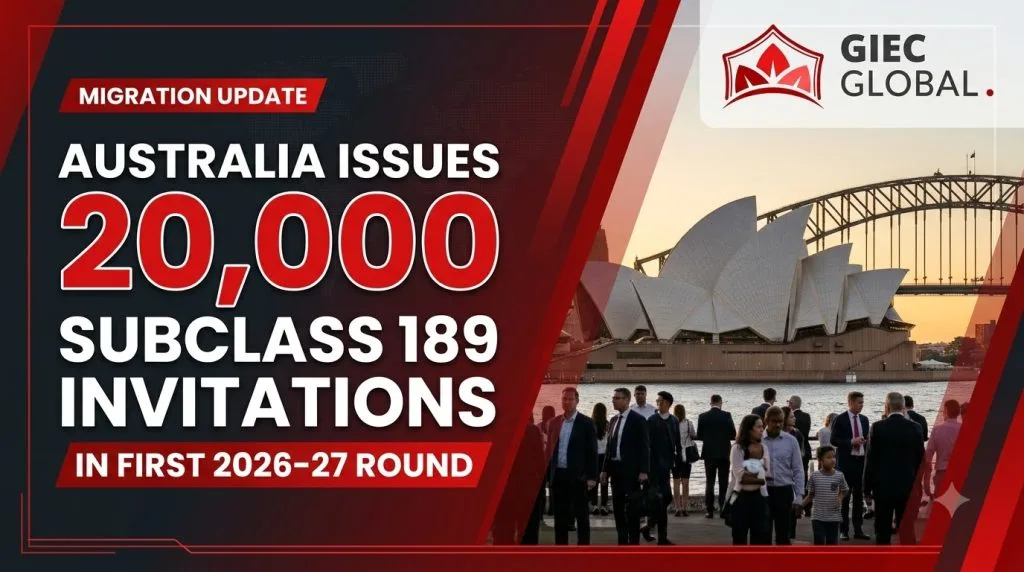
Summary: Australia's first SkillSelect round of 2026–27, held on 15 October 2026, issued 20,000 Skilled Independent (subclass 189) invitations with minimum scores from 65 points. No family-sponsored subclass 491 invitations were issued.
Australia issued 20,000 invitations for the Skilled Independent visa (subclass 189) in its first SkillSelect invitation round of the 2026–27 program year, held on 15 October 2026. The round, double the size of the previous one in June, gives a first indication of how the Department of Home Affairs intends to use this year’s skilled independent places. No invitations were issued for the family-sponsored stream of the Skilled Work Regional (Provisional) visa (subclass 491).
What happened in the October round?
Results published by the Department of Home Affairs, and reported widely by Australian migration practitioners, show:
- Round date: 15 October 2026.
- Subclass 189 invitations: 20,000.
- Subclass 491 family-sponsored invitations: none.
- Minimum points: from 65 to 100, depending on the occupation.
Practitioner analysis of the published results counts invitations across around 159 occupations. The previous round, on 4 June 2026, issued 10,000 subclass 189 invitations.
The round came later than many applicants expected. Home Affairs had earlier indicated the first round of the program year would take place by the end of September, before updating its guidance. The department has not announced the date of the next round.
How SkillSelect invitations work
Applicants for the subclass 189 visa must first lodge an Expression of Interest (EOI) through SkillSelect, claiming points for factors such as age, English language ability, qualifications and skilled employment. They must also have a suitable skills assessment for an occupation on the relevant list.
Invitations are issued in rounds, ranked by points score within each occupation. Where candidates have the same score, the date they reached that score acts as a tie-breaker. Only invited candidates can lodge a visa application, and they have 60 days to do so.
Because invitations are allocated by occupation, the minimum score varies widely. An occupation in high demand with few EOIs may see invitations at 65 points, while popular occupations require much higher scores.
The 2026–27 planning context
The government has kept the permanent Migration Program at 185,000 places for 2026–27, with 132,240 places allocated to the Skill stream, according to published planning levels. Within that, analysis by migration agents shows two notable shifts compared with 2025–26:
- Employer-sponsored places rose from 44,000 to 58,040.
- Skilled independent places rose from 16,900 to 21,090.
Regional allocations, which cover subclass 491 and employer-sponsored regional visas, were reduced. That is consistent with the absence of family-sponsored 491 invitations in the October round.
Invitations do not equal visa grants. Not every invited candidate lodges an application, and some applications are refused or withdrawn, so the department may invite more people than the number of places available.
Who will be affected?
Candidates with existing EOIs for subclass 189 are directly affected. A larger round increases the chance of invitation, especially for those just below previous cut-offs.
Applicants hoping for a family-sponsored 491 visa received no invitations and face continued uncertainty given the reduction in regional places.
State-nominated applicants are not covered by federal 189 rounds. Their prospects depend on state and territory nomination programs, several of which opened for 2026–27 in October, while others had not confirmed their allocations.
UK-based professionals considering Australian permanent residence should note that the October round was the first of the year, and that competition varies greatly by occupation.
State nomination programs are also reopening
For many applicants, the federal 189 round is only part of the picture. State and territory nominated visas, the subclass 190 and the state-nominated stream of the subclass 491, run on separate allocations set by each jurisdiction. According to practitioner tracking of state announcements, Victoria opened its 2026–27 subclass 190 program on 26 October with 900 nomination places, and South Australia opened its General Skilled Migration program on 22 October. Other states, including Queensland, were still waiting on federal confirmation of their allocations at the end of October.
Applicants who are not competitive in federal rounds often find a state nomination is a more realistic route, as states can prioritise occupations and applicants who meet their own needs. Each state publishes its own criteria, and these can change at short notice during the program year.
What changes for applicants?
The rules for the subclass 189 visa have not changed. What has changed is the volume of invitations and the planning levels behind them. Applicants should make sure their EOI is accurate and up to date. Points must be claimable at the time of invitation, and any overstated claim can lead to refusal.
Candidates can strengthen their position by improving English test scores, completing additional skilled employment, or gaining recognised qualifications, but only where those claims can be evidenced.
What happens next?
Home Affairs updates its invitation rounds page after each round and has said further rounds will be held during the program year. Applicants should rely on that official page for dates and results.
Our guides explain the process in more detail, including the subclass 189 visa and Australian permanent residency routes. Applicants can estimate an indicative score using the Australia PR points calculator. Registered nurses may find our guide to Australia PR for nurses useful, and former students can read about getting PR in Australia after a study visa.