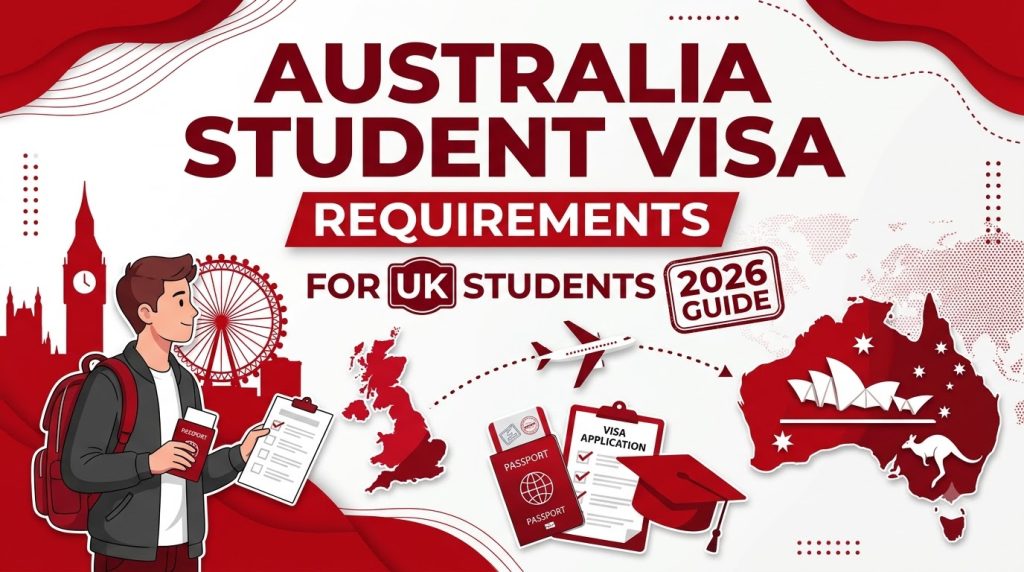
Australia remains one of the most popular study destinations for students from the UK, offering world-ranked universities, a strong graduate job market and a lifestyle many find hard to resist. If you are planning to study there, you will almost certainly need a Student visa (subclass 500). This guide explains the Australia student visa requirements for UK students in 2026, including the latest fee, how much money you need to show, who is exempt from English tests and how the 2026 enrolment settings affect processing.
The rules differ in some important ways depending on whether you hold a British passport or are an international student living in the UK, so this guide covers both. If you are still at the early planning stage, our overview of studying in Australia from the UK is a useful starting point.
Do UK Students Need a Visa to Study in Australia?
Yes, for most courses. Any student enrolling in a full-time course registered on CRICOS (the Commonwealth Register of Institutions and Courses for Overseas Students) needs a Student visa (subclass 500). The visa lets you study, work part-time and live in Australia for the length of your course, up to a maximum of five years.
There are two exceptions for short courses:
- eVisitor (subclass 651): British citizens can study for up to three months on an eVisitor visa, which suits short courses and study tours.
- Working Holiday (subclass 417): UK passport holders aged 18 to 35 can study for up to four months on a Working Holiday visa while also working.
Visitor visa holders cannot apply for a Student visa from inside Australia, so if you plan to study a full course you should apply from the UK before you travel.
Australia Student Visa Requirements at a Glance
| Requirement | What you need (2026) |
|---|---|
| Enrolment | Confirmation of Enrolment (CoE) for a CRICOS-registered course |
| Visa fee | AUD 2,500 base charge (from 1 July 2026) |
| Genuine Student requirement | Answers and evidence showing you genuinely intend to study |
| Financial capacity | AUD 29,710 living costs for 12 months, plus tuition and travel, if requested |
| English language | UK passport holders exempt; others usually need an approved test |
| Health insurance | Overseas Student Health Cover (OSHC) for your whole stay |
| Health and character | Health examinations and police checks if requested |
| Under-18 students | Approved welfare arrangements (CAAW) or a suitable guardian |
1. Confirmation of Enrolment (CoE)
Your application starts with a place on a course. After you accept an offer and pay the deposit your provider requires, the provider issues a Confirmation of Enrolment. You need a CoE for each course you include in your visa application. If you are combining courses, such as an English language course followed by a degree, a package of CoEs can cover the full study period.
Choose your provider carefully, because it now affects how quickly your visa is processed (see the section on 2026 processing priorities below). Our guide on what you should know before studying in Australia covers course and provider selection in more detail.
2. The Genuine Student Requirement
Since March 2024, every applicant must meet the Genuine Student (GS) requirement, which replaced the older Genuine Temporary Entrant test. In the application form, you answer targeted questions about:
- Your current circumstances, including ties to the UK or your home country
- Your study history and any gaps in it
- Why you chose this course and provider in Australia
- How the course will benefit your future career
- Any previous visa history in Australia or elsewhere
Answer in your own words and support your answers with documents such as transcripts, employment references or evidence of a career plan. Vague or copied statements are a common reason for refusal. Our article on whether it is difficult to get an Australian student visa explains how decision-makers assess this requirement.
3. Financial Capacity Requirements
You must be able to support yourself during your stay. Depending on your nationality and education provider, Home Affairs may ask you to provide financial evidence with your application. You can check what you need to submit using the Document Checklist Tool on the Home Affairs website.
| Item | 12-month amount (AUD) |
|---|---|
| Living costs, student | 29,710 |
| Living costs, partner | 10,394 |
| Living costs, each child | 4,449 |
| School costs, each school-age child | 13,502 |
| Travel (applying from outside Australia, except from Africa) | 2,000 |
| Tuition | First 12 months of fees, minus any amount already paid |
As an alternative to savings, you can show that your parents or partner earned at least AUD 87,856 in the previous 12 months, or AUD 102,500 if family members are coming with you, using official tax documents.
Funds must be genuinely available to you and come from a legitimate source. If family members are supporting you, our guide on who can sponsor a student visa for Australia explains acceptable sponsors and evidence. Scholarships can significantly reduce the amount you need to show, so it is worth reviewing fully funded scholarships in Australia for 2026 before you apply.
4. English Language Requirements
This is where the requirements differ most between UK applicants.
British passport holders
Citizens who hold a valid passport from the United Kingdom, the United States, Canada, New Zealand or the Republic of Ireland are exempt from providing English test results for the Student visa. British National (Overseas) passports are not accepted for this exemption.
Your university or college still sets its own entry requirements, but most accept UK schooling or qualifications as evidence of English for admission.
International students living in the UK
The passport exemption depends on citizenship, not residence. If you are, for example, an Indian or Nigerian national studying in the UK, you will usually need an approved English test. The exception is if you have completed at least five years of study in English in one or more eligible countries: Australia, the UK, the USA, Canada, New Zealand, South Africa or the Republic of Ireland. A single three-year UK degree on its own will not meet the five-year requirement.
English test requirements for the Student visa changed on 7 August 2025, including new minimum scores for tests such as PTE Academic. For IELTS, the typical visa minimum is an overall score of 6.0. Lower scores can be accepted when combined with an English language (ELICOS) course before your main course. Always check both the visa minimum and your provider’s entry requirement, because universities often ask for more.
5. Overseas Student Health Cover (OSHC)
You must hold Overseas Student Health Cover for the full length of your stay as a condition of your visa. Only students from Belgium, Norway and Sweden have a standard exemption.
The UK has a Reciprocal Health Care Agreement with Australia, so UK students on a Student visa can also access some Medicare services for medically necessary treatment. This is in addition to OSHC, not a replacement for it. Many providers arrange OSHC for you when you accept your offer.
6. Health, Character and Welfare Requirements
- Health: You may be asked to complete health examinations depending on your country of citizenship, where you have lived and your intended course. Applicants planning to study in healthcare or teaching may face additional checks.
- Character: Police certificates may be requested. For UK residents, these are issued through ACRO Criminal Records Office.
- Under 18s: You need either a parent or relative over 21 to act as your guardian, or a Confirmation of Appropriate Accommodation and Welfare (CAAW) letter from your provider.
Need help with your application? GIEC Global UK’s Study in Australia service supports UK students with course selection, CoE, the Genuine Student statement and visa documentation.
Australia Student Visa Fees and Costs in 2026
The government’s visa application charges increased on 1 July 2026. The table below summarises the main costs to budget for.
| Cost | Amount |
|---|---|
| Visa application charge, main applicant | AUD 2,500 |
| Additional applicant aged 18 or over | AUD 1,530 |
| Additional applicant under 18 | AUD 500 |
| OSHC | Varies by provider and length of stay |
| Tuition fees | Varies by course and institution |
| English test, if needed | Varies by test |
The visa charge is not refunded if your application is refused, so make sure your application is complete before you lodge it.
2026 Processing Priorities and the National Planning Level
Australia now manages international student numbers through a National Planning Level (NPL) of new overseas student commencements. The NPL is 295,000 for 2026 and will stay at 295,000 for 2027.
The NPL is not a cap on visas, but it does affect processing speed. Under Ministerial Direction 115, which has applied since 14 November 2025, applications are processed as high priority until your chosen provider reaches 80% of its allocation of new students. After that point, applications for that provider are processed more slowly. In practice:
- Applying early in your provider’s intake cycle can help.
- Your choice of provider can affect how long you wait.
- Some groups are exempt from the planning level, including higher degree by research students and certain government scholarship holders.
Work Rights on an Australian Student Visa
Student visa holders can generally work up to 48 hours per fortnight while their course is in session and unlimited hours during scheduled course breaks. Students in master’s by research or doctoral programmes have unlimited work rights once their course has started. Work should support your living costs, not fund your studies, so do not rely on part-time earnings to meet the financial capacity requirement.
Step-by-Step: How to Apply from the UK
- Choose your course and provider. Check that the course is CRICOS-registered and fits your study and career history.
- Apply for admission. Submit transcripts and English evidence, or your passport if you are exempt.
- Accept your offer and receive your CoE. Pay the required deposit and arrange OSHC.
- Prepare your documents. Gather your passport, CoE, Genuine Student evidence, financial evidence if required and any welfare documents.
- Create an ImmiAccount and apply online. Lodge your Student visa (subclass 500) application and pay the fee.
- Complete biometrics, health checks and police checks if requested. Respond promptly to any requests from Home Affairs.
- Receive your decision. Check your visa conditions carefully before you travel.
Common Reasons for Student Visa Refusal
- Weak or generic Genuine Student answers that do not explain your choices
- Financial evidence from unclear sources or with large unexplained deposits
- A course that does not logically follow your previous study or work
- Assuming living in the UK gives you an English exemption when your passport does not
- Missing OSHC or welfare arrangements
- Applying as a visitor from inside Australia, which is not permitted
After Your Studies: Work and PR Options
After graduating, eligible students can apply for a Temporary Graduate visa (subclass 485). The main post-study stream generally requires applicants to be 35 or under, and the length of stay depends on your qualification. Australian study can also earn points toward skilled migration. Our guides on getting PR in Australia after a study visa and Australia PR for students explain how study can lead to permanent residency.
British citizens considering a longer move may also find our guide on living in Australia with a British passport helpful.
Final Thoughts
For UK students, the Australian student visa is achievable with good preparation. British passport holders benefit from the English test exemption, but every applicant must meet the Genuine Student requirement, hold OSHC and show they can support themselves. In 2026, your choice of provider and the timing of your application also affect how quickly your visa is processed.
If you would like expert help choosing a course and preparing a strong application, contact GIEC Global UK to book a consultation.
Disclaimer: This article provides general information only and is not immigration advice. Australian student visa requirements, fees and processing arrangements change regularly. Always confirm current requirements with the Department of Home Affairs and your education provider before applying.
Frequently asked questions
Do UK students need a visa to study in Australia?
Yes, for most courses. UK citizens need a Student visa (subclass 500) to study a full-time CRICOS-registered course. Short courses of up to three months can be studied on an eVisitor visa, and up to four months on a Working Holiday visa.
How much is the Australian student visa fee in 2026?
The base application charge for a Student visa (subclass 500) is AUD 2,500 for applications lodged on or after 1 July 2026, with additional charges for any family members included.
Do UK students need IELTS for an Australian student visa?
Not for the visa. Citizens holding a valid UK passport are exempt from providing English test results for the Student visa, although universities set their own entry rules. British National (Overseas) passports are not accepted for this exemption.
How much money do I need to show for an Australian student visa?
The 12-month living cost amount for a single student is AUD 29,710, plus the first year of tuition fees and travel costs. Home Affairs may ask for this evidence depending on your nationality and education provider.
Do UK students need OSHC in Australia?
Yes. Overseas Student Health Cover is a visa condition for UK students. The UK's reciprocal health care agreement gives some Medicare access, but it does not replace the OSHC requirement.
What is the Genuine Student requirement for an Australian student visa?
It replaced the Genuine Temporary Entrant test in March 2024. Applicants answer questions about their circumstances, study history, course choice and how the course will benefit their future, supported by evidence.
Can I work while studying in Australia on a student visa?
Yes. Student visa holders can generally work up to 48 hours per fortnight while their course is in session and unlimited hours during scheduled course breaks.
Can I apply for an Australian student visa while in Australia on an eVisitor visa?
No. Visitor visa holders cannot apply for a Student visa from inside Australia, so you should apply from the UK before you travel.
Is there a cap on international students in Australia?
Australia uses a National Planning Level of 295,000 new international student commencements for 2026 and 2027. It is not a hard cap, but it affects how quickly visas are processed depending on your education provider.
Can international students living in the UK use the UK passport English exemption?
No. The exemption depends on citizenship. International students in the UK usually need an approved English test unless they have completed at least five years of study in English in an eligible country such as the UK.
Can I work in Australia after graduating?
Eligible graduates can apply for the Temporary Graduate visa (subclass 485). The main post-study stream generally requires applicants to be 35 or under and to have completed eligible study in Australia.
How early should I apply for an Australian student visa from the UK?
Apply as soon as you receive your Confirmation of Enrolment, ideally several months before your course starts, because processing times vary with your provider's priority level and the time of year.