Planning a holiday to Australia from the UK? If you hold a British Citizen passport, you can usually apply for an Australian eVisitor visa (subclass 651) online before you travel. The eVisitor is a free electronic visa for eligible visitors travelling to Australia for tourism, family visits or certain business visitor activities. It allows you to visit as often as you like during a 12-month period, staying up to three months each time.
The application is made online, and the eVisitor itself is free when you apply through the official Australian Government process. However, not everyone living in the UK is eligible. Your passport nationality and the purpose of your visit matter more than where you live, so it is important to check the requirements before applying.
This guide explains how to apply for an eVisitor visa for Australia from UK in 2026, who may qualify, which documents and details to prepare, how long the visa lets you stay, what the visa conditions mean, and what to check before travelling. If you are still weighing up your options, our eVisitor visa Australia (subclass 651) overview gives a summary of the visa itself.
Quick answer: how do you apply for an eVisitor visa from UK?
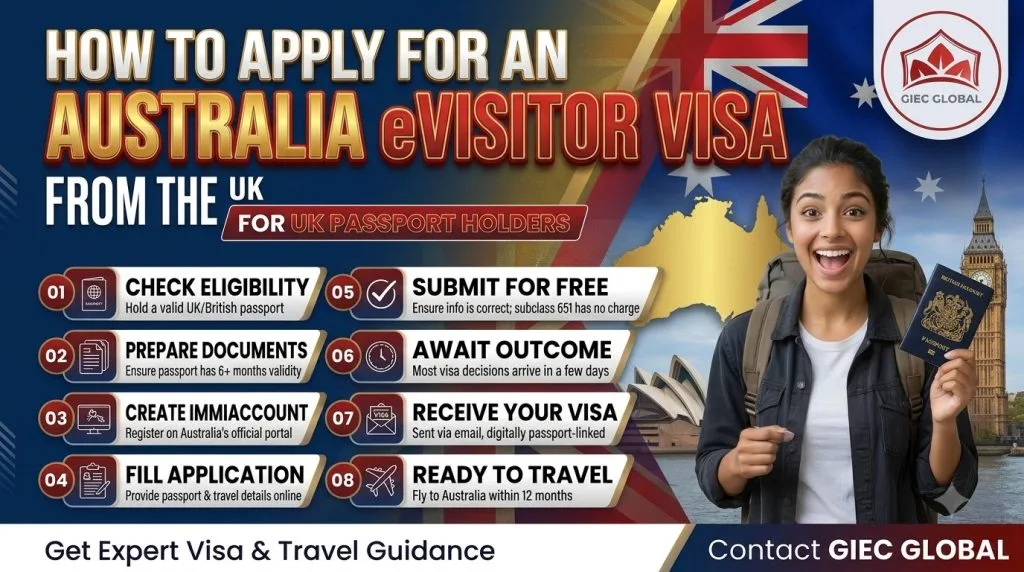
To apply for an Australian eVisitor visa from UK, check that your passport is eligible, create or sign in to an ImmiAccount on the Department of Home Affairs website, complete the eVisitor (subclass 651) application online, and wait for your written grant notice before travelling. You must be outside Australia when you apply and when the visa is decided. There is no government visa application charge.
In summary:
- Confirm you hold an eVisitor-eligible passport, such as a British Citizen passport.
- Make sure your trip is for tourism, visiting family or friends, or permitted business visitor activities.
- Apply online through the official Department of Home Affairs website.
- Enter your details exactly as they appear in your passport.
- Submit the application and monitor your email and ImmiAccount.
- Travel only after you receive written confirmation that the visa has been granted.
Australia eVisitor visa from UK: key facts at a glance
| Feature | eVisitor visa (subclass 651) |
|---|---|
| Who it is for | Holders of eligible passports, including British Citizen passports, visiting Australia temporarily |
| Purpose of visit | Tourism, visiting family or friends, and permitted business visitor activities |
| Government cost | Free – no visa application charge |
| Validity | Generally 12 months from the date of grant |
| Stay per visit | Up to 3 months each time you enter Australia |
| Number of entries | Multiple entries during the validity period |
| Where to apply | Online, from outside Australia, through the Department of Home Affairs |
| Work rights | No general work rights; only permitted business visitor activities |
| Study | Short study or training of up to 3 months in total, subject to visa conditions |
| Visa label | None – the visa is linked electronically to your passport |
These are general features of the visa. Your own grant notice sets out the exact conditions that apply to you, so always read it carefully.
What is an Australian eVisitor visa (subclass 651)?
The Australian eVisitor visa, also known as subclass 651, is an electronic visa for eligible passport holders visiting Australia for tourism or permitted business visitor activities. It is issued by the Australian Department of Home Affairs.
The visa is linked electronically to your passport, so you do not need a physical visa label or stamp. You must still receive confirmation that your visa has been granted before travelling. Airlines check your visa status electronically at check-in, and Australian Border Force officers check it again when you arrive.
The eVisitor visa generally allows multiple visits to Australia during its 12-month validity period, with each visit lasting up to three months. Your individual visa grant notice and visa conditions should always be checked before travel.
Common reasons for visiting Australia with an eVisitor visa include:
- Going on holiday or sightseeing.
- Visiting family or friends.
- Taking a cruise or exploring Australian cities.
- Attending certain business meetings or conferences.
- Taking part in other activities permitted under the business visitor conditions.
- Completing a short course of study or training of up to three months.
An eVisitor visa does not give you general permission to work in Australia. If you intend to work, study for an extended period, migrate or stay longer than the visitor conditions allow, you should look at the appropriate visa pathway instead. Our guide to migrating to Australia explains the main longer-term routes.
Who can apply for an eVisitor visa from UK?
Eligibility depends mainly on the passport you hold, not on where you live. A British citizen travelling on a British Citizen passport can usually apply for an eVisitor visa, provided they meet the other requirements.
A person who lives in the UK but holds a passport from a country that is not eligible for subclass 651 cannot qualify simply because of UK residence. The same caution applies to other types of British nationality. British Overseas Territories Citizens, British Nationals (Overseas), British Overseas Citizens, British Subjects and British Protected Persons hold different passport types from British citizens, so they should check the official eligibility list for their exact passport before applying.
eVisitor eligibility checklist
Before starting your application, check the following:
- Passport eligibility: Confirm that your passport nationality and passport type are accepted for subclass 651.
- Location: You must be outside Australia when you apply and when the visa is decided.
- Purpose of travel: Your visit must fall within the activities the visa allows.
- Health and character requirements: You may need to meet Australian health and character requirements. You may be asked about tuberculosis or criminal convictions.
- Genuine visitor intentions: You should be able to show that your plans are consistent with a temporary visit.
- Funds: You should have enough money to support yourself during your stay.
- Debts to the Australian Government: Any outstanding debt to the Australian Government may affect your application.
- Visa conditions: You must agree to follow the conditions attached to your visa.
Can British citizens use the ETA instead?
Yes. British citizens are usually eligible for both the eVisitor and the Electronic Travel Authority (ETA, subclass 601). UK Foreign, Commonwealth & Development Office (FCDO) travel advice confirms that British citizens visiting Australia need a visa and can usually get either one. The eVisitor has no application charge or service fee. The ETA has no application charge, but you pay a service fee when you apply through the Australian ETA app.
Both allow stays of up to three months at a time during a 12-month period. For most British holidaymakers, the free eVisitor is the simpler choice. Some travellers prefer the ETA because it is applied for through a smartphone app.
If you do not qualify for either, the Australia Visitor visa (subclass 600) may be suitable. These visas have different eligibility rules, application procedures and charges.
Check the official Australian Government page before applying: eVisitor visa (subclass 651) – Department of Home Affairs.
Documents required for an Australia eVisitor visa application
The eVisitor application is completed online. Before you begin, gather your personal and travel information so you can enter the details accurately in one sitting.
Depending on your circumstances, you may need to provide or refer to the following:
- A valid passport from an eligible country. You must travel on the same passport you used in your application.
- Your full name, date of birth and passport details.
- Your current contact details, including an email address you check regularly.
- Information about your intended visit to Australia.
- Details of your travel plans, if requested.
- Information showing that you can support yourself during your visit, if required.
- Answers to questions about your health and character.
- Any supporting documents requested by the Department of Home Affairs.
Not every applicant will be asked to upload the same documents. Many eVisitor applications are decided on the information provided in the form. Follow the instructions in your application and provide any extra evidence the Australian Government asks for.
If any supporting documents are not in English, arrange suitable English translations. Make sure your personal information matches across your passport, application and supporting documents.
How long should my passport be valid?
Your passport must be valid for the whole of your planned stay in Australia. FCDO travel advice also points out that many countries require six months’ remaining passport validity for transit. If your flight stops in another country, for example in the Middle East or Asia, check that country’s rules as well. If you renew your passport after the eVisitor is granted, the visa does not move to the new passport automatically. You will need to update your details with the Department of Home Affairs, or apply again, before travelling.
Step-by-step: how to apply for an eVisitor visa Australia from UK
The steps below follow the Australian Department of Home Affairs’ published guidance for subclass 651 applications.
Step 1: Check your passport eligibility
Confirm that your passport is accepted for the eVisitor subclass 651. The difference between being a British citizen with a British Citizen passport and simply living in the UK is important. UK residence alone does not make you eligible. Each family member travelling on a different passport should check their own eligibility.
Step 2: Confirm your travel purpose
Make sure your plans fit the permitted tourism, family visit or business visitor activities. If you intend to take up employment, you will need a visa that permits the work you plan to do. If you want to study for more than three months, you will need a different visa.
Step 3: Apply through the official Australian Government website
Go to the official eVisitor subclass 651 page and follow its online application instructions. You will usually need to create an ImmiAccount, the Department of Home Affairs’ online account, or sign in to an existing one. Avoid unofficial websites that look like a government service and charge a fee for an application you could make yourself for free.
Step 4: Complete the application carefully
Enter your name exactly as it appears in your passport, including any middle names. Check your passport number, nationality, date of birth, passport issue and expiry dates, and email address before submitting. Mistakes can cause delays at check-in or on arrival, or may mean the visa is linked to the wrong passport details.
Step 5: Submit and monitor your application
Submit the application and check your email and application status for updates. The official guidance says that if you do not receive an acknowledgement within 12 hours, you should check your application status in ImmiAccount. Check your spam or junk folder too, as automated government emails are sometimes filtered.
Step 6: Wait for the visa decision before travelling
Submitting the form does not mean your visa has been approved. Wait for written confirmation of the grant, check the visa conditions, and make sure the passport you will travel on matches your visa record. You must be outside Australia when the decision is made. You can confirm your visa details at any time through the Australian Government’s Visa Entitlement Verification Online (VEVO) service.
How much does an eVisitor visa for Australia cost?
The Australian eVisitor visa (subclass 651) is free when you apply through the official Australian Government process. You should not have to pay any government visa application charge for this visa.
However, there is a difference between a government visa charge and a private service fee. A third-party website or visa assistance provider may charge for its own services. That charge is not the government fee for the eVisitor visa.
If someone asks you to pay a large amount for a supposedly compulsory eVisitor visa fee, check the information directly with the Department of Home Affairs before going ahead.
eVisitor cost compared with other Australian visitor visas
Other Australian visitor visas have different charges. The ETA (subclass 601) has an AUD 20 service charge for using the Australian ETA app. The Visitor visa (subclass 600) has its own visa application charge. Australian visa application charges were increased from 1 July 2026, with the Tourist stream charge for applications lodged outside Australia reported at AUD 250 for most applicants. The eVisitor remained free. These are different visa pathways, so do not confuse their fees with the free eVisitor subclass 651.
| Visa | Government cost (2026–27) | Notes |
|---|---|---|
| eVisitor (subclass 651) | Free | No visa application charge |
| ETA (subclass 601) | AUD 20 service charge | Paid when applying through the Australian ETA app |
| Visitor visa (subclass 600) – Tourist stream, outside Australia | From AUD 250 | Charges vary by stream and location; check the Home Affairs visa pricing estimator |
Visa charges are usually reviewed each year on 1 July. Always confirm the current amount on the Department of Home Affairs website before applying.
How long does an Australian eVisitor visa take to process?
Processing times vary depending on the application and the applicant’s circumstances. The Australian Government publishes a global visa processing times guide based on recently decided applications. It gives an indication only and is not a guarantee of how quickly an individual application will be decided.
Many straightforward eVisitor applications are decided quickly. Others take longer if further checks or information are needed, for example where health or character questions need follow-up.
To help avoid preventable delays:
- Check that your passport is eligible before applying.
- Enter your personal details accurately.
- Use an email address you can access.
- Answer every question honestly.
- Supply any additional information the department requests promptly.
- Check your application status and email regularly.
Apply well before your planned departure. Do not book non-refundable travel on the assumption that your visa will be granted by a particular date.
How long can you stay in Australia on an eVisitor visa?
The eVisitor visa is generally valid for 12 months from the date it is granted. It allows multiple entries, with a stay of up to three months after each entry, subject to the visa conditions.
For example, if your eVisitor visa is valid and you visit Australia for a holiday, you may stay for up to three months on that visit. You can leave and return during the validity period, but each entry is still subject to Australian immigration requirements.
The 12-month validity period does not mean you can stay in Australia continuously for 12 months. It also does not guarantee that every future entry will be permitted. Border officers may ask questions if your pattern of travel suggests you are living in Australia rather than visiting.
Can you extend an eVisitor visa?
No. The eVisitor visa cannot be extended. If you want to stay longer than three months at a time, you need to look at another suitable visa. Depending on your circumstances, this may be possible from inside Australia, but you must apply before your current stay ends. If your grant notice includes a “No Further Stay” condition, you generally cannot apply for most other visas while in Australia.
eVisitor visa conditions explained
Every eVisitor grant comes with conditions. The conditions on your grant notice are the ones that legally apply to you, so read them carefully. Conditions commonly seen on eVisitor grants include:
| Condition | What it generally means |
|---|---|
| 8115 – Business visitor activity | You must not work in Australia, apart from permitted business visitor activities |
| 8201 – Maximum three months study | You may study or train for a maximum of three months while in Australia |
| 8527 – Tuberculosis free | You must be free from tuberculosis when you enter Australia |
| 8528 – No criminal convictions | You must not have criminal convictions for which the sentence or sentences total 12 months or more when you enter Australia |
Breaking a visa condition can lead to your visa being cancelled. It can also affect future Australian visa applications.
Can you work in Australia on an eVisitor visa?
No. The eVisitor visa is not a work visa, and it does not allow you to do paid work for an Australian employer.
Permitted business visitor activities can include attending meetings, negotiating or reviewing business contracts, making general business enquiries, or taking part in certain conferences and trade events where the conditions are met. These activities are different from taking up employment or providing services to an Australian business.
If your main purpose is to work in Australia, look for a visa that specifically permits your intended work. Young British citizens may be eligible for the Working Holiday visa (subclass 417), subject to age and other criteria. People coming for workplace-based training may need to consider the Training visa (subclass 407). Business owners and investors looking at a longer-term commitment can explore business and investment visa options for Australia. Do not rely on an eVisitor visa as a route to working or settling in Australia.
Can you study in Australia on an eVisitor visa?
You can usually study or train for up to three months in total on an eVisitor visa. This may suit a short English course, a short professional course or a brief training programme. If study is the main reason for your trip, or your course lasts longer than three months, you will need a Student visa. Our guide to studying in Australia explains universities, courses and the student visa process for international students.
Can you apply for an eVisitor visa for family members?
Each family member needs their own application. You cannot add your spouse or children to a single eVisitor application. You can, however, manage several applications from the same ImmiAccount.
Check each traveller’s passport eligibility separately. This is particularly important for families whose members hold different nationalities or passport types. For example, a British parent and a child travelling on a non-eligible passport may need different visas.
For children, parents or guardians should make sure the information is accurate and follow any extra instructions that apply to the child’s application.
If you are visiting a partner or relatives in Australia and are thinking about a longer-term move, an eVisitor will not meet that need. Families in that position may look at the Partner visa (subclass 100) or, for parents of Australian citizens or permanent residents, the Sponsored Parent (Temporary) visa.
What if you are a UK resident but do not hold a British Citizen passport?
You may still be able to visit Australia, but your visa options depend on the passport you hold and your circumstances.
For example, a UK resident with a passport from a country that is not on the eVisitor eligibility list cannot qualify for subclass 651 just because they live in Britain. Depending on the passport, an ETA or Visitor visa subclass 600 may be more suitable. Holders of an EU passport living in the UK may find that their EU passport is itself eVisitor-eligible.
Do not choose a visa based only on the country you are departing from. Confirm eligibility using the passport you intend to travel on.
What about dual nationals?
If you are a British-Australian dual national, you must enter and leave Australia on your Australian passport, and you do not need an eVisitor. If you hold British citizenship and another nationality, apply using the passport you will actually travel on, and make sure that passport is eligible.
eVisitor visa vs ETA vs Visitor visa subclass 600
| Feature | eVisitor (651) | ETA (601) | Visitor visa (600) |
|---|---|---|---|
| Main purpose | Tourism, family visits and permitted business visitor activities | Tourism, family visits and permitted business visitor activities | Tourism, family visits and permitted business visitor activities, depending on stream |
| Eligibility | Specific eligible passports, including British Citizen passports | Specific eligible passports, including British Citizen passports | Depends on the relevant stream and applicant |
| Government cost | Free | AUD 20 app service charge | Application charge applies (from AUD 250 for most Tourist stream applications lodged outside Australia from 1 July 2026) |
| Application route | Online through the official Department of Home Affairs process | Australian ETA app for ETA-eligible passport holders | Online application process |
| Validity | Generally 12 months | Generally 12 months | Depends on the visa granted |
| Stay period | Up to 3 months per entry | Up to 3 months per entry | Depends on the visa granted; can be longer than 3 months |
| Work rights | No general work rights | No general work rights | Subject to visa conditions; not a work visa |
| Best suited to | Most British citizens on a holiday or short business trip | Eligible travellers who prefer applying through an app | Travellers who are not eligible for 651 or 601, or who need a longer stay |
Always check the current official visa page before deciding which option to use.
Arriving in Australia: what to expect at the border
Holding a granted eVisitor visa lets you travel to Australia, but you must still meet entry requirements on arrival. Australian Border Force officers may ask about the purpose of your visit, where you will stay and when you plan to leave.
You will also need to complete an incoming passenger card, which covers immigration, customs and biosecurity declarations. On 13 July 2026, the Australian Border Force announced that the digital Australia Travel Declaration (ATD) will be introduced at all international airports and seaports before the end of 2027, gradually replacing the paper card. During the rollout, the digital option is only available to some passengers. If you are not invited to use it, expect to complete the paper card on your flight or on arrival.
Australia has strict biosecurity rules. You must declare certain food, plant material, animal products and other items. Undeclared items can lead to fines, so if you are unsure whether something must be declared, declare it.
Common mistakes to avoid when applying
Even though the eVisitor process is online and free, it is important to give accurate information and follow the visa rules.
- Choosing the wrong visa type: Do not assume every UK resident qualifies for an eVisitor visa. Check the passport eligibility list first.
- Entering incorrect passport details: A spelling mistake, wrong date of birth or wrong passport number can cause problems at check-in or on arrival.
- Paying an unofficial website unnecessarily: The eVisitor visa is free through the official Australian Government process. Check any service fee before paying.
- Travelling before the visa is granted: An application receipt is not a visa grant notice.
- Travelling on a different or renewed passport: Your visa is linked to the passport used in the application. Update your details or reapply if your passport changes.
- Assuming the visa permits employment: Business visitor activities are limited. Paid employment and providing services to an Australian organisation are not generally permitted.
- Overstaying the permitted period: Check your grant details and leave Australia within the authorised stay unless you hold another visa that permits you to remain. Overstaying can affect future visa applications.
- Treating repeat visits as permission to live in Australia: The visa is for temporary visits. Frequent or lengthy stays can lead to questions about whether you genuinely intend to visit temporarily.
Thinking beyond a visit? Longer-term options in Australia
Many people first visit Australia on an eVisitor and later decide they would like to live, work or study there. The eVisitor itself does not lead to residence, but other visa pathways may be available depending on your age, skills, qualifications, family connections and circumstances.
Skilled professionals can start by checking their score with our Australia PR points calculator. They can then read about the Skilled Independent visa (subclass 189) and the wider routes to Australian permanent residency. These visas have their own detailed eligibility criteria, which should be reviewed carefully before you apply.
Final checklist before travelling to Australia
Before you leave the UK, make sure you have:
- Confirmed that your passport is eligible for the visa granted.
- Received written confirmation of the visa grant.
- Checked the visa validity dates and conditions.
- Confirmed that the passport you will travel on matches your visa record.
- Prepared evidence of your travel plans and funds, if needed.
- Arranged suitable travel and health insurance.
- Checked airline requirements and any transit country rules.
- Reviewed what you must declare on arrival under Australian biosecurity rules.
The eVisitor visa can be a convenient and cost-free option for eligible British travellers, but approval and entry requirements still matter. Use official Australian Government information as your main source, and make sure the visa matches your travel purpose. If your plans go beyond a short visit, GIEC Global can help you understand which Australian visa pathway may suit your circumstances.
Official sources: Department of Home Affairs – eVisitor (subclass 651); Department of Home Affairs – Electronic Travel Authority (subclass 601); GOV.UK – Australia travel advice: entry requirements; Australian Border Force – Australia Travel Declaration to be rolled out nationwide.
Visa rules, charges and processing arrangements can change. This guide is general information, not legal or migration advice. Check the Department of Home Affairs website for the latest requirements before applying or travelling.
Frequently Asked Questions
What is an eVisitor visa for Australia?
The eVisitor visa (subclass 651) is a free electronic visa for eligible passport holders visiting Australia for tourism, visiting family or friends, or permitted business visitor activities.
How can I apply for an eVisitor visa Australia from the UK?
Check that your passport is eligible, visit the official Australian Government eVisitor page, complete the online application, provide accurate information and wait for written confirmation of the visa decision.
Is the Australia eVisitor visa free for UK citizens?
Yes, the eVisitor subclass 651 is free through the official Australian Government application process for eligible passport holders, including qualifying British Citizen passport holders.
Who is eligible for an Australian eVisitor visa?
Eligibility depends on holding citizenship and a valid passport from a country listed by the Australian Department of Home Affairs, as well as meeting the visa requirements.
Can all UK residents apply for an eVisitor visa for Australia?
No. Living in the UK is not enough to qualify. Applicants must hold an eligible passport and meet the relevant Australian visa requirements.
How long is an Australian eVisitor visa valid for?
The eVisitor visa is generally valid for 12 months from the date it is granted and allows multiple visits, subject to its conditions.
How long can I stay in Australia on an eVisitor visa?
Eligible travellers can generally stay for up to three months after each entry during the visa's validity period, subject to the conditions of their visa.
How long does an eVisitor visa Australia application take?
Processing times vary. Some applications may be decided quickly, but others can take longer if further information or checks are required.
What documents are required for an Australia eVisitor visa application?
You need a valid passport from an eligible country and accurate personal and travel information. Additional documents may be requested depending on your circumstances.
Can I work in Australia on an eVisitor visa?
No. The eVisitor visa does not allow general paid employment or providing services to an Australian business. Permitted business visitor activities are limited.
Can I visit family in Australia on an eVisitor visa?
Yes, visiting family or friends is a permitted purpose for eligible eVisitor visa holders, provided they comply with the visa conditions.
Can I include my spouse and children in one eVisitor application?
No. Each family member, including children, must make a separate eVisitor visa application and meet the eligibility requirements.
Can I extend my Australian eVisitor visa?
The eVisitor visa itself cannot be extended. If you need to stay longer, you must investigate another suitable visa and meet its requirements.
Can I apply for an eVisitor visa while I am in Australia?
No. You must be outside Australia when applying for an eVisitor visa and when the application is decided.
What happens if my eVisitor visa application is refused?
The Department of Home Affairs will notify you of the decision and explain the reasons and whether review rights are available. Check the decision notice for your options.
What is the difference between an eVisitor visa and an ETA for Australia?
The eVisitor is subclass 651 and is free through the official process, while the ETA is subclass 601 and has a service charge for applications through the Australian ETA app. Eligibility and application procedures differ.
Can I study in Australia on an eVisitor visa?
In some circumstances, eVisitor holders can study or train for up to three months in total. If study is your main purpose, check whether a student visa is more appropriate.
Do I need to print my Australian eVisitor visa?
The visa is electronically linked to your passport, and a physical visa label is not issued. Keep a copy of your written visa grant notice and check your visa details before travelling.
Can I apply for an Australian eVisitor visa using a British National Overseas passport?
A British National Overseas passport is not eligible for the eVisitor subclass 651. Check the Australian Government's visa options to identify an alternative.
Where can I check the official Australia eVisitor visa requirements?
Visit the Australian Department of Home Affairs website at https://immi.homeaffairs.gov.au/visas/getting-a-visa/visa-listing/evisitor-651 for the current eligibility rules, application instructions and conditions.