How to Get PR in Australia After Study
Australia PR means you can live and work here forever and many international students want to settle in Australia. So they plan to get Australia PR through Study visa because it adds 5 points for study and you can do part time work that also adds 5 points for a work visa. The main route starts with your student visa. You study a CRICOS registered course. After that you move to a temporary visa. Then you aim for a permanent one. The government checks your skills. Your age matters. English level counts. Work experience helps. If you meet the points test you get an invitation. This system keeps the process fair for everyone.
Here is why so many students dream of getting Australia PR after their student visa:
- You can work anywhere in Australia without needing employer sponsorship
- You get access to Medicare, Australia’s public health system
- You can sponsor eligible family members to come and live in Australia
- You can apply for bank loans to buy property
- After a few years as a permanent resident you can apply for Australian citizenship
- You get to travel in and out of Australia freely as long as your travel permit is valid
Can I Apply for PR After Studying in Australia?
Yes, you can apply for PR after Studing but it’s a long process. To gain additional points you have to apply for Temporary Graduate visa (Subclass 485) after graduation.
Australia actively encourages skilled graduates to stay back and contribute to the economy. There is no rule that forces you to go home after your degree.
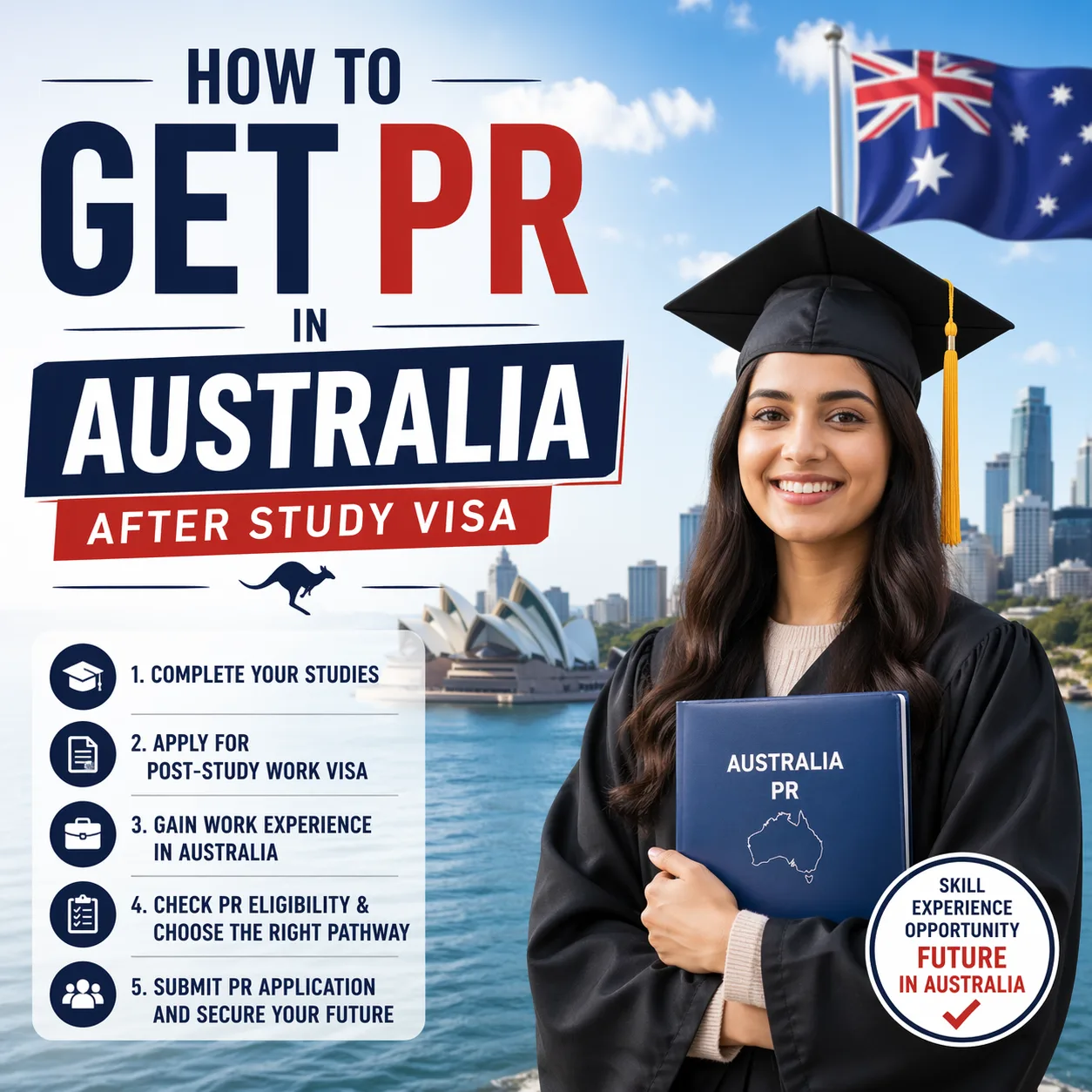
However, you cannot apply for PR directly from your student visa in most cases. You will need to follow a structured process that involves:
- Completing an eligible CRICOS-registered course in Australia
- Applying for a Temporary Graduate Visa (Subclass 485) after graduation
- Gaining relevant work experience in your nominated occupation
- Meeting the PR points requirement and getting a skills assessment done
- Submitting an Expression of Interest through SkillSelect
- Receiving an invitation and then lodging your PR application
The timeline for this process is typically between 3.5 to 6.5 years depending on your occupation, points score and state nomination strategy.
Australia PR After Masters
Absolutely yes. If you are wondering about australia pr after masters, a master’s or doctorate degree gives you 20 points for education compared to just 15 points for a bachelor’s degree and 10 points for a diploma. Those extra 5 to 10 points can make a meaningful difference in a competitive pool.
Additionally, if you complete a Master’s by Research or a PhD in a STEM field from an Australian institution, you can earn an additional 10 bonus points under the Specialist Education category. This makes the australia pr after masters route particularly powerful for STEM graduates.
Students in fields like nursing or engineering often succeed faster. IT graduates face more competition, but it totally depends on applicants. One of our client did masters in IT and with the combination of age and IELTS, achieved 90 points and got invited within 2 months of submitting EOI.
PR Pathways in Australia After Study: Which Visa Is Right for You?
When it comes to the pr process in australia after study, there is no single route that works for everyone. The right pathway depends on your occupation, your score, and whether you are willing to live in a regional area.
Here are the main options available:
1. Skilled Independent Visa (Subclass 189)
This is the most popular and competitive route for after study PR in Australia. It is a points-based visa. You do not need an employer sponsor or state government nomination. You just need to score enough points in the General Skilled Migration (GSM) program.
The minimum requirement is 65 points but in reality most applicants invited to apply have between 85 and 95 points. If you are aiming for this visa you need to maximise your score in every possible way.
2. Skilled Nominated Visa (Subclass 190)
This visa requires a nomination from an Australian state or territory. Each state has its own occupation list so you need to check which states are currently nominating people in your field. Getting a state nomination adds 5 points to your total score and also gives you a better chance of being invited quickly.
This is a great option for people who are happy to commit to living in a specific state or territory.
3. Skilled Work Regional Visa (Subclass 491)
If you are open to living outside major cities this visa gives you 15 additional points which is a massive boost. Cities like Adelaide, Gold Coast and Perth are classified as regional areas for this purpose. You would get a provisional visa first and then after 3 years living and working in the regional area you can apply for permanent residency through the Subclass 191 visa.
4. Employer Nomination Scheme (Subclass 186)
This is the employer-sponsored pathway to Australia PR. If you find an employer who is willing to sponsor you permanently, this can be a faster and more direct route. You typically need at least 3 years of work experience with your sponsoring employer. This pathway is less explored by students but it is very effective.
5. Temporary Graduate Visa (Subclass 485)
This is not a PR visa but it is the most important first step for most students. Right after graduation you apply for this visa which gives you 2 to 4 years of full work rights in Australia. This time is golden because it lets you gain Australian work experience which significantly boosts your PR points score.
Can I Get PR After Doing Diploma in Australia?
yes, but it requires more planning. A diploma gives you 10 points for education which is lower than a degree, so you need to compensate in other areas. Here is how diploma holders can still achieve PR:
- Score Superior English on your IELTS or PTE (20 points) instead of just Proficient
- Be in the youngest age bracket you can (25 to 32 years earns maximum 30 points)
- Gain relevant Australian work experience on your 485 visa
- Choose a state nomination pathway (190 or 491) which adds 5 to 15 bonus points
- Complete the Professional Year Program if your occupation qualifies (adds 5 points)
- Study and work in a regional area for the additional 5 regional study points
Diploma holders often find the Subclass 491 regional visa to be the most accessible pathway because the 15 bonus points from regional nomination can offset the lower education score.
Tips to Boost Your Australia PR Points as a Student
If you are currently on a student visa here are the most impactful things you can do right now to improve your australia pr after student visa chances:
- Study at a regional institution: Universities outside Sydney and Melbourne often qualify for regional bonus points. You can gain 5 extra points just for studying and living in a regional area.
- Nail your English test: Take IELTS Academic or PTE and aim for an 8 in every band. The difference between IELTS 7 and IELTS 8 is 10 points which is enormous in a competitive pool.
- Start your skills assessment early: Do not wait until graduation. Some professional bodies require work experience before they assess you so starting early saves time later.
- Choose a high-demand occupation: Before you finish your course confirm that your occupation is still on the relevant skilled occupation list. Lists change and your occupation could be removed.
- Consider the Professional Year Program: This 12-month program for IT, accounting and engineering graduates adds 5 PR points and also gives you valuable Australian work experience.
- Do not ignore partner skills: If your partner also meets the age, English and skills assessment requirements you can claim up to 10 bonus points.
FAQs
The process involves applying for a Temporary Graduate Visa (Subclass 485) after graduation, gaining work experience, getting a skills assessment done, achieving a competitive points score and submitting an Expression of Interest through SkillSelect. Once invited you lodge your PR application and wait for a decision. The full journey typically takes between 3.5 and 6.5 years.
Yes. The Skilled Independent Visa (Subclass 189) does not require a job offer or employer sponsorship. It is purely points-based. However if you struggle to score enough points on your own, an employer-sponsored pathway like the Subclass 186 visa can be a strong alternative.
A master’s degree gives you 20 education points instead of 15 for a bachelor’s degree. If you complete a Master’s by Research or PhD in a STEM field from an Australian university you also qualify for an additional 10 Specialist Education points. This makes australia pr after masters one of the strongest PR profiles available to international students.
Your chances depend heavily on your occupation, points score, age and English proficiency. Applicants in healthcare, IT and engineering with 80 or more points and Superior English generally have good chances. In 2025 the realistic scores needed for invitation range from 70 to 95 points depending on the occupation. The more points you have the better your chances.
Yes significantly. Studying and living in a regional area can earn you an additional 5 bonus points for the Australian Study Requirement plus another 5 points for regional study. The Subclass 491 regional visa also provides 15 extra nomination points. Cities like Adelaide, Perth and Gold Coast are classified as regional for immigration purposes.
Occupations with consistent demand include registered nursing, software engineering, civil and mechanical engineering, accounting, teaching and allied health professions. These fields appear regularly on both the MLTSSL and state occupation lists. If you are still choosing your study direction, these fields offer the strongest PR prospects in 2026.
It is not mandatory but it is highly recommended especially if your situation is complex or if you have previously had a visa refused. A Registered Migration Agent (MARA agent) can accurately calculate your points, advise on the best pathway and make sure your application is error-free. Mistakes in PR applications can lead to refusals and bans so professional guidance is worth the investment.